




In today's competitive glass production environment, high-level technology is needed to keep operations running smoothly while protecting the quality of the products. Modern glass loading equipment is a game-changing answer. Glass loaders make the sensitive job of moving big sheets of glass from storage to processing sites automatic. These systems get rid of the problems that come with moving things by hand, like breaking things, hurting workers, and slowing down production. They also give architectural glass makers, curtain wall installers, and furniture manufacturers the accuracy they need. As we talk about what modern glass handling options can do and how to choose one, you'll learn how smart investments in tools can change the economics of your production floor.
Understanding Precision Glass Loading Equipment
Automated systems that move, place, and move glass pieces safely during the manufacturing process are called precision glass loading equipment. Instead of simple conveyors or human carts, these high-tech machines have vacuum suction arrays, servo-controlled movement, and smart sensing technologies that can adjust to different glass sizes and thicknesses.
The Critical Role in Modern Glass Manufacturing
Every plant manager knows that poor material handling can slow down production. There are three main problems with traditional ways that glass feeders solve. When human error is taken out of the equation, breakage rates go down by a lot. Computer-controlled pointing devices ensure accuracy down to the millimetre level, so there are no more problems with misalignment. When workers don't have to lift sheets that weigh hundreds of pounds by hand, workplace safety goes up by a huge amount.
Common Challenges Without Advanced Loading Systems
When you handle things by hand, your business is more likely to run into problems that will cost you a lot of money. During shifts, operators get tired, which makes it hard to put glass in the right place on cutting tables. Thin building glass that is easy to bend is hard for even semi-automated roller devices to work with. When there is a mismatch, mistakes are passed on to processes that come after, like trimming, hardening, or laminating, which makes more waste. The financial effects go beyond actual loss. Accident claims at work and lost production time are secret costs that cut into profits.
Key Technologies Driving Performance
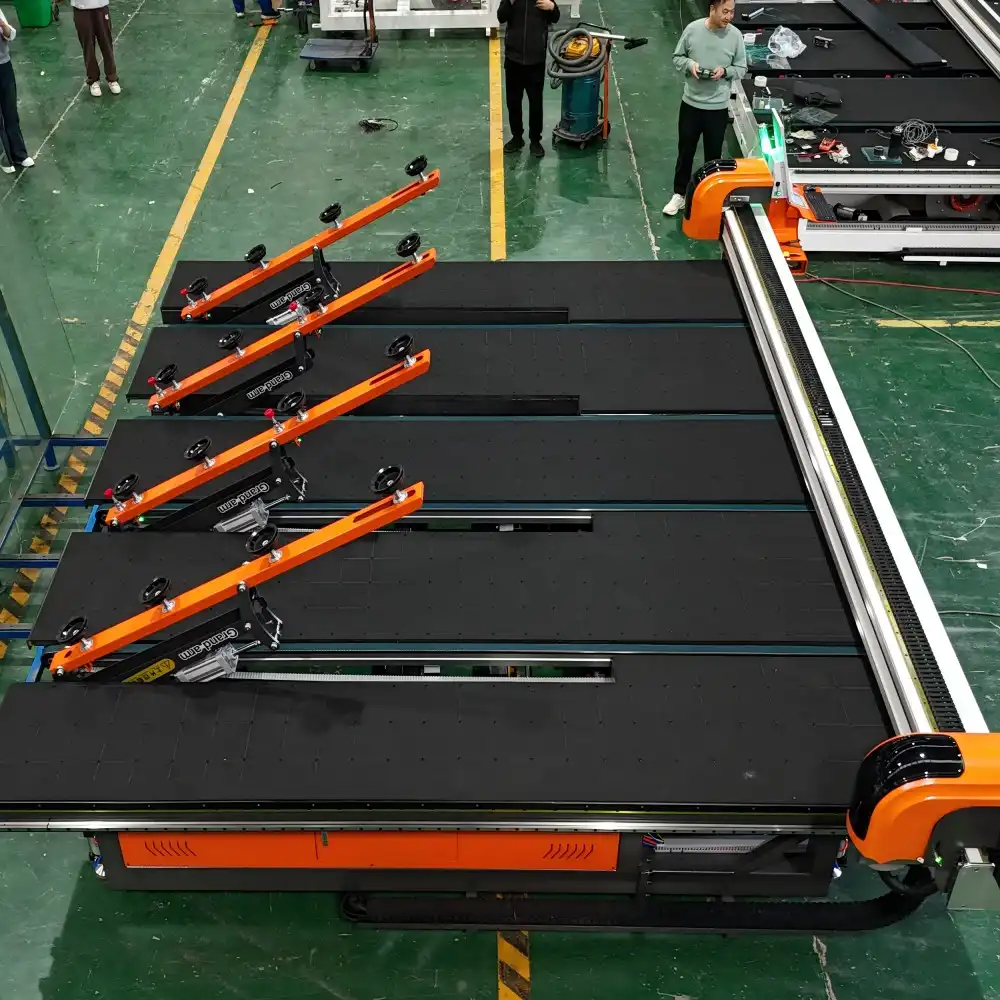
Several new technologies are built into modern filling tools. Air-floating devices put a cushion of air under the glass sheets so that people can move easily across filling tables without touching the surface. Vacuum pad arrangements fit around glass shapes and spread the pulling force out evenly to keep stress from building up in one place. Position sensors talk to programmed logic controls, which change actions based on the size of the sheet in real time. All of these features turn handling glass from a job that requires a lot of manual labour into a task that can be done precisely and can be scaled up or down depending on the production volume.
How to Choose Advanced Glass Loading Equipment for Your Business?
To choose the right loading method, you have to weigh the technical requirements against the practicalities of the job. Your choice process should take into account both the current needs for output and the needs for growth in the future.
Evaluating Core Technical Criteria
The base performance level of your tools is set by their production capability. Figure out how many square metres of glass you use every day and mark the times when demand is highest. The machinery should be able to handle your biggest regular glass size, plus extra space for custom orders. When making building parts with tight tolerances, precision skills are very important. For curtain wall uses, placement accuracy within ±1mm is best, while wider errors may be acceptable for furniture production.
The level of automation has a direct effect on how work is distributed. For entry-level systems, workers have to start each loading cycle by hand. Mid-level options have preset steps for doing the same thing over and over again. High-end setups are connected to plant management systems so they instantly get cutting plans and work with equipment further down the line. To avoid problems with merging, your tech team should check to see if the new communication methods will work with the ones already in use.
Balancing Investment Against Operational Savings
There are more costs than just the price of the car that come with owning it, including the glass loader. Think about how much it will cost to set up, how long it will take to train people to use it, and how often it will need to be fixed. Systems that work well have parts that can be bent, which makes it easier to find missing parts. Equipment that is CE and ISO9001-certified shows that the company that made it cares about quality and safety, which means that fixes will cost less in the long run.
Tools of different kinds need very different amounts of power. More electricity is used by older hydraulic systems than by newer ones that have servo motors and variable frequency drives. Figure out how much you think your yearly energy costs will be based on how many hours you plan to work and how much power costs where you live. In ten years, even small changes in how well some things work add up.
Practical Recommendations by Operation Type
Tracked rollers with long travel ranges are best for architectural glass plants that work with big sheets. The form of the crawler frame makes it stable when moving around plant floors and keeps its precise position. Models like the HSL-SPT3624 can hold sheets up to 3660x2440mm, which covers normal building sizes and allows for unique projects that are too big.
Furniture and artistic glass makers who work with different sheet sizes need to be able to adapt. Look for systems that can be controlled from any angle with a remote so workers can carefully place equipment without having to move it themselves. Breaking tables that are built into the filling system make work easier because there is no need for separate steps to move materials between the cutting and breaking stations.
Integrators of curtain walls that need full production lines should give preference to providers that offer OEM and ODM customisation. Depending on how quickly you need to finish your project, you may need to change the way things are loaded or use special handling equipment. Manufacturers with their own tech teams can make products that are exactly what you need for your production flow.
In-Depth Tutorial: How to Use Advanced Glass Loaders for Optimal Efficiency?
Maximising equipment performance demands understanding both operational procedures and troubleshooting protocols. This practical guide walks you through deployment best practices developed from real-world installations.
Step-by-Step Operational Workflow
Begin each shift with a systematic pre-operation inspection. Verify vacuum system pressure gauges read within the specified range—typically 0.6 to 0.8 bar for most applications. Check air flotation table surfaces for debris that could scratch the glass undersides. Test remote control responsiveness across the full operational range, confirming all directional commands execute smoothly.
Loading procedures follow a consistent sequence. Position the loader adjacent to your glass storage rack, ensuring the vacuum pad array aligns parallel to the target sheet. Activate the vacuum system and allow pressure to stabilise before initiating contact. The system will indicate successful suction through pressure sensors or visual indicators. Slowly raise the glass sheet, maintaining horizontal orientation to prevent stress concentration at pickup points.
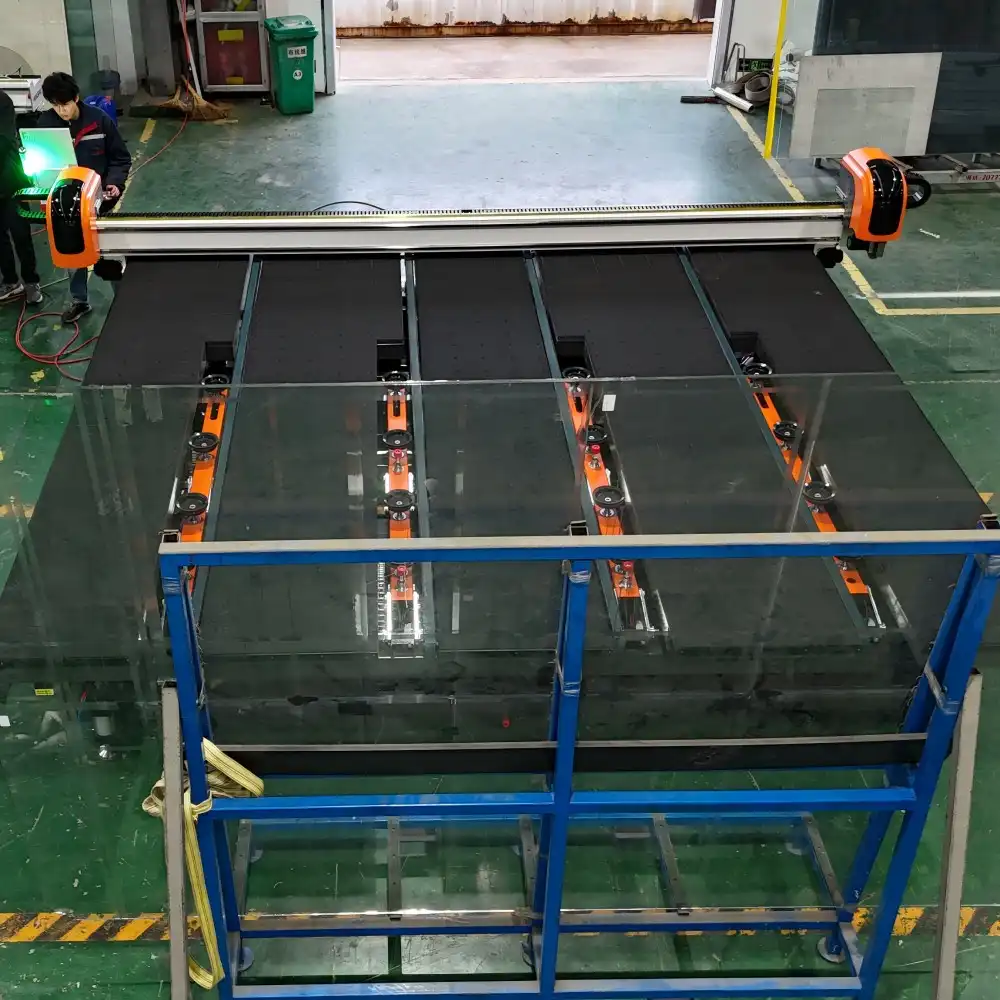
Transport the sheet to your processing station using smooth, controlled movements. Advanced systems featuring crawler tracks navigate uneven factory floors without transmitting vibration to the glass. Upon reaching the destination, align the sheet with positioning guides on your cutting or edging table. The air flotation system activates automatically when the glass descends, creating a frictionless surface for final positioning adjustments. Deactivate vacuum suction only after confirming stable placement on the destination table.
Preventing Common Operational Issues
Misfeeds typically stem from improper vacuum distribution. When lifting sheets thinner than 4mm, reduce the vacuum pressure slightly to avoid surface deformation. Conversely, increase pressure for textured or coated glass where air-seal quality may be compromised. Calibrate position sensors quarterly to maintain accuracy—thermal expansion in factory environments can shift reference points over time.
Safety incidents often result from overlooking load capacity limits. Operators tempted to expedite production may attempt loading sheets exceeding the rated dimensions. This practice stresses mechanical components and compromises vacuum seal integrity, creating drop hazards. Enforce strict adherence to manufacturer specifications and implement load verification procedures before each lift cycle.
Real-World Performance Case Study
A mid-sized architectural glass fabricator in the South-west United States recently deployed automated glass loader equipment to address persistent throughput bottlenecks. Their previous semi-automated system required two operators per shift for glass handling, limiting production to approximately 180 sheets daily. Labour costs and breakage losses—averaging 3.2% of processed material—pressured profit margins on competitive curtain wall projects.
After installing a crawler-type loader with integrated air flotation and remote control capabilities, the facility consolidated handling tasks to a single operator per shift. Daily throughput increased to 265 sheets while breakage rates dropped to 0.8%. The 24-month payback period factored in direct labour savings, reduced material waste, and decreased workers' compensation claims. Equally valuable were qualitative improvements: operators reported reduced physical strain, while production managers gained scheduling flexibility from faster material changeovers.
Comparing Advanced Glass Loading Solutions in the Market
Understanding the competitive landscape helps procurement teams identify equipment offering genuine performance advantages versus marketing claims. Several categories of glass handling equipment address different operational needs.
Technology Categories and Applications
Basic vacuum lifters represent entry-level automation suitable for small shops processing standardised sheet sizes. These devices typically require manual positioning by operators but eliminate direct hand contact with glass surfaces. Their limited lifting capacity—often under 500kg—restricts applications to furniture production or small architectural components.
Automated loading tables integrate vacuum systems with powered conveyor sections, enabling one-touch material transfer. These systems excel in dedicated cutting operations where glass flows continuously from storage to processing. However, their fixed installation limits flexibility when production schedules require equipment reconfiguration.
Tracked glass loaders combine mobility with precision handling, addressing the widest range of applications. The crawler chassis design permits operation across multiple workstations without fixed rails or tracks. Remote control operation allows a single operator to manage loading tasks throughout a facility. Models incorporating air flotation tables simplify precise positioning on downstream equipment, reducing cycle times between cutting, edging, and inspection stations.
Key Performance Differentiators
Precision capabilities vary substantially across equipment classes. Entry-level systems achieve positioning accuracy within ±5mm, acceptable for rough cutting operations but inadequate for architectural applications requiring tight dimensional control. Professional-grade equipment featuring servo motors and optical position feedback delivers ±1mm accuracy, meeting the demands of curtain wall fabrication and tempered glass production.
Automation sophistication determines labour requirements and production flexibility. Manual systems require constant operator presence for each loading cycle. Semi-automated solutions execute programmed movement sequences but need human intervention for material selection and destination confirmation. Fully automated installations integrate with manufacturing execution systems, retrieving production schedules and coordinating material flow without human input.
User interface design significantly impacts operational efficiency. Systems offering intuitive touchscreen controls and visual process monitoring reduce training time for new operators. Remote control units with ergonomic button layouts minimise operator fatigue during extended shifts. Diagnostic displays that identify specific fault conditions, along with the glass loader, accelerate troubleshooting, reducing unplanned downtime.
Financial Considerations for Procurement
Equipment pricing reflects capability differences. Basic vacuum lifters start around $15,000 for manual positioning models, suitable for low-volume operations. Mid-tier automated tables range from $45,000 to $85,000, appropriate for dedicated production lines. Advanced tracked loaders with full automation capabilities typically cost $120,000 to $180,000, justified by their versatility and productivity gains in high-volume facilities.
Corporate procurement should evaluate suppliers offering flexible payment terms, particularly for complete production line installations. Manufacturers providing volume discounts for multi-unit purchases reduce per-equipment costs in facility expansion projects. Warranty coverage significantly impacts the total cost of ownership—standard one-year warranties are common, while premium suppliers offer extended coverage up to three years with priority spare parts access.
Maximising Return on Investment Through Strategic Implementation
Equipment acquisition represents only the initial phase of realising productivity improvements. Comprehensive planning around installation, training, and ongoing support determines whether your investment delivers projected returns.
Financial Planning and Procurement Models
Understanding pricing structures helps align equipment selection with budget constraints. Manufacturers typically offer tiered pricing based on feature sets and customisation requirements. Standard models with fixed specifications provide the most favourable pricing, while OEM configurations incorporating specialised handling fixtures or modified control systems command premium rates reflecting engineering development costs.
Volume procurement opportunities emerge when coordinating equipment purchases across facility expansion projects or multi-site operations. Suppliers motivated by larger order values often negotiate favourable terms, including reduced per-unit pricing, expedited delivery schedules, and enhanced warranty provisions. Letters of credit remain the preferred international payment instrument, balancing buyer protection with supplier cash flow requirements.
Comprehensive Support Infrastructure
Post-installation support quality separates professional equipment suppliers from commodity vendors. Establish clear expectations during procurement negotiations regarding technical assistance availability, response times for service enquiries, and spare parts lead times. Equipment downtime directly impacts production revenue—even a two-hour delay waiting for remote technical support costs thousands of dollars in lost output.
Training programmes should address both operational procedures and preventive maintenance protocols. Operator training typically requires two to three days for basic proficiency, covering normal operating sequences, safety procedures, and first-level troubleshooting. Maintenance technicians need additional instruction on hydraulic systems, electrical diagnostics, and mechanical adjustments. Suppliers offering on-site training during equipment commissioning accelerate workforce readiness.
Demonstrated ROI from User Deployments
Multiple architectural glass fabricators document substantial performance improvements following advanced loader deployment. A West Coast curtain wall manufacturer reported a 34% productivity increase within six months of installation, attributing gains to faster material changeover and reduced handling errors. Their analysis showed equipment costs recovered through labour savings alone within 18 months, with additional value from decreased breakage losses and improved workplace safety metrics.
Furniture glass producers emphasise flexibility benefits. A Midwest manufacturer processing varied sheet sizes for custom furniture projects previously required 45 minutes for equipment changeover between production runs. Their tracked glass loader system reduced changeover time to under 10 minutes, enabling economical production of smaller batch sizes. This capability opened new market opportunities in custom architectural glass, where competitors' equipment constraints limited responsiveness.
Conclusion
Investing in advanced glass loading equipment transforms production economics through multiple value streams. Automated handling eliminates the labour costs and injury risks inherent in manual material transfer while dramatically reducing expensive glass breakage. Precision positioning capabilities ensure dimensional accuracy that downstream processes depend upon, preventing costly rework and scrap. Systems designed for flexibility—featuring crawler mobility, remote operation, and air flotation positioning—adapt seamlessly to changing production requirements without facility modifications. The competitive advantage extends beyond cost savings to encompass production capacity expansion, product quality consistency, and workforce safety improvements that enhance your market position.
FAQ
1. What glass sizes can advanced loaders handle safely?
Professional glass loading equipment accommodates a wide dimensional range, depending on model specifications. The HSL-SPT3624 series handles sheets up to 3660×2440 mm, covering architectural glass standards and most speciality applications. Thickness capacity typically ranges from 3mm to 19mm, with vacuum system adjustments accommodating both thin decorative glass and thick structural components. Always verify equipment specifications against your production requirements, allowing margin for occasional oversized projects.
2. How long does equipment installation require?
Installation timelines depend on system complexity and facility preparation. Standalone tracked loaders typically require two to three days for mechanical setup, electrical connections, and initial calibration. Complete production line installations incorporating multiple processing stations may extend to two weeks, including equipment integration and operator training. Coordinate with suppliers on site preparation requirements—adequate electrical service, compressed air capacity, and floor-loading capacity—to prevent project delays.
3. What maintenance intervals ensure optimal performance?
Daily pre-shift inspections covering vacuum pressure, air flotation system function, and control responsiveness prevent most operational issues. Weekly maintenance includes cleaning vacuum pad surfaces and checking hydraulic fluid levels. Quarterly service intervals address mechanical lubrication, electrical connection inspection, and sensor calibration. Annual comprehensive service by factory-trained technicians verifies structural integrity and replaces wear components before failure. Following manufacturer maintenance schedules maximises equipment lifespan while minimising unplanned downtime.
Partner with HUASHIL for Your Glass Handling Automation Needs
Shandong Huashil Automation Technology delivers proven glass loading solutions backed by rigorous engineering and comprehensive customer support. Our HSL-SPT3624 crawler loader combines 3660×2440mm handling capacity with advanced air flotation positioning and 360-degree remote control operation, addressing the complete spectrum of architectural and furniture glass production requirements. CE and ISO9001 certifications validate our commitment to quality and safety standards that international markets demand.
We understand procurement decisions require evaluating technical specifications alongside commercial terms and long-term support commitments. As an experienced glass loader manufacturer, we offer flexible customisation for glass loader OEM applications and complete production line integration. Our engineering team collaborates with your technical staff to optimise glass loader equipment configuration for your specific production workflow, ensuring seamless deployment and rapid productivity gains.
Contact our technical sales team at salescathy@sdhuashil.com to discuss your glass handling challenges and receive detailed specifications tailored to your operational requirements. We provide transparent pricing, realistic delivery schedules, and documentation meeting tender requirements for capital equipment procurement.
References
1. Glass Manufacturing Industry Council. "Automation Best Practices in Architectural Glass Production." Industrial Glass Technology Journal, 2022.
2. Thompson, R. and Martinez, S. "Safety Analysis of Automated Material Handling in Glass Fabrication Facilities." Occupational Safety in Manufacturing, Vol. 18, No. 3, 2023.
3. International Glass Processing Standards Committee. "Technical Specifications for Precision Glass Loading Equipment." IGPS Standard 4762, 2021.
4. Chen, W. "Economic Impact Assessment of Automated Glass Handling Systems in Mid-Scale Manufacturing." Production Economics Quarterly, Spring 2023.
5. National Association of Architectural Glass Manufacturers. "Equipment Selection Guide for Curtain Wall Fabrication Plants." Technical Bulletin 891, 2022.
6. Bergstrom, K. "Comparative Analysis of Vacuum Lifting Technologies in Industrial Glass Applications." Materials Handling Engineering Review, Vol. 45, 2023.