




A dependable industrial glass cutting table rests on three things: a stiff welded steel frame, a flat support surface, and low vibration during motion. Steel resists bending under heavy sheets. Flatness gives the glass even support. Vibration control keeps the score line clean. When one of the three falls short, you see chipped edges, off-size parts, and extra breakage. I wrote this guide for plant managers, engineers, and buyers across the United States who want to judge a machine by its build, not only its price. Below, I cover each factor and show how the HSL-YTJ3829 fits.
Why Industrial Glass Cutting Table Construction Matters
A Cutting Table Is a Complete System
Most of the time, when people buy something, they first look at the cutting head. But what's below it is just as important. The frame is accurate because it has a flat surface, stable action, steady glass support, and smooth loading. The line you make on the glass must always be the same depth and place when you score it, or the sheet will break along it. No matter how much support or wobble there is, it shows up in the cut. This is the reason why I see an industrial glass cutting table as a machine and not just a tool on a bench.
What Weak Construction Costs You
A cheaper machine might look good on a quote, but it might cost you more each month. When the quality of the build is low, there is waste, repeat work, longer cycle times, and stops that weren't planned. Every broken sheet wastes time, work, and materials. They look at the total cost of ownership, which includes the price of the machine, setting it up, teaching on how to use it, broken parts, and downtime. Building a stable frame may cost more, but it can pay for itself in fewer rejected parts and more stable output. Not just the price, but also how they handle the whole build should be shown by each provider.
Where Stable Cutting Matters Most
It's important to be stable in every job we have. Big sheets are cut by architectural glass and window plants and then sent to lines to be trimmed, hardened, and insulated. This means that if there is a mistake in one size, it moves to lines below it. People who put up curtain walls need pieces that go together well for the whole job. People who make walls, furniture, and shower doors can work with a variety of sizes in one shift. Glass and mirror makers who are smart add new shapes. The way the table is set up is the first thing that determines what cuts each group needs. Because solid stone needs to be cut in a certain way, we have tools that are made just for that.
Steel, Flatness, and Vibration: The Three Foundations
Steel Construction
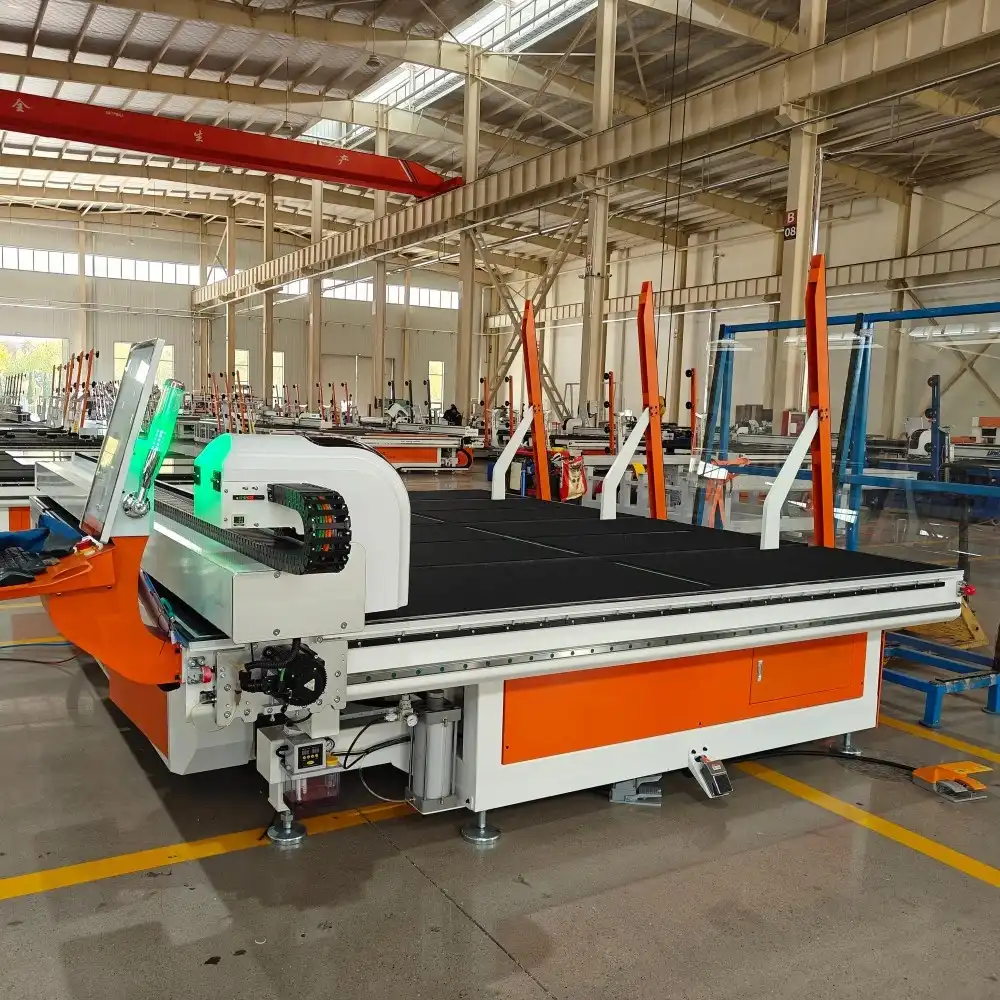
The cutting bridge, guide rails, and drive system of an industrial glass cutting table are typically supported by a welded steel frame. Buyers should examine the steel grade, structural dimensions, wall thickness, weld quality, and stress-relief procedures used during manufacturing. Material strength alone does not determine structural stability; the arrangement of beams, reinforcing ribs, and supporting components also plays an important role. Precision machining of the guide rail mounting surfaces and drive bearing seats helps maintain accurate bridge movement and consistent cutting performance. During high-speed cutting, loading, and glass-breaking operations, a rigid frame helps minimize deformation and maintain alignment. Ask the equipment supplier what stress-relief treatments are performed before machining, and request structural drawings, frame design details, and information about welding procedures to better evaluate manufacturing quality.
Table Flatness
Whether the sheet rests evenly on the surface depends on how flat it is. As long as there is a low spot, the score might not be good, and if there is a high spot, chips or cracks might spread quickly. In ISO 1101, you can find out how to talk about flatness limits. When you do inspections and modeling, you can use the same language for ease. Before you start cutting, make sure the table is level and flat all the way around. It should also be flat in the cutting area. Plan ahead to get the site ready. The outcome will also depend on the floor's condition and how it was moved. Don't just take broad comments as ideals when you ask for them.
Vibration Control
The machine shakes because the bridge moves, the servo drives turn, the cutting head touches, the vacuum fans turn, other machines shut down, and the floors aren't level. The cut level changes, the score lines look bad, and the tracks and wheels get worn out quickly. That's okay, because ISO 20816-1 tells you how to measure and judge machine vibration in a general way. You can ask for readings in a standard format. For good control, you need a stiff frame, a balanced bridge, straight rails, and motion that is tuned. Before making a choice, you should ask for test cuts on your own glass and information on how fast and accurately they cut. Together, you should check how stable the hardware and program choices are.
The HSL-YTJ3829 Automatic Glass Cutting Line
Core Specifications
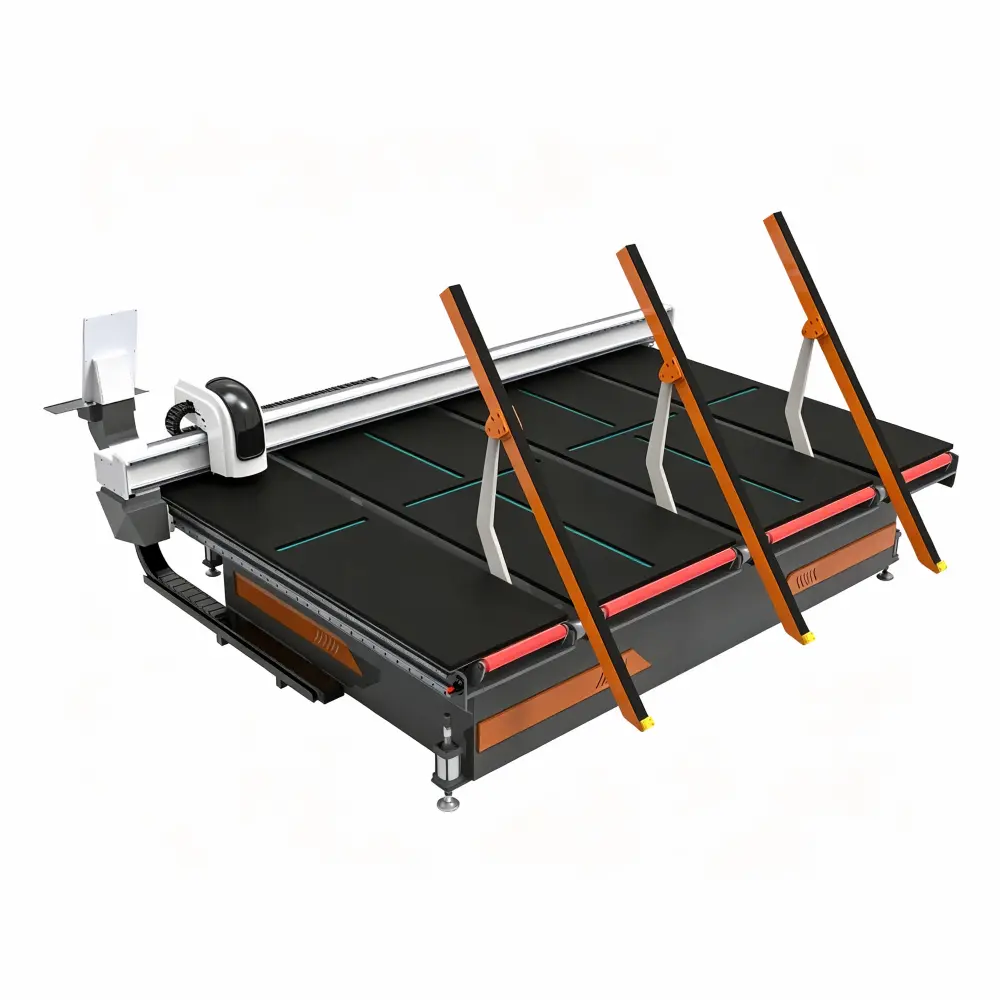
HUASHIL made the HSL-YTJ3829 for plants that need to cut big sheets. This machine can cut glass that is up to 3660 mm x 2800 mm and 2 mm to 19 mm thick. The Optima software figures out how to cut things so that each sheet can make as many pieces as possible. The glass is moved by belts that work together, and it is certified by both CE and ISO 9001. This range of glass can be used for building, cars, smart mirrors, and home decor. Check these numbers against the size and width of the sheet you already have before you ask for a price.
Automation Functions
The HSL-YTJ3829 finds edges automatically, loads automatically, and controls the pressure automatically. When automatic filling is used, you only have to lift a few of the heavy sheets by hand. The cutting force is set by the pressure control, so the user doesn't have to keep making changes. Edge finding makes sure that the sheet is found so that the layout can start from the right place. With a method that floats on air, the glass can move with less resistance, which keeps the surface safe while it's being put in place. A breaking table divides scored sheets, and a remote-controlled walking feature that works in all directions lets the operator move around the machine without getting out of it. Together, these features cut down on the number of steps needed to deal with things and the stress that workers feel.
How a Cutting Cycle Runs
To begin a standard cutting cycle on an industrial glass cutting table, operators enter the sheet dimensions, glass type, thickness, and required part specifications. Optima software then generates an optimized cutting layout designed to improve material utilization and minimize waste. The automatic loading system positions the glass sheet, while the edge detection function identifies its location for accurate cutting. Synchronous belts provide controlled material movement, helping maintain stable positioning throughout the process. The cutting head applies the required scoring pressure along the programmed paths, and the breaking table separates the scored glass into individual pieces. Although operating parameters may vary depending on glass type and thickness, the general processing sequence remains consistent. A user-friendly touchscreen interface can simplify daily operation and reduce the learning curve, but proper operator training is still necessary to ensure safe handling, accurate setup, and reliable cutting performance.
Choosing, Verifying, and Maintaining Your Machine
Matching the Machine to Your Production
They can be useful in shops that don't do a lot of work or for one-time tasks, but only if the person running them is skilled. Placement and output are more stable when automatic methods are used, like the HSL-YTJ3829. Fully digital CNC lines let you program complicated shapes for big orders with a mix of items. You can pick based on your budget, the number of sheets you need each month, the available work, the sheet size, the thickness range, and the floor space. For full lines, it takes three to six months because of technical review and site visits. For a single machine, it only takes a few weeks. Start by telling us about your project. That way, we can help you come up with a good setup or a unique line.
Verification Before and After Delivery
Ask for a factory acceptance test that checks the safety features, size, and flatness of the frame, as well as the movement of the bridge. You can learn about tests for machine geometric correctness and a general way to plan checks in ISO 230-1. For test cuts, use your own glass if you can. Techs should make sure the table is level, the rails are lined up, the motion is set, the air float system is tested, and the people who will be using the machine at your site are trained. Records should be kept of diagonals, score quality, and edge chipping. Anyone in the US should also check the power source and safety laws in their own country, since CE approval doesn't replace those.
Maintenance and Common Mistakes
With daily care, the accuracy stays the same. Take care of any broken glass, check the oil and cutting wheels, and see how well the air flotation works. Every week or month, clean and grease the tracks, check the belts, and make sure the machine is level. Have extra wheels, sensors, and belts ready ahead of time. Lots of times, people buy something without thinking about the floor strength or power source. They also focus too much on the software and not enough on how stable it is mechanically. If there is a rapid drop in accuracy or a strange sound, you should call for help. Before you sign, make sure you know what the warranty covers, when to expect extra parts, and how to get written help.
Conclusion
A big industrial glass cutting table only works as well as the way it was built. Our steel frame is strong and won't bend. The sheet is supported evenly by a flat surface, and controlled vibrations keep the quality of the scores high and the rails and wheels lasting longer. For these three things to work together, you need accurate rails, stable motion, the right way to place them, and regular upkeep. Standards such as ISO 1101, ISO 20816-1, and ISO 230-1, as well as test cuts, help buyers check claims with numbers. The HSL-YTJ3829 shows how to make a building stronger with auto-loading, pressure control, edge finding, air floating, and a breaking table. Do not judge a single rule, but the whole regime.
FAQ
1. What size glass can the HSL-YTJ3829 cut?
This machine can cut glass that is up to 3660 mm x 2800 mm and 2 mm to 19 mm thick. The cutting plans are made by software called Optima.
2. Does a thicker steel frame always mean better accuracy?
No, the type of steel, how the beams are laid out, how well they are welded, how the stress is eased, and how well the industrial glass cutting table work is done all matter. Test data and frame drawings are what you should ask for.
3. How do I check flatness and vibration before buying?
Check to see how flat the glass is and how much it shakes. Also, cut some of your own glass to compare. Both sides can follow rules such as ISO 1101 and ISO 20816-1.
4. What should I send for a quotation?
Tell us about the shapes, sizes, thicknesses, weekly amount, and power needs of the glass. From there, we'll offer a good setup.
Request an Industrial Glass Cutting Table Quote from HUASHIL
HUASHIL, a brand associated with Shandong Huashil Automation Technology Co., Ltd., has experience in manufacturing and exporting glass processing equipment. If you are looking for an industrial glass cutting table, contact our team at salescathy@sdhuashil.com with your required glass dimensions and production capacity. We can discuss equipment configuration, installation support, operator training, spare parts availability, and customization options based on your specific needs. Our team will also review delivery arrangements and after-sales service terms and help you evaluate a suitable HSL-YTJ3829 configuration for your glass cutting operations.
References
1. ISO 1101: Geometrical Product Specifications (GPS), Geometrical Tolerancing, 2017
2. ISO 20816-1: Mechanical Vibration, Measurement and Evaluation of Machine Vibration, 2016
3. ISO 230-1: Test Code for Machine Tools, Geometric Accuracy of Machines, 2012
4. ASTM C1036: Standard Specification for Flat Glass, 2021
5. Machinery Directive 2006/42/EC, European Parliament and Council, 2006
6. Introduction to Glass Science and Technology, Royal Society of Chemistry, 2005