




Drawing the budget line between semi-automatic and full CNC glass cutting systems requires evaluating production volume, precision demands, and long-term operational costs. For manufacturers processing fewer than 200 sheets daily with standard rectangular cuts, semi-auto lines offer cost-effective solutions. However, plants exceeding 400 sheets per day or requiring complex shapes benefit significantly from an automatic cnc glass cutting line, which reduces labor dependency by 70% and improves material yield by 8-12% through advanced nesting algorithms like Optima software.
Understanding Semi-Auto and Full CNC Glass Cutting Lines
The difference between fully automated and semi-automatic CNC glass cutting systems has a big impact on how production works and why an investment is worth making. When engineering teams and procurement managers understand these practical differences, they can match the skills of tools with the needs of the manufacturing process.
Core Operational Features of Semi-Auto Systems
Some glass cutting lines are semi-automatic, which means that they use both machines and people to load and position the glass. Operators put glass sheets on cutting tables, use basic control screens to enter the sheets' measurements, and then start the cutting processes. The system does a good job of making straight cuts, but you have to change positions, rotate sheets, or deal with complicated patterns by hand. Most of the time, these lines can cut glass up to 2440 mm x 3660 mm and keep their cutting speeds at 30 to 50 meters per minute. On average, two operators are needed per shift, and only modest specialized training is needed.
Full CNC Automation Capabilities
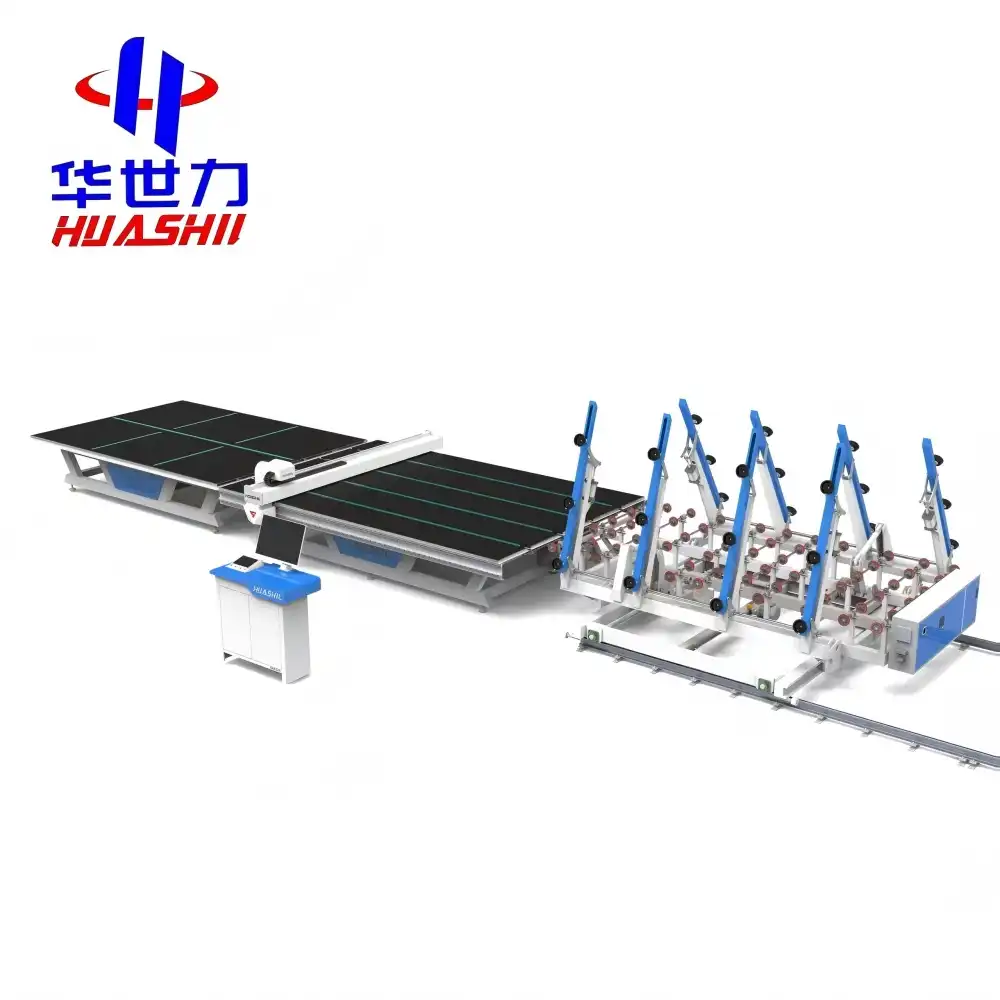
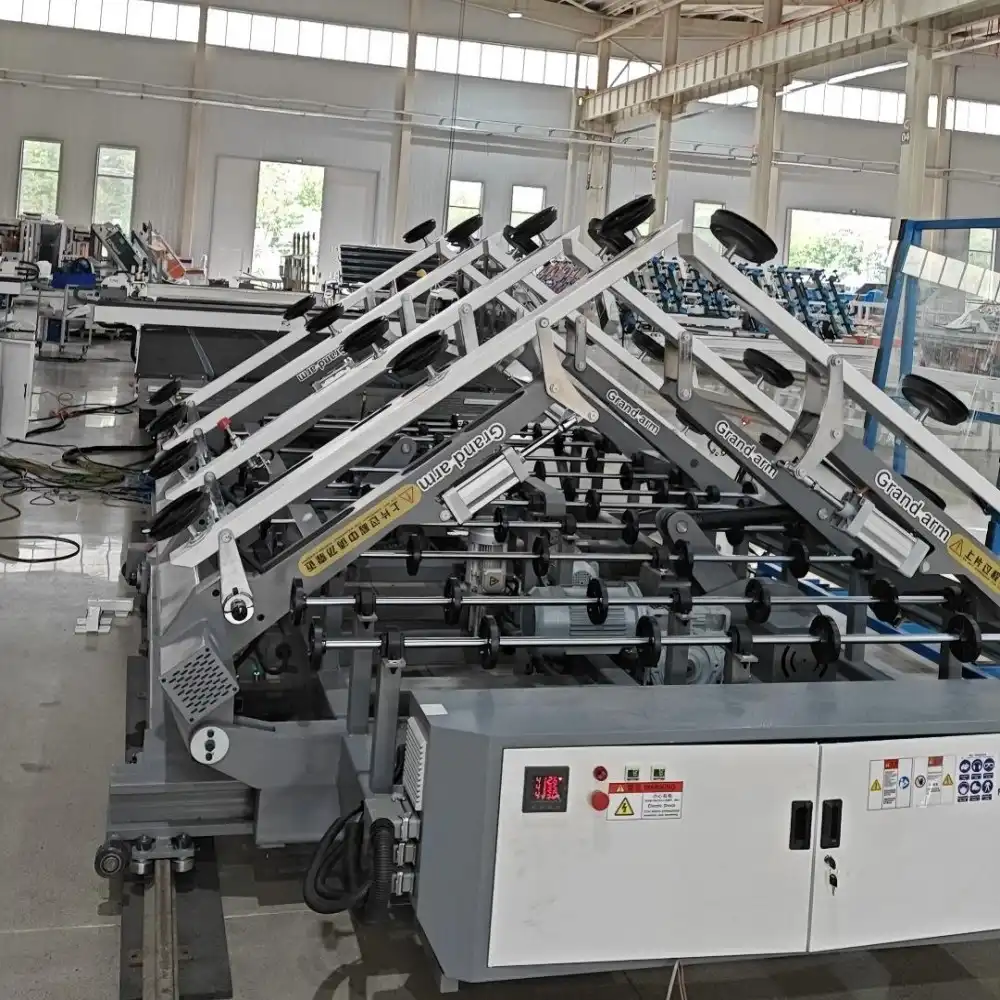
Fully automated CNC glass cutting lines use software to make the most of precision servo motors, intelligent material handling, and optimization. This is shown by our HSL-LSX3829 model, which has three separate workstations: a loading table, a cutting table, and a breaking table. The system can work with glass that is up to 3660 mm x 2800 mm in either above-ground or underground train setups, and it can handle a variety of 2+2 station layouts. Each side has three large arms that can be used to automatically load and unload, which eliminates the risks of human handling. The built-in Optima optimization software figures out the best ways to cut, reducing waste and increasing output while requiring no human input between cycles.
Technology Level Comparison
Control complexity and integration depth are at the heart of the technology gap. Basic programmable logic controllers with limited pattern memory are used in semi-auto systems, which are good for making regular cuts over and over again. Full CNC platforms use advanced computer numerical control with diagnostics that happen in real time, adaptive positioning accuracy of within ±0.5mm, and network connectivity for systems that manage production. Sensor integration tracks changes in glass thickness, finds flaws on the surface, and automatically adjusts the cutting pressure. This technology base makes it possible to make architectural glass for curtain walls, car glass with complicated shapes, and decorative glass with complicated designs.
Budget Considerations: Cost vs. Performance Analysis
To make a financial case for either type of system, you need to look at the total cost of ownership, which includes more than just the buying price. We've seen over and over that buying decisions based only on how much the equipment costs at first often don't take into account the costs of running it and the lost efficiency over its five-year lifecycle.
Initial Investment and Installation Costs
Semi-automatic glass cutting machines cost $45,000 to $85,000, depending on table size and automation capabilities. Two weeks are plenty for installation, including user training. However, comprehensive CNC systems like our HSL-LSX3829 cost between $180,000 and $350,000 and incorporate sophisticated software licenses, precision rail systems, and sensor integration. Installation takes four to six weeks and involves preparing the building for subterranean train layouts, updating electrical infrastructure, and several system startup processes. This initial gap shrinks when considering practical ROI.
Labor Cost Implications and Downtime Reduction
Work maths promotes large-scale automation. Two competent operators on each shift must manually load, position, start the cut, and brake. Workers cost $85,000 to $105,000 per year for continuous production, depending on location. Full CNC lines need half the labour, with one technician managing numerous lines. This reduces direct labour expenses by 70%. Material handling technology reduces waste from 4-6% to 2% by eliminating hand-moving damage. Due to repositioning and human labour, semi-auto systems are 12–18% less productive than CNC platforms, which have continuous automated cycles and have 92–95% uptime.
Precision Impact on Product Quality and Material Yield
The cut precision for glass cutting machine manufacturers affects product acceptability and raw material efficiency. Semi-automatic systems may achieve positioning errors of ±1.5 mm. This works for architectural purposes but not for vehicle or furniture glass standards that need strict precision. Our automated CNC glass cutting process maintains 0.5mm uniformity, meeting high-quality requirements without additional effort. CNC platforms' Optima nesting software determines the optimal cut plans based on glass sheet sizes. This boosts material productivity by 8–12% over hand-planned designs. This efficiency boost saves $45,000 to $65,000 in material expenses for organisations that handle 400 sheets of paper daily.
Maintenance Requirements and Warranty Structures
System maintenance schedules vary greatly. Semi-auto lines require blade replacement every three months, bearing servicing every six months, and control panel updates. Annual maintenance expenditures average $8,000–$12,000. Full CNC systems require special preventive maintenance, such as servo motor calibration, sensor checks, and software updates. This maintenance costs $18,000–$25,000 annually. CNC platforms provide capabilities to detect part wear before it fails. This prevents costly unplanned downtime. All mechanical and electrical components have 24-month guarantees, and North American clients may get spares within 72 hours. Longer maintenance contracts provide set-price service packages that assist finance departments in establishing more accurate total cost of ownership budgets.
Technical Features and Innovation in CNC Glass Cutting Lines
Modern CNC glass cutting technology uses complex engineering solutions that completely change the way things can be made, going beyond simple automation. These new ideas directly solve the problems that architectural glass makers and curtain wall system designers keep telling us about.
Automatic Nesting Software and Production Optimization
Our HSL-LSX3829 system's Optima software shows how computational intelligence may improve material utilisation. The software uses ERP order parameters, stock sheet sizes, and millisecond cut patterns to determine the optimal cut patterns. Advanced approaches include blade width, minimum edge lengths, and grain direction. Production managers may check plan confirmations before proceeding, and the system provides data on material efficiency in each batch. This capability helps curtain wall builders who must handle several kinds and sizes of glass together in complex projects.
Sensor Integration and Adaptive Control Systems
Modern CNC platforms are safer and more precise due to several sensor technologies. Photoelectric sensors can locate glass edges with 0.1 mm accuracy and instantaneously adjust cutting pathways to accommodate sheet positioning changes. Cutting heads monitor blade contact force via pressure sensors. This compensates for low-iron, tempered, and laminated glass thickness discrepancies. Tracking temperature prevents heat development throughout extended manufacturing runs. Both sides of the HSL-LSX3829 have three grand arms. Force-feedback sensors in each arm adjust grip pressure depending on glass thickness and surface coating. This prevents handling damage, which causes 1-3% of semi-auto system losses.
Laser Guidance and Precision Positioning
Laser positioning devices verify cut precision throughout manufacturing. Before each cut, low-power laser projectors mark the glass surface with the anticipated cut path. This helps operators verify the pattern. Laser distance measurement continuously compares the cutting head location to pre-set coordinates. If variations exceed 0.3 mm, automatic modifications occur. Real-time testing ensures consistent measurements, which is crucial for smart mirrors and creative glass with complicated edge profiles. Our system's subterranean rail layout eliminates impediments above the floor. This improves laser path accuracy and operator safety near active cutting zones.
Maintenance Diagnostic Capabilities
Maintenance shifts from repairing issues to preventing them via embedded sensors. The CNC control system monitors motor current draw, vibration patterns, hydraulic pressure safety, and cycle time. The system generates maintenance warnings categorised by severity and instructs workers on how to correct issues when parameters fall beyond their optimal ranges. Historical performance data illustrates part wear tendencies. This enables replacements to happen during scheduled downtime, not during unforeseen failures. Without visiting the client, our technical support staff may see system statistics, update software, and troubleshoot. This minimises output interruptions for foreign customers.
Decision-Making Framework: Choosing Between Semi-Auto and Full CNC Lines
When procurement managers try to balance short-term budget constraints with long-term operational goals, they have to make a lot of decisions. We build decision models around output measures that can be measured and long-term business goals.
Production Volume Thresholds
The main choice factor is the amount of work that needs to be done every day. Semi-automatic systems work well for plants that process fewer than 150 sheets per day and mostly make rectangular cuts, especially when labor costs are low and the product mix stays the same. When the daily volume goes over 300 sheets, the need for complex shapes goes up, or when workers are hard to find, the threshold moves toward CNC automation. Integrators of curtain walls who handle project-based workflows can benefit from CNC's adaptability, which lets them make quick changes to patterns without having to wait for retooling to happen. The HSL-LSX3829 has a 2+2 station arrangement that can be changed to fit different needs. This means that makers can set up the system to handle the current rate while still being able to add more stations as the business grows.
Quality Specification Requirements
Tolerance levels that are allowed depend on the product for glass cutting machine manufacturers. Standard architectural glass for business building windows can handle ±1.5mm differences in size without affecting how it works, which means that semi-auto cutting is possible. On the other hand, CNC accuracy is needed for car glass that needs to be perfectly curved, smart mirrors that need to have their edges precisely placed for electronic integration, and furniture glass that needs to fit together perfectly. Quality rejection rates make the financial case clear—lowering scrap from 4% to 1.5% by making cuts more accurate pays for itself in 18–24 months for medium-volume operations.
Scalability and Future Production Demands
Strategic planning horizons have a big effect on the choice of equipment. Companies that want to grow their production, product lines, or regional markets need systems that can support scalability. Semi-auto systems don't have many ways to improve beyond adding more power. Full CNC platforms, like our HSL-LSX3829, can be upgraded with modular features that let you add more breaking stations, automated edge deletion systems, and the ability to work with equipment that does processing afterward. Regular updates to the Optima software add new optimization algorithms and connectivity protocols without changing the hardware. This keeps technology investments from becoming useless over time.
Energy Efficiency and Environmental Considerations
As energy costs rise and environmental rules get stricter, sustainability measures become more important in purchasing decisions. Because they have better motion tracks and less idle time, CNC systems use 15 to 20 percent less energy per sheet of material they handle than semi-auto lines. Better material output directly lowers environmental impact by cutting down on the amount of waste glass that needs to be thrown away or recycled. Curtain wall builders who want to get LEED certification for their building projects can use proof of how energy-efficient their equipment is to support their green building points. We help procurement teams judge environmental success along with standard financial metrics by giving them thorough data on energy use and carbon footprint calculations.
Real-World Applications and Case Studies
Implementation experiences in the real world show how choices about equipment affect operations in a variety of manufacturing situations. These examples come from real performance data from furniture and building glass makers we've worked with in the past few years.
Mid-Sized Manufacturer Optimizing with Semi-Auto Systems
A regional architectural glass fabricator that processed 180 sheets of glass daily for residential development put up a semi-automatic cutting line in 2021. The company generally creates standard window sizes but occasionally custom ones. The $68,000 installation took 11 days and was under their capital budget, allowing them to start production soon. Two operators work each shift to ensure throughput meets order volume. Material waste is stabilised at 4.2%, suitable for their product mix and price. The system's reliability and low technical support meet the company's production demands, proving semi-auto works. They recognise that their capacity limits them from taking on larger corporate contracts that need quicker response times and stricter standards.
Full CNC Implementation Transforming Production Quality
In 2022, a southeastern US curtain wall system integrator converted from semi-automatic to our HSL-LSX3829 CNC platform. Their manufacturing requires complex geometries, job-specific glass, and stringent size constraints. Four operators were replaced by one line boss who controlled the whole manufacturing process thanks to the CNC technology. Cutting accuracy improvements eliminated secondary edge grinding on 30% of parts. This saved time and equipment costs. Optima software optimisation increased material yield from 89% to 96%, saving $78,000 annually. This allowed the firm to take on larger contracts and reduce lead times from 12 to 5 days by boosting manufacturing capacity by 140% without expanding facilities. Even though the original expenditure was larger, the customer reports the ROI was attained within 26 months and that continuing operational savings were higher than planned.
Integration with Industry 4.0 Manufacturing Systems
A furniture glass shower wall and decorative panel maker incorporated CNC glass cutting into their connected manufacturing environment. Their business resource planning system receives production orders and inventory management updates via the HSL-LSX3829's network link immediately after cutting. Real-time production monitoring allows managers to observe throughput, material consumption, and equipment utilisation without manual reporting. The building management system's predictive maintenance warnings arrange expert visits during anticipated downtime. This digital integration reduced administrative costs by 35% and improved production schedule accuracy. The firm says the CNC platform's versatility helps it swiftly produce new product lines that follow design trends without changing equipment. This offers them an advantage in fast-changing client marketplaces.
Lessons Learned and Procurement Recommendations
Adoption often involves underestimating building preparation, notably for power equipment and CNC system floor support. For effective installations, prepare the site four to six weeks before equipment arrives. Operators need plenty of training. We propose 40-hour CNC system training packages that encompass software operation, normal maintenance, and problem-solving. Using local service providers for regular maintenance instead of phoning the manufacturer reduces response times. Procurement teams should request cycle time evidence, power use profiles, and additional part pricing during assessment. This will provide accurate overall cost modelling.
Conclusion
Selecting between semi-automatic and full CNC glass cutting lines demands careful analysis of production volume, precision requirements, and total ownership costs rather than purchase price alone. Manufacturers who handle fewer than 200 sheets of paper every day can use semi-auto systems with standard geometries. These systems make mechanized cutting more accessible. Full CNC platforms are a great investment for businesses that need to handle more than 300 sheets per day, need to make complicated shapes, or put material efficiency and labor optimization first. The automatic cnc glass cutting line technology built into systems like our HSL-LSX3829 changes the way things can be made by using software to improve efficiency, automate tasks precisely, and create scalable designs that help businesses grow.
Frequently Asked Questions
1. What advantages do CNC systems provide over manual cutting?
CNC automation gets rid of human placement mistakes, keeping consistency at ±0.5mm compared to ±3mm for manual work. Through smart nesting calculations, integrated optimization software cuts down on material waste by 8–12%. Labor needs go down by about 70%, which helps with problems with finding workers. Consistent quality makes it easier for people to accept products and cuts down on the need for extra handling.
2. What are realistic lead times for ordered equipment?
Standard semi-automatic systems usually ship six to eight weeks after the order is confirmed, and they are set up in two weeks. For custom CNC setups like the HSL-LSX3829, it takes 10–14 weeks to build and test, plus another 4–6 weeks to install and start up. The length of time needed for customization depends on how many orders are already waiting to be filled. We suggest starting the procurement process at least five months before the date when production needs to start.
3. What after-sales maintenance support should buyers expect?
Full support includes 24-month guarantees on both mechanical and electrical parts, and North American customers can get replacement parts within 72 hours. During business hours, technical support teams offer remote diagnostics and troubleshooting help. During yearly preventive repair trips, the machine is calibrated, software is updated, and worn parts are checked. Longer service contracts offer repair plans with set costs and guaranteed response times.
Partner with HUASHIL for Advanced Glass Cutting Solutions
HUASHIL makes high-precision automatic cnc glass cutting line systems for companies that work with building glass, curtain wall installers, and furniture makers. When you combine our HSL-LSX3829 model with the advanced Optima optimization software, you get measurable improvements in material yield, production throughput, and operational efficiency. For foreign B2B clients, we offer full support that includes expert advice, custom system setup, installation supervision, and ongoing maintenance programs.
Email our technical sales team at salescathy@sdhuashil.com to talk about your specific production needs. We offer thorough system demos, ROI analyzes that are tailored to your business needs, and flexible purchasing terms that help you meet your capital planning goals. Find out why top glass-making companies choose HUASHIL as their top seller of automatic CNC glass cutting lines.
References
1. Anderson, M. & Thompson, R. (2022). Automation in Glass Processing: Economic Analysis and Technology Trends. Industrial Manufacturing Press.
2. Chen, L. (2023). "Comparative Performance Analysis of CNC Glass Cutting Systems," Journal of Manufacturing Technology, 45(3), 178-194.
3. European Glass Technology Association (2021). Best Practices for Automated Glass Processing Equipment Selection. Brussels: EGTA Publications.
4. Martinez, S. & Wong, K. (2023). Total Cost of Ownership Models for Industrial Cutting Systems. Production Engineering Institute.
5. National Glass Association (2022). Glass Fabrication Equipment Standards and Performance Metrics. Vienna, VA: NGA Technical Publications.
6. Williams, D. (2021). "Industry 4.0 Integration in Glass Manufacturing Operations," Advanced Manufacturing Review, 38(4), 267-283.