




Multiple ways are used to cut glass during fabrication, depending on production needs and material. Modern glass cutting lines use automated scoring, precise breaking, and powerful control software to provide uniform architectural, automotive, and ornamental finishes. Automated solutions, including CNC systems, waterjet cutting, and laser technology, dominate industrial manufacturing due to their higher throughput, lower labor costs, and improved safety. Procurement managers must grasp the technical and economic consequences of each process based on glass thickness, manufacturing volume, and accuracy requirements.
Overview of Glass Cutting Methods in Fabrication
Different cutting processes serve different operating sizes and quality demands in glass production. From trained operators' manual hand-scoring to completely automated manufacturing, glass processing has evolved to improve efficiency and uniformity.
Manual vs. Automated Glass Cutting Approaches
Custom workshops still employ handheld carbide or diamond-tipped cutters to score glass surfaces and provide controlled pressure for clean breakage. This method works for low-volume projects with distinctive forms but has uneven edge quality and operator fatigue over long runs.
Automated glass cutting lines revolutionize manufacturing with programmable placement, scoring, and precise breaking. These technologies remove human error, standardize output quality, and achieve production speeds that manual labor cannot. Automation helps architectural glass and automotive component factories fulfill tight dimensional tolerances and stay safe.
How Material Properties Influence Cutting Method Selection
Fabrication problems vary by glass type. Tempered glass cannot be cut after heat treatment, thus makers must cut it beforehand. Multilayer laminated glass with polymer interlayers requires unique cutting methods to avoid delamination. Low-iron ultra-clear glass used in premium architectural applications needs extremely clean edges, which typically necessitates integrated grinding operations in cutting lines.
Laser cutting causes thermal stress on some glass compositions differently from mechanical scoring. Waterjet technique eliminates heat-related distortion but requires water and abrasive control. Production managers assessing equipment investments must match cutting technique with target materials' physical properties.
Detailed Comparison of Glass Cutting Methods
Analysis of performance parameters, operating expenses, and material compatibility is needed to choose the best cutting technique. Each approach has pros and cons that affect long-term production economics.
CNC Automated Glass Cutting Lines: Performance and Economics
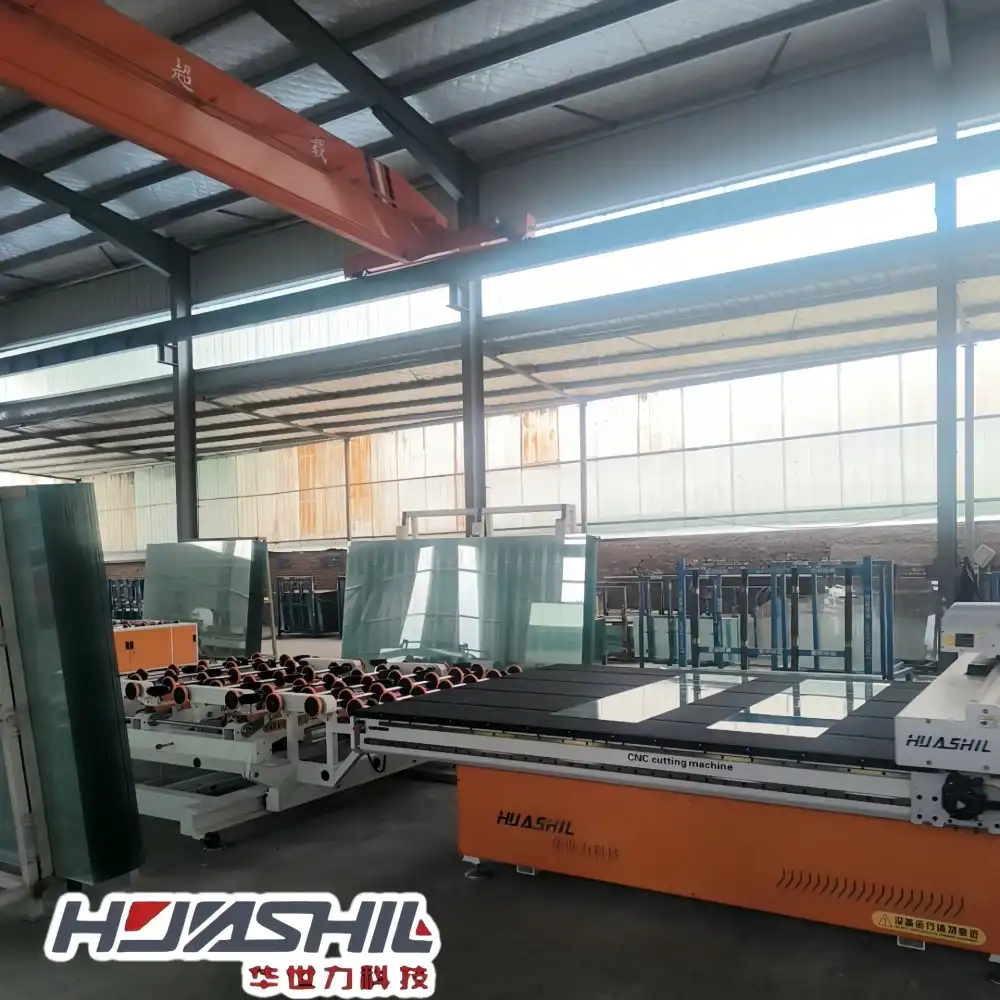
CNC systems are the norm for high-volume glass manufacturing. The loading tables place raw sheets, the cutting tables use precision scoring equipment, and the breaking tables apply calibrated force along scored lines in these integrated lines. Advanced CNC capabilities in the HSL-LSX6133 model allow for glass diameters up to 6100×3300mm and safe material handling with variable 2+2 station combinations and six grand arms per side.
Optima optimizes nesting designs to improve glass sheet production and reduce raw material waste. This computational efficiency reduces material prices, which is important because glass accounts for 40-60% of architectural manufacturing costs. CNC systems work constantly with minimum supervision, reducing labor and achieving ±0.5mm cutting precision compared to manual techniques.
The economic rationale for CNC automation grows with output. Labor, material waste, and quality-related rework reductions yield 18-24 month payback times for facilities processing 500+ square meters daily. When evaluating equipment from different manufacturers, buyers must consider the total cost of ownership, power usage, spare parts availability, and regular maintenance.
Laser vs. Waterjet: Specialized Cutting Technologies
Laser cutting melts and cracks glass locally with CO2 or fiber laser beams. This non-contact approach excels at delicate shapes and small-radius curves that mechanical scoring equipment cannot. Laser technologies produce excellent edge quality on thin glass (2-6mm) without mechanical stress, but create heat-affected zones that may compromise structural integrity in thicker materials. Energy costs are higher than mechanical techniques, and coated glasses reflect laser wavelengths, restricting application.
Waterjet cutting erodes material in preset routes with ultra-high-pressure water and fine abrasives in small nozzles. Cold-cutting eliminates thermal stress and works with most glass thicknesses and coatings. The slower speed of waterjet systems (300-800mm/min vs. 60-100 meters/min for scoring) makes them economically feasible only for unique forms or small production batches. Waterjet technology requires intricate water recycling and abrasive containment infrastructure, complicating facilities.
Semi-Automatic vs. Fully Integrated Production Lines
Glass loading, placement, and removal are human in semi-automatic systems, but cutting is automated. These designs provide flexible task order processing with frequent size variations without the capital expenditure of fully automated lines. Manual handling bottlenecks limit productivity to 80–120 cuts per hour, depending on glass size and operator efficiency.
Fully integrated lines have vacuum lifters or robotic arms for loading, programmed cutting stations with numerous tool heads, synchronized breaking systems, and quality inspection modules. Glass may be transported between stations without physical intervention on above-ground or underground rails at over 300 cuts per hour. These systems enhance labor allocation by letting one technician manage several units, but they need more upfront investment and specialized upkeep. Automation purchases should match production volume predictions and labor cost structures for each site.
Key Process Steps and Maintenance of Glass Cutting Lines
Systematic process control and preventative maintenance go beyond equipment selection for effective operation. Knowing workflow mechanics and maintenance needs helps extend equipment life and maintain output quality.
Step-by-Step Workflow in Automated Glass Processing
The loading table uses vacuum suction to arrange raw sheets for automated glass manufacturing, preventing surface blemishes. Before sending glass to the cutting station, optical sensors check size and orientation. In the scoring phase, diamond or carbide wheels provide precise downward pressure (8-15kg depending on glass thickness) while following programmed patterns at specified speeds. Scoring depth must reach the surface without microfracturing.
After scoring, the breaking table exerts mechanical force perpendicular to the scored routes using synchronized pressure bars or running pliers. Proper breaks provide clean edges that require little grinding. Before sending finished items to packing stations, quality inspection systems use cameras or laser profilers to check dimensions and edge problems. For process optimization, Optima software controls station time, optimizes cutting sequences, and logs production data.
Maintenance Best Practices for Sustained Performance
Regular maintenance of the glass cutting line affects cut quality and machine dependability. Cleaning cutting tables to eliminate glass debris that affects positioning precision, monitoring scoring wheels for wear or chips that reduce edge quality, and checking vacuum system integrity are daily tasks. Linear guide rails need daily lubrication, whereas pneumatic systems need weekly air filter and moisture separator inspections.
Monthly alignment checks avoid cutting accuracy drift. Technicians use precise measurement equipment to ensure beam straightness and calibrate positioning devices to the manufacturer's requirements. Scoring wheel replacements generally occur after 30,000–50,000 linear meters of cutting, depending on usage intensity. During equipment acquisition, purchasing teams should validate spare parts availability and delivery times, as unexpected component failures can halt production for days if parts need overseas shipment.
Too much scoring pressure, poor cutting wheels, or insufficient breaking force cause edge chipping. These faults need methodical troubleshooting—adjusting pneumatic pressure, changing consumables, or recalibrating breaking mechanisms. Data from maintenance operations and quality indicators informs preventative service intervals and component replacement scheduling.
How to Choose the Right Glass Cutting Line for Your Business
Glass processing equipment is expensive and requires careful consideration of technical standards, supplier capabilities, and long-term running expenses. Production capacity, product quality, and competitive positioning are affected for years after installation.
Matching Equipment Capacity to Production Requirements
Equipment choice is based on production volume forecasts. Semi-automatic systems work well for 200-400 square meters every day, while fully automated lines are needed for 800 square meters or more. Standard float glass facilities need simpler equipment than those handling tempered, laminated, and coated glasses, which require specific handling.
Equipment parameters depend on maximum glass dimensions. Designed for 6100×3300mm architectural glass sheets, the HSL-LSX6133 eliminates the need to break down large panels before processing. This lowers handling and material waste compared to smaller cutting tables that need pre-sizing. Buyers should assess their work mix to see if normal or excessive capacity is worth the cost.
Evaluating Supplier Credentials and Support Infrastructure
Manufacturing quality and after-sales support affect equipment dependability. Reputable vendors have ISO 9001 certification and verified installation history in target applications. High-quality technical guides, including electrical schematics, pneumatic diagrams, and troubleshooting flowcharts, enable efficient maintenance and decrease downtime due to failures.
Given the specialist nature of glass processing equipment, after-sales service is crucial. Buyers should check technical help response times, spare parts stocking locations near their operations, and on-site training. IoT-enabled machine monitoring allows suppliers to remotely diagnose numerous faults without sending technicians, lowering mean time to repair. Warranty period, servicing visits, and expiration circumstances should be specified in the contract.
Budget Considerations Beyond Purchase Price
Total cost of ownership goes beyond equipment purchase. Foundation preparation, electrical infrastructure modifications, compressed air system capacity, and manufacturing process integration cost money. Operators and maintenance staff need 3-5 days of intense training, depending on system complexity.
CNC cutting lines demand 15-30kW while active cutting, consume scoring wheels and grinding belts, and require periodic maintenance. Energy-efficient designs with servo-driven positioning and improved vacuum pump controls save equipment lifetime utility costs. Finance choices like equipment leasing or vendor payment plans influence cash flow management, especially for developing companies balancing growth investments and working capital needs.
Emerging Trends and Future Directions in Glass Cutting Technology
Digitalization, AI, and sustainability are changing glass manufacture. These advancements provide early adopters a competitive edge and set new industry benchmarks.
Smart Manufacturing and Predictive Maintenance
IoT-enabled glass cutting lines send real-time operational data to cloud platforms where analytics algorithms predict component failures. Before failures, predictive maintenance models arrange preventative service using vibration signatures, cutting force changes, and positioning system performance. It decreases unnecessary downtime by 30-40% compared to reactive maintenance and extends component lifespan through timely interventions.
Based on past performance data, machine learning algorithms adjust scoring pressure, traversal speed, and breaking force for different glass varieties and thicknesses. While switching production runs, these adaptive systems enhance cut quality and save setup time. Integration with ERP systems streamlines data flow from order entry to production scheduling to quality documentation, improving traceability and customer communication.
Environmental Sustainability in Glass Processing
Energy efficiency programs reduce vacuum system, positioning motor, and auxiliary equipment energy use. Instead of running at full capacity, variable frequency drives adjust pump and motor speeds to demand, saving 20–35% of energy. Servo-driven axes' regenerative braking systems transfer kinetic energy to electricity during deceleration.
Material waste reduction solutions use powerful nesting algorithms to obtain 90%+ from raw glass sheets. Automated remnant management systems categorize leftover parts after primary cuts, allowing reuse in the following orders. In waterjet cutting, closed-loop water recycling filters and reuses process water to reduce consumption and effluent output. These sustainability strategies save operational costs and meet expanding environmental restrictions, aligning economic and ecological objectives.
Conclusion
Glass cutting technology has advanced from manual to automated methods with unmatched precision, speed, and consistency. Modern glass cutting lines fulfill architectural, automotive, and ornamental fabrication needs with mechanical scoring, programmed breaking, and intelligent optimization software. Production volume, material qualities, automation level, and total cost of ownership must be considered while investing. Forward-thinking fabrication facilities gain competitive advantages by adopting smart systems and efficient processes early in the digitalization and sustainability revolution.
FAQ
Q1: What determines which cutting method suits specific glass types?
Material properties—including thickness, tempering status, coating presence, and intended application—dictate appropriate cutting technology. Annealed float glass accommodates all methods, while laminated glass requires specialized protocols to prevent delamination. Coated energy-efficient glasses may restrict laser cutting due to reflective properties. Thickness above 12mm typically necessitates mechanical scoring over thermal methods.
Q2: How does automation improve cutting precision and consistency?
Automated systems eliminate human variability through computer-controlled positioning accurate to ±0.1mm, consistent scoring pressure application, and synchronized breaking force. CNC glass cutting lines maintain uniform quality across thousands of cuts without operator fatigue, achieving dimensional tolerances unattainable through manual techniques while documenting every production parameter for quality traceability.
Q3: What maintenance frequency keeps cutting lines operating reliably?
Daily cleaning and visual inspection prevent common issues, while weekly lubrication maintains mechanical components. Monthly precision alignment verification catches gradual drift before affecting product quality. Comprehensive quarterly service addressing pneumatic systems, electrical connections, and software updates maximizes uptime. Spare parts inventory for high-wear consumables like scoring wheels prevents production delays.
Partner with HUASHIL for Advanced Glass Cutting Solutions
HUASHIL delivers proven expertise in automated glass fabrication technology through comprehensive cutting line solutions tailored to architectural, automotive, and decorative applications. Our HSL-LSX6133 model combines robust construction with Optima optimization software, processing glass up to 6100×3300mm through configurable multi-station designs that maximize throughput while minimizing waste. As an established glass cutting line manufacturer, we provide complete technical support from initial consultation through installation, operator training, and ongoing maintenance services. Our quality assurance protocols ensure reliable operation backed by responsive after-sales support and readily available spare parts. Contact our technical team at salescathy@sdhuashil.com to discuss your production requirements and receive customized recommendations aligned with your operational goals and budget parameters.
References
1. National Glass Association. (2022). Automated Glass Fabrication Systems: Technical Standards and Best Practices. Vienna, VA: NGA Publications.
2. Chen, W., & Robertson, M. (2021). Precision Cutting Technologies for Architectural Glass Processing. Journal of Manufacturing Systems, 58, 234-247.
3. International Association of Glass Manufacturers. (2023). Global Survey of Glass Processing Equipment and Automation Trends. Brussels: IAGM Research Division.
4. Thompson, R. (2020). Industrial Glass Cutting: Methods, Equipment Selection, and Quality Control. New York: Industrial Press.
5. Kumar, S., & Zhang, L. (2022). Comparative Analysis of Mechanical and Thermal Glass Cutting Technologies. Materials Processing Technology, 145, 112-129.
6. European Committee for Standardization. (2021). EN 12150: Glass in Building—Thermally Toughened Soda Lime Silicate Safety Glass. Brussels: CEN Technical Standards.