




An industrial glass cutting table differs from a workshop bench mainly in control. A bench gives you a flat surface, and the operator supplies the measuring, scoring pressure, and handling by hand. An industrial glass cutting table builds those tasks into the machine, so loading, positioning, edge finding, scoring, and breaking follow programmed settings. That change improves repeatability, reduces material waste, and cuts the heavy lifting that causes injuries and breakage. A bench still suits repairs, prototypes, and small custom jobs. Once daily volume or sheet size grows, a table pays back through yield, labor savings, and consistent quality.
Why the Cutting Surface Matters in Industrial Glass Processing
Where a Workshop Bench Still Makes Sense
When I go to a shop, I never advise them to get rid of a bench. Fixes, samples that are one-of-a-kind, and small bespoke orders are all ideal examples of situations in which a bench is an excellent choice—especially when speed is less critical than setting up fast. Immediately after the installation of a straightedge, the worker will mark the glass and create scores by hand. Once this is done, the sheet is broken over a support. Having the ability to operate in such a manner requires both talent and caution. It is possible for three persons to utilise the same drawing and have somewhat different outcomes; nevertheless, the majority of the time, only one person lifts for each page. This trade-off is appropriate for a few pieces every day, and it works out nicely. Increasing the number of tasks leads to an increase in the frequency of minor errors, which in turn leads to an increase in the expenses associated with scrap, repairs, and workers who are exhausted.
What an Industrial Glass Cutting Table Adds
The processes that were previously carried out by hand may now be completed in a single step as a result of the use of an industrial glass cutting table. The cutting head is held in position by a bridge constructed of metal, and software instructions are sent to the machine to determine where to cut. The sheet is held in place by the frame. Due to the fact that the machine does the same action each and every time, the final outcome is the same for each and every worker or shift. According to Shelby's "Introduction to Glass Science and Technology" and other works on glass science, a scored line is responsible for the formation of a fault on the surface of the glass, which ultimately results in the glass breaking. Because of this, it is essential to maintain a consistent level of wheel pressure and to position it in the appropriate location. A fatigued hand is not capable of doing these activities as well as a machine.
How the Difference Shows Up in Cost and Safety
Although the initial purchase price of a basic cutting bench may be relatively low, ongoing expenses such as labour, glass breakage, and material waste can significantly affect operating costs. Manual measuring, lifting, and positioning require additional time and effort, while an industrial glass cutting table may improve workflow efficiency, reduce material handling requirements, and lower long-term production costs. Another essential aspect of the job is safety. Machine guarding rules established by OSHA may include physical guards, interlocks, and emergency stop systems, depending on the kind of equipment and the potential dangers of the machine. Buyers should get in touch with the suppliers to get comprehensive information on the safety aspects of each piece of equipment and whether or not it is suitable for the intended purpose. It is not enough for plant managers, engineers, and procurement teams to just compare purchase prices; they also need to take into account the expenses of equipment, installation, operator training, maintenance, energy consumption, and downtime. Purchasing and operational planning could be improved as a result of this greater examination.
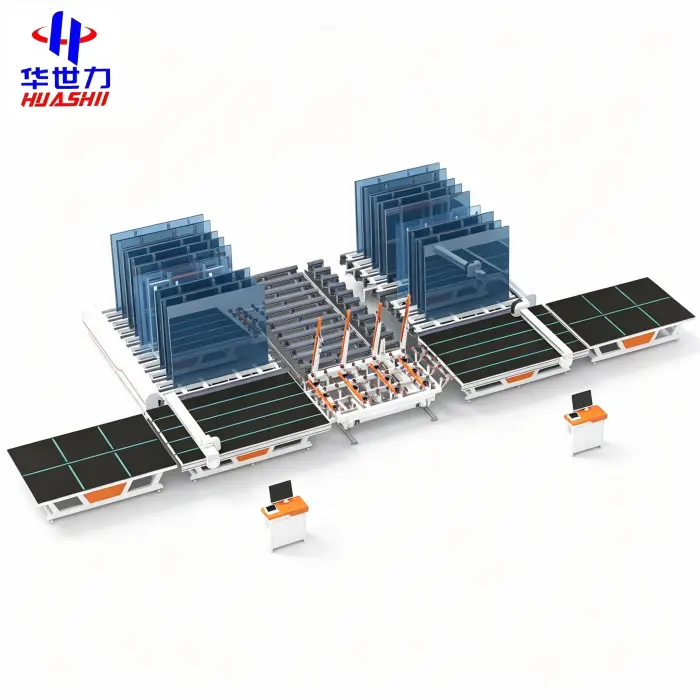
How the HSL-YTJ3829 Handles Each Cutting Step
Loading, Air Flotation, and Synchronous Belts
The HSL-YTJ3829 is capable of working with sheets that are as long as 3660 × 2800 mm (about 144 × 110 inches) and has a thickness ranging from 2 to 19 mm. Instead of having to manually move large sheets, the sheet is placed on the table by itself, saving the workers time and effort. Air flotation is a technique that allows the glass to remain in place on a cushion of air. This makes it easier for the sheet to move around the surface without becoming trapped or having to adhere to it. The glass is moved along by synchronised belts, which also work to maintain its movement under control. You will not have to worry about moving large, heavy sheets by hand and ensuring that they fall securely where the cutting software instructs you to do so, since these features eliminate the need for you to do so.
Edge Finding, Pressure Control, and Optima Software
The edge of each sheet is automatically located once the sheets have been fed into the machine. Therefore, the cutting program begins from a point that has been measured rather than the operator making an educated guess. A mechanism known as automated pressure control allows for the score pressure to be altered. In order to score glass with a thickness ranging from 2 to 19 millimetres, you will need to determine the appropriate scoring force. The cutting pattern is planned by the Optima optimisation software in such a way that the pieces will fit on the sheet with a greater number of scraps than not. To create the pattern, the software and the edge finder collaborate with one another. The disc is instructed by the pressure control as to where it should travel and how many points it should get. It used to be that people who use benches would make a lot of decisions by looking at them, but now this combination does it for them rather than them.
Breaking Table, Remote Control, and Certificates
In the beginning, the machine will score the sheet. The glass is then held in place by the breaking table while the person who is using it cuts it into pieces following the lines that were scored by the machine for the breaking process. Due to the fact that the machine may move in any direction, the user can use a portable tool to control how it travels and stand in a position that allows them to get the greatest possible view of the glass. There are CE and ISO9001 markings on the HSL-YTJ3829 circuit board. In the same way that CE refers to European regulations for equipment, such as Directive 2006/42/EC, ISO 9001 is concerned with quality management. In the event that you are located in the United States and do not need CE, you should also examine the OSHA safety guidelines and the local electrical laws before putting it in place.
How to Choose an Industrial Glass Cutting Table
Specifications That Matter Most
When evaluating an industrial glass cutting table, start by reviewing the key specifications that determine its operating capabilities, including maximum sheet dimensions, supported glass thickness ranges, and compatible glass types. Next, examine the loading mechanism, cutting system, pressure control, and edge detection capabilities. While mechanical components are important, software functionality also plays a critical role in production efficiency. Buyers should confirm how cutting layouts are transferred to the machine and whether the software supports their existing design files and production workflows. Installation requirements should also be assessed early, including electrical supply, compressed air availability, floor space, and sufficient access for handling glass sheets measuring up to 3660 × 2800 mm, where applicable. Before making a purchasing decision, buyers should document the following specifications and site requirements:
- A work area and range of thicknesses that are right for your real orders.
- A way to load, find edges, and receive help for breaking.
- Make a plan for the software and how you will add your pictures to it.
- Needs for utilities, set up, training, and extra parts.
When suppliers write back answers to these questions, it's easy to compare quotes.
Matching the Machine to Your Application
The right machine will come after your thing. You need to know how to work with large forms when you buy architectural glass for windows, doors, and curtain walls. It comes in big sheets that have to fit together perfectly. It's important to cut auto glass exactly and over and over again. Layout software is helpful for making smart mirrors and artistic glass that need to be shaped in strange ways. For people who make furniture, cutting shower doors, walls, and tabletops needs to be done quickly and with straight lines. Remember that you can't usually cut toughened glass that has already been heated up. The cutting has to happen before the glass is heated up. The different types of flat glass are listed in ASTM C1036. When you buy a class, be sure to know what the cut line needs to do at different times.
Testing, Maintenance, and Total Cost
Before you buy, send us a picture of your own glass so we can cut it. Measure the length, width, and diagonals, and write down the cycle time and offcut rates. Then check the edges. Those numbers are more useful than any brochure for teaching you. Besides that, make plans for upkeep. The operators should check the belts, sensors, scoring wheels, and air holes on a regular basis. The technicians should also calibrate the machine every so often. Then, make a full cost picture that includes the machine's price, shipping, setup, training, warranty, and any extra parts that you might need. If the provider can help quickly and professionally, there will be less downtime. That's why I see service after the sale as an extension of the machine.
Conclusion
An industrial glass cutting table is not the same as a workshop bench because the person using it needs to know how to measure, press, handle, and plan the layout of the machine. A bench is still useful for small jobs, fixes, and prototypes, but as the output goes up, more steps have to be done by hand, which means more waste, more work, and a higher risk of harm. It can load itself automatically, float on air, move multiple belts at once, find edges, control pressure, come with Optima software, and have a breaking table. Everything in the HSL-YTJ3829 works with the other parts. You should think about the sheet size, range of thicknesses, use, benefits, and total cost of ownership when making a choice. You should also get test cuts to make sure the product works well, and you should read carefully about service, safety, and repair.
FAQ
1. What is an industrial glass cutting table?
A computer runs this machine, which holds glass sheets in place, places them, and scores them. The HSL-YTJ3829 adds an air float, a breaking table, and automatic filling to that process, which means it can do more than one thing at the same time.
2. Can a workshop bench handle large sheets?
For safety reasons, they are too heavy to move on a bench without help, which makes it more likely that they will break. Air flotation and belt conveying make it easy for the HSL-YTJ3829 to move sheets that are up to 3660 mm x 2800 mm.
3. What should I ask a supplier before buying?
Find out about the utility needs, warranty terms, when spare parts will be delivered, and plans for installation and training. Also, ask for a sample cut on your own glass. Get copies of the certificates and compare each answer in writing before you sign off on the budget.
Request a Customized Industrial Glass Cutting Table Solution
Are you ready to see how a factory machine compares to your workbench? We'll help you set up your glasses if you tell HUASHIL what size, thickness, and daily amount they are. You can buy the HSL-YTJ3829 from our company. It is an industrial glass cutting table. There are CE and ISO9001 marks on it, and we offer quick, expert help after the sale. Email salescathy@sdhuashil.com to learn more.
References
1. Introduction to Glass Science and Technology, Royal Society of Chemistry, 2005
2. Safeguarding Equipment and Protecting Employees from Amputations, Occupational Safety and Health Administration, 2007
3. Directive 2006/42/EC on Machinery, European Parliament and Council of the European Union, 2006
4. ISO 9001:2015 Quality Management Systems – Requirements, International Organization for Standardization, 2015
5. ASTM C1036 Standard Specification for Flat Glass, ASTM International, 2021
6. ANSI Z97.1 Safety Glazing Materials Used in Buildings, American National Standards Institute, 2015
