




Air float is usually the safer choice for Low-E coatings. A glass loading table with an air cushion cuts sliding friction and keeps the coated face from dragging across hard surfaces. A roller table can still protect coatings when the rollers are clean, non-abrasive, and well aligned, and the coated side faces away from them. I will compare both options, explain how each one works, and show how the HUASHIL air floating loading table with three grand arms handles sheets up to 3660*2440mm. Use this guide to match the technology to your glass, line, and budget.
Why Low-E Glass Needs a Specialized Glass Loading Table
Where Low-E Coatings Get Damaged
When it comes to energy, the U.S. Department of Energy says that Low-E coatings are layers of very thin metal or metallic oxide. That is why it is important to handle: it's thin. ASTM C1376 covers two main types of coatings: sputtered coatings, which are put on in a vacuum, and pyrolytic coatings, which are put on when float glass is being made. Most of the time, it's easier to scratch sputtered, or soft-coat, goods than hard coats. When sheets move over dirty rollers, metal scrap, or guides that aren't lined up right, they can leave behind lines, fingerprints, scratches, and caught dirt. I tell the plants to check the whole path, from the rack to the loading table to the cutting line.
How Air Float and Roller Tables Work
There are small holes in the top of an air float table that let air flow through them. Because the glass sheet sits on a thin air cushion, it's easy for someone to move, tilt, and square it. Glass is held in place on wheels that move around set points in a roller table. It works well with straight lines because it gives a steady speed and action that can be done again and again. In both, you can use alignment tools, sensors, and PLC links. How they touch the surface is what makes them different. Rollers provide direct support along straight lines, while air float spreads it out over the whole surface. It varies on the type of roller, the fresh air, how clean they are, and how much space there is between them.
Loading Table or Complete Loading Machine?
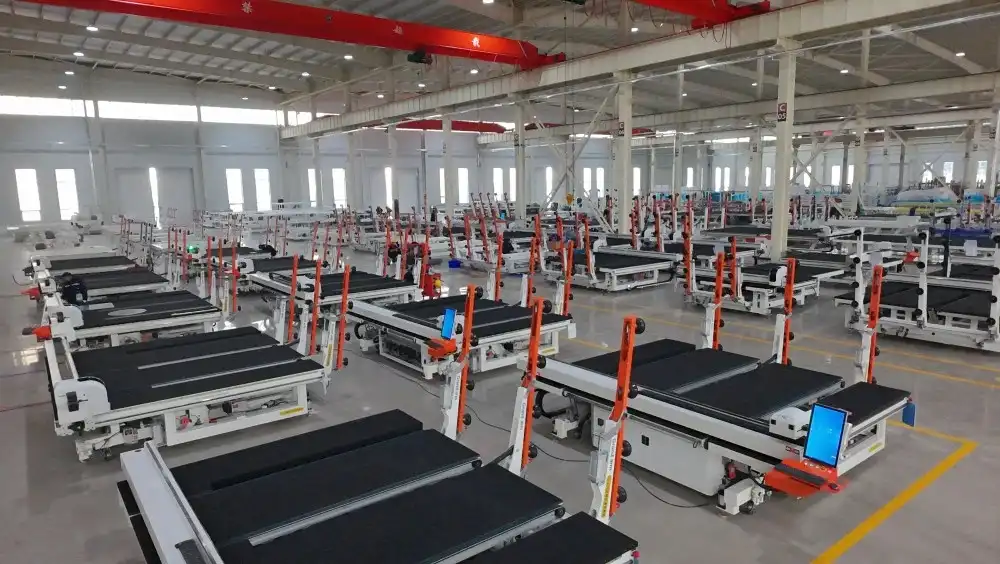
A simple table can hold and set down a sheet. The glass doesn't have to be moved by hand as often when there is a glass loading machine. It can be moved from the rack to the table. For Low-E glass, that difference is important because touch can happen during rack-to-table movement, which is not what you want to happen. The HUASHIL unit is in the second group. A surface that floats in the air is moved automatically by three big arms. You should ask each provider what steps their equipment takes care of automatically, since each step that needs to be done by hand raises the risk of getting in touch.
Air Float vs. Roller: Which Technology Better Protects Low-E Coatings?
What Air Float Does Well
When minimal contact is the priority, an air-float glass loading table is a suitable choice. The air cushion reduces friction during positioning, so operators need less force to push or pull glass sheets. This is especially helpful for large, valuable, or frequently moved sheets. However, the system requires a continuous supply of compressed air, which increases energy consumption. ISO 8573-1 defines compressed air purity classes for particles, water, and oil. Filters and nozzles should be inspected and cleaned regularly because oil or moisture in the air supply could damage glass finishes. Confirm with the supplier that the airflow can support the full range of glass sizes and weights being handled.
When a Roller Table Works
Rolling tables keep things safe for Low-E glass when it's meant to be touched. First, make sure the covering is facing the right way. Follow the maker's care instructions and keep the soft sides away from rollers that aren't meant for them. Then check the rollers' speed, cleaning, material, spacing, alignment, and material. Things don't shake or itch because the speed is steady and the covers don't scratch. For lines that have a lot of glass and need a stable cycle time, rollers are great. The glass needs to keep moving to CNC cutters, drilling machines, edging lines, or insulating glass equipment. But I would still test with normal coated glass, since a clean demo on samples that aren't coated doesn't tell us much about how safe coatings are.
A Simple Decision Guide
Start with the glass. Note the coating's type, size, thickness, weight, and where it is placed. Then you need to add the direction of the loading, the amount of automation, the cycle time, and the equipment that comes after. For finishes that are easy to damage or things that you move around a lot, air float works well. Rollers are good for moving things over and over again. An air float can be used to balance a hybrid line without touching it, and driven rollers can be used to move things quickly. Please rate each option based on how safe it is, how well it works with other systems, how easy it is to maintain, and how much it costs to run. When engineering, purchasing, and finance all care about the same numbers, it's okay to talk about them in different ways. There is still talk because of the weighted score.
HUASHIL Air Floating Glass Loading Table: Key Features
Automatic Loading by Three Grand Arms
HUASHIL's machine has three big arms that load things for you. With these arms, sheets can be moved from a rack to a table without a group of people. For the plant manager, that means less lifting by hand and less time with his or her hands near the glass. To an engineer, it means a clear way to fill that can be seen while the layout is being planned. It's less likely that someone will accidentally touch the line when there are fewer steps, but you should still test with your own Low-E sheets before giving the line the green light.
Air Floating System and 360-Degree Walking
The air floating device uses an air cushion to lift the sheet. This cuts down on friction, which makes it easier to move and line up big pieces of glass. Coated glass used in buildings, cars, furniture, and smart mirrors is less likely to get scratched because of this. You can stand in the loading area in more places because the machine can walk in any direction. For HUASHIL, the best things about its glass loading table are the safety features like emergency stop and overload protection, as well as the non-scratch surface. As you go over the layout, make sure you know the exact path you will take.
Maximum Size 3660*2440mm and Customization
The biggest piece of glass that can be bought in the U.S. is 3660*2440mm, which is about 144 inches x 96 inches. Because the machine can be changed to fit your needs, you can talk to our experts about how to set up the table and connect the lines. Door, window, and curtain wall glass is often used in architecture. It's also used to make cars, furniture, and art glass for walls and shower doors. Smart mirror glass is also often used. Tell people early on about your layout if your plant uses CNC to cut things. This way, the loading position will work with the line.
Buying Guide: Risks, Validation, and the Right Choice
Common Selection Risks
The cost over a longer period of time goes up if you only look at price quotes and don't think about features like safety, alignment, automation, and maintenance. You are wrong to think that all air float tables are safe for coatings. Still important are the air quality and pressure. You shouldn't always avoid roller tables, but you should look at the material, direction, contact pressure, and how well it's cleaned. Talk about how the operator moves and the whole process of loading and unloading. Before you place an order from outside the U.S., make sure you have all the technical documents, installation help, spare parts, training, warranty terms, and remote service you need. Get a written price quote for everything that costs money.
How to Validate Before Purchase
Make a technical proposal based on real production data, like the item's size, weight, thickness, where the Low-E coating is placed, the cycle time, the utilities, the floor space, and the equipment that comes next. You should ask for a test with real covered glass, not just pieces that aren't coated. Before and after, look for scratch marks, pollution, edge damage, optical flaws, and pressure marks. Write down settings like air pressure and alignment position. You should include things like correct loading, safety features, cycle time, setup, operator training, and installation duties in the contract so that it is accepted. The people who work on engineering, buying, and banking all work on the same paper.
Recommended Choice by Application
Choose air float if you don't want to touch something, want to protect delicate coatings, or need to move things around a lot. Rollers are the best choice for steady movement, long lead times, and large quantities. You can also do something with the contact. Pick a combination if you need to line up the line without touching it and then move it fast. You might want to try an air-floating table that loads itself if your business cuts sealed sheets into shower doors, walls, or safe glass units. Technology doesn't always work best in one way. What matters are the specs for the glass, where the coating goes, the volume, and the layout.
Conclusion
Both types of glass loading tables can handle Low-E glass, but they protect coatings in different ways. Air-float tables reduce surface contact and friction when moving sensitive, valuable, or frequently handled sheets. However, they require clean, stable compressed air and regular valve maintenance. Roller tables support consistent, repeatable transfers in high-volume production lines when roller material, spacing, direction, and cleanliness are properly managed. Soft-coated glass is generally more susceptible to scratching than glass with pyrolytic coatings, so it requires additional care. The choice depends on glass type, coating position, production volume, and line configuration. Performance should be verified through tests using actual coated glass. Both systems can also be combined in hybrid layouts.
FAQ
1. Is an air float table always safer than a roller table for Low-E glass?
Not all the time. To work, air float needs stable, clean compressed air and nozzles that are kept in good shape. The cover can also work if you take good care of your roller table. Test with your own glass.
2. Can the HUASHIL glass loading table be customized?
Yes. The machine can work in different ways, and the largest glass it can hold is 3660*2440mm. Tell us about the cutting tools you have, the sheet sizes, and the layout of the lines. Our engineers will then talk to you about your options.
3. What information do you need for a quotation?
Please write down the types of glass, their sizes, thicknesses, weights, where the Low-E coating is located, how much is being made, which way the glass is loaded, how automated it is, and any CNC or downstream equipment that comes to mind. Early sharing of normal production data lowers the risks of integration and helps make a better investment choice.
Request a Glass Loading Table Recommendation from HUASHIL
What is the size, thickness, weight, Low-E coating position, and cutting line plan of your glass? Let HUASHIL know, and we'll help you find a good air floating setup. We are a company that has been making and exporting glass loading tables for many years. We can make changes and help you after the sale. Email salescathy@sdhuashil.com to start your question.
References
1. U.S. Department of Energy, Energy Saver: Window Types, 2023
2. ASTM International, ASTM C1376 Standard Specification for Pyrolytically and Vacuum Deposition Sputtered Coatings on Flat Glass, 2015
3. International Organization for Standardization, ISO 8573-1 Compressed Air: Contaminants and Purity Classes, 2010
4. Glass Association of North America, GANA Glazing Manual, 2008
5. Jelle, B. P. et al., Solar Energy Materials and Solar Cells, 2012
6. Granqvist, C. G., Solar Energy Materials and Solar Cells, 2007