




Automatic all in one glass cutting machines load, score, and shatter glass. Standard multi-step operations become fluid routines. This unified system reduces labor, increases cutting accuracy, and accelerates production. Industrial buyers who want dependable automated glass processing should understand how these three key tasks work together to provide consistent outcomes in construction, autos, and furniture.
Understanding the All-in-One Glass Cutting Machine
What Makes Integrated Glass Processing Different
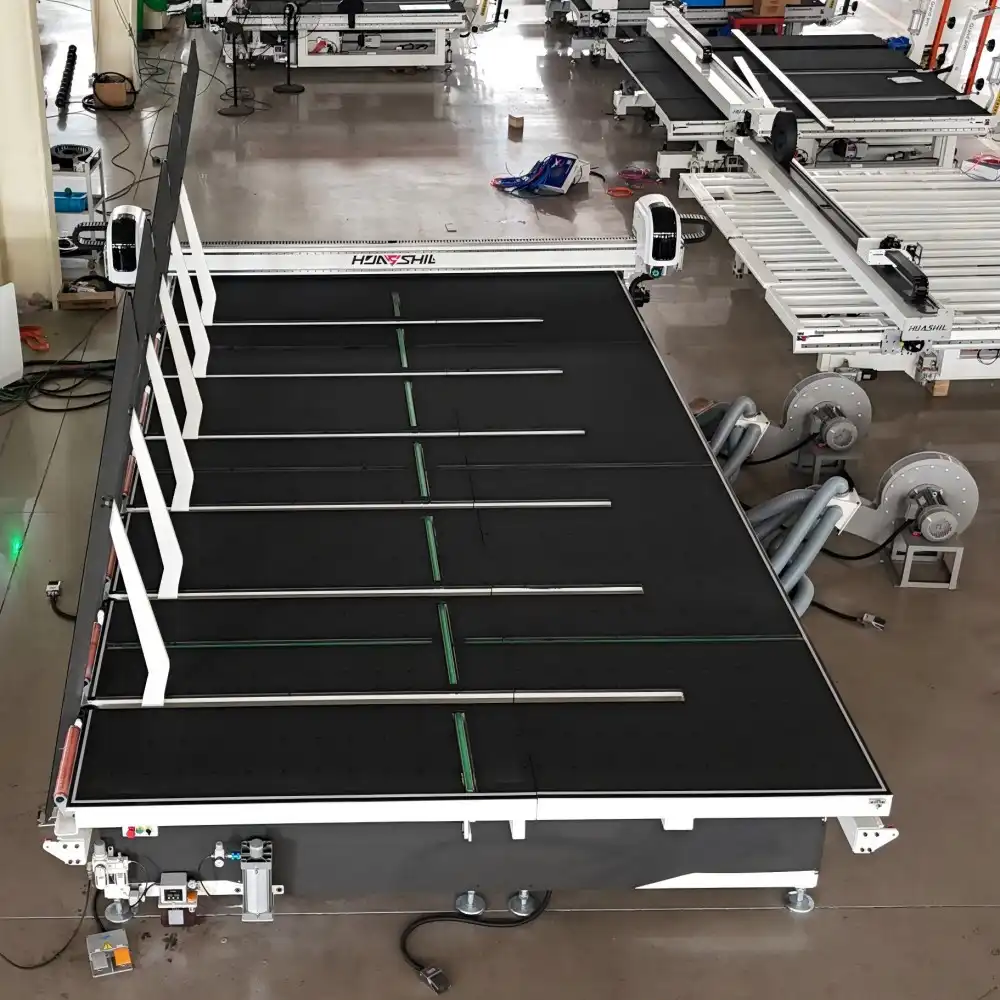
Modern integrated glass-cutting machinery scores, breaks, and handles glass on one platform. This combination eliminates the need to shift glass between workstations, saving time and reducing damage. Sheets are manually transferred between cutting tables and breaking stations in conventional arrangements. All-in-one glass-cutting machines continually process raw glass into finished pieces.
In the HSL-YTJ3829 model, glass sheets up to 3660 x 2800 mm and 2mm to 19mm wide may be held. Production managers enjoy that this flexibility may be utilized for many projects without many instruments. System's Optima optimization program determines the optimal cutting patterns to maximize material utilization. This directly impacts unit manufacturing costs.
Core Functions Explained
Automatic Loading
Synchronous belt conveyors transfer raw glass sheets from racks to the cutting table. This avoids risky hand-lifting and manufacturing delays. The automated edge-finding function aligns the glass before processing by detecting its size and placement. This precision is crucial for the all-in-one glass cutting machine when dealing with large building glass panels, where millimeter-level placement influences fit.
Precision Scoring Technology
Diamond-tipped cutting heads slash glass with controlled pressure, creating design-based fractures. Automatic pressure control adjusts force for glass type and thickness. Stops the glass from over-scoring, which causes chips, or under-scoring, which causes incomplete fractures. The air float mechanism supports the glass and distributes the weight properly during scoring to prevent stress buildup and cut quality issues.
Automated Breaking
Integrated breaking tables precisely separate parts with calibrated pressure along scored lines. The controlled breaking approach produces smoother edges than hand-breaking, requiring less grinding afterward. The 360-degree remote control walking capability enables operators to see the whole operation from a safe distance, addressing workplace safety issues that procurement teams consider when buying products.
Machine Classification and Selection Criteria
Fully automated machines can load ingredients and ship the completed product without human assistance. Semi-automatic models need human assistance during certain processes but are cheaper for organizations with limited resources. Plant managers must consider production objectives, floor space, and labor capabilities when determining automation levels.
Compatible glass includes toughened, laminated, and low-E coated kinds. High-quality all-in-one glass-cutting machines with adjustable specs can handle different materials. Engineering teams should make sure new equipment requirements support the glass their production lines use, as repairing machines that don't operate together is costly and time-consuming.
Key Features and Benefits for Procurement Professionals
Technical Specifications That Drive ROI
Equipment with CE and ISO9001 certifications satisfies international quality and safety requirements for an all in one glass cutting machine. This is crucial for US companies that must follow OSHA and other industry norms. These credentials make it simpler to acquire insurance and demonstrate your study when justifying capital expenditures to finance departments.
Technical buyers should focus on Optima's interface. Advanced nesting algorithms reduce glass waste by optimizing cutting patterns across irregular shapes and dimensions. High-volume production leaders find that even a 3-5% increase in material usage saves a lot of money when operating hundreds of thousands of square feet a year.
Measurable Business Impacts
Built-in glass cutting machines have these primary advantages:
- Labor Cost Reduction: Automation reduces shift operators from three to four to one supervisor handling many machines. This immediately decreases pay expenses and addresses the US industrial sector's training needs.
- Continuous automation operations may complete cutting cycles 40–60% quicker than manual procedures, allowing present facilities to boost productivity without establishing new facilities.
- Quality Consistency: Computerized controls eliminate the need to modify scoring pressure and breaking force. This ensures edge quality, reducing rejections and customer complaints.
- Workplace Safety Improvement: Less physical glass handling reduces laceration injuries and recurrent strain disorders, lowering workers' compensation claims and improving safety audit results.
- These operational adjustments provide companies with an advantage over the competition. Faster response times allow manufacturers to complete urgent projects, and consistent quality fosters customer loyalty and word-of-mouth advertising.
Maintenance Considerations and Supplier Support
The frequency of preventive maintenance and the availability of all-in-one glass-cutting machine parts affect the total cost of ownership. Purchasing managers should examine whether manufacturers store parts in the US so they can provide replacements immediately or if they source parts abroad, which may tie up equipment for weeks. Suppliers with English-language phone service during US business hours resolve issues more quickly than those using email solely across time zones.
Equipment lifespan depends on maintenance compliance. Buy from firms with detailed service schedules, how-to videos, and operator training to preserve your investment. Organized maintenance facilities have 30–40% longer machine service lifetimes than reactive maintenance facilities.
Comparing All-in-One Glass Cutting Machines with Traditional Glass Cutting Methods
Traditional Manual Cutting Limitations
In most glass cutting methods, loading, scoring, and breaking occur separately. Hand-positioning sheets on cutting tables and scoring lines with little cutters. They then place the fragments on breaking tools or tables. This broken-up method wastes time transferring items between stations, unequal human scoring pressure, and operator expertise that affects breaking technique.
Manual scoring requires skill, particularly with thicker glass or specific coatings, to achieve clean breaks. Even competent workers might have quality issues during long shifts due to fatigue, and apprentices require months of training to produce excellent work. As workers repeatedly lift and put away large glass pieces, safety concerns rise.
Automation Advantages Quantified
All-in-one glass cutting devices solve all traditional technique issues:
Eliminating inter-station swaps boosts speeds. Automation processes continuous glass streams instead of batches. From the same floor area, daily production doubles or triples. Production planners may boost productivity by comparing human cycle durations (8–12 minutes per sheet) to automated cycles (3–5 minutes).
Computer-controlled score heads maintain pressure and speed, improving cutting accuracy. Automated processes typically maintain ±0.5mm tolerances throughout the sheet, whereas competent hand cutting may maintain ±2mm. Curtain walls and cars with strict assembly fit tolerances need this level of precision.
Major operator safety improvements. Automation saves workers' backs from lifting heavy objects, while remote control keeps them out of cutting zones. Facilities report that glass-handling incidents have dropped 70–80% when technology was used. This impacts insurance premiums and regulatory compliance.
Cost-Efficiency Analysis Framework
When comparing energy use, new all-in-one glass cutting machines come out on top, even though they need more power. The faster processing cycles of integrated systems mean that each piece is worked on for shorter periods of time, and the optimized cutting patterns cut down on material waste, which is the variable cost that changes the most. Finance teams should figure out the return on investment by taking into account things like time saved, materials used more efficiently, output rises, and lower medical bills.
Payback times for all in one glass cutting machine investments are usually between 18 and 36 months, but they rely on how much is made and how much people are paid. High-volume operations that handle 500 or more sheets per day usually see a return on their investment within the first year. Smaller operations may need more time, but they will still get a lot of long-term value from improved quality and safety.
Procurement Guide: Selecting and Buying the Right Machine
Defining Your Operational Requirements
Technical buyers should start by writing down their exact production needs, such as the largest measurements of the glass, the ranges of thickness, the daily volume goals, and any special types of material that are needed. These standards help choose the right all-in-one glass cutting machine and prevent systems from not meeting the needs of the job. Production leaders need to decide whether a single machine that can do a lot of different jobs or specialized equipment is better for meeting all the different cutting needs.
Floor space availability and facility infrastructure capacity require early assessment. Large-format mechanical systems take up a lot of space and need to be connected to the power grid, supplied with compressed air, and sometimes kept at a certain temperature. Facility managers should either make sure that the current infrastructure can handle the new tools or set aside money for the changes that are needed.
Supplier Evaluation Criteria
Reputation and knowledge in the business of the manufacturer are signs of trust. Suppliers with a history of trustworthiness show that their equipment works well and their business is stable, which ensures that parts and expert help are always available. Shandong Huashil Automation Technology has years of experience making and exporting all-in-one glass cutting machines for the building glass, curtain wall, furniture, and solid stone industries around the world.
Verification of certification is still very important. Instead of believing promises without proof, buyers should ask for copies of CE and ISO9001 certificates. These licenses are checked on a regular basis, so new certificate numbers show that the company is still following the rules, not old approvals. To avoid expensive changes after delivery, international buyers should make sure that the equipment they are buying meets the electricity and safety standards of the country where it will be used.
Customization and Integration Considerations
Different businesses have very different needs when it comes to production line interaction. Facilities that want to add capacity to human processes can use stand-alone all-in-one glass-cutting machines. However, for a full production line to be automated, the machines must be able to work with both the upstream and downstream handling systems. To make sure that system integration goes smoothly, engineering managers should make sure that interface standards are clear early on in the specification talk.
Curtain wall system installers and speciality glass makers who need custom features can use OEM and ODM capabilities. Suppliers with flexible modification methods can meet specific output needs that can't be met by standard tools. To see if a seller can do more than just give standard products, buyers should ask for case studies that show similar customization projects.
Safe Operation and Best Practices Tutorial
Pre-Operation Setup and Safety Verification
As part of the daily startup process, the cutting heads, conveyor belts, and breaking devices of the all-in-one glass cutting machine are looked at to make sure they are not damaged or worn in an odd way. Before turning on equipment, operators should make sure that the emergency stop buttons work and that the safety guards stay in the right place. If there is compressed air pressure, it must meet the manufacturer's requirements so that the air floating system works properly.
Glass loading requires attention to sheet orientation and positioning. Automated features for finding edges work well as long as the edges of the glass are mostly clean and not broken. Operators should take off all of the protective packaging and look over the sheets for chips or cracks that could spread while they are being cut.
Operating Cycle Best Practices
The combined cutting process goes through different steps that are watched over by workers instead of being controlled by hand. The automatic edge-finding function maps sheet measurements and places the material correctly on the cutting table after it has been loaded. When the air float system is turned on, the glass is suspended on an air cushion that keeps it from rubbing against the cutting head as it moves in the all-in-one glass cutting machine.
The Optima program figures out the best cutting patterns, which operators then look over and clear before the job is done. Users with a lot of experience can judge how well a pattern works and sometimes change automatic setups to meet specific needs. During the score phase, diamond cutters follow pre-set paths while automatic pressure control changes the force based on the glass specs that were put into the system.
Breaking happens right after the scoring is over. The built-in breaking table uses measured pressure to separate the pieces neatly along the scored lines. During this step, operators check to make sure that the pieces are completely separated and find any that need to have their edges touched up. The 360-degree remote control feature lets you keep an eye on things from the best watching spots, without having to go into equipment zones while they're running.
Common Errors and Preventive Measures
The most common mistake made by operators is setting the glass thickness incorrectly. This can lead to either not enough scoring pressure, which results in partial breaks, or too much pressure, which results in edge chips on the all-in-one glass cutting machine. Interfaces for equipment should make it easy to see what the current parameter values are, and workers must make sure that the specs match the material before starting processes. Proper integration with air float tables helps reduce positioning errors, as the floating effect allows operators to adjust sheet alignment with minimal effort before clamping and scoring begin.
When upkeep times are too short, cutting heads wear out, which lowers the quality of the scores. Diamond cutter tips need to be checked and replaced every so often, but not at random times. It depends on how much tape is being handled. In user manuals, manufacturers usually list wear markers and replacement steps that maintenance teams should always follow.
Participation in a training program has a big effect on the success of operations. We suggest that facilities name key machine operators and make sure they get full training in normal operation, regular upkeep, and basic troubleshooting. Manufacturer-led training programs usually last two to three days and include hands-on practice that helps operators become more proficient faster than learning by reading instructions alone.
Conclusion
Compared to old methods, integrated all-in-one glass cutting machines make production more efficient, quality more consistent, and the workplace safer. The HSL-YTJ3829 is a great example of current technology because it has automatic loading, precise scoring with pressure control, air flotation support, and built-in braking that is approved to meet international standards. When purchasing managers look at automated glass processing options, they should look at the total cost of ownership, including labor savings, material utilization, throughput gains, and the quality of provider support. Selecting equipment that matches operating needs to machine capabilities and supporting it with thorough training and maintenance programs sets up glass production businesses to succeed in the tough building, automotive, and speciality glass markets.
Frequently Asked Questions
1. What glass thickness range can integrated cutting machines process effectively?
Professional all-in-one glass cutting machines can usually handle widths between 2 mm and 19 mm, which is wide enough for most uses in architecture, cars, and furniture. The HSL-YTJ3829 model works with all of these materials because it has automatic pressure control that changes the score force based on the type of material. Thinner glass (less than 3 mm) needs very accurate pressure management to keep it from breaking, while thicker architectural glass needs higher cutting forces that are hard to get regularly with manual methods.
2. How often should repairs be done on integrated glass-cutting machines?
How often routine repair is done depends on how much is being made and how hard it is being used. High-volume facilities that handle 400 to 600 sheets per day should check the cutting heads, conveyor belts, and breaking devices once a week and grease the moving parts once a month. Manufacturer standards say that intervals can be extended to every two weeks or once a month for lower-volume activities. Important wear parts, like diamond cutting tips, need to be replaced every 80,000 to 120,000 linear feet of cutting.
3. Can automated cutting systems accommodate custom glass shapes and special projects?
Modern all-in-one glass cutting machines that are fully integrated and have optimization software can easily handle odd forms, bent cuts, and complicated nesting patterns. Premium equipment uses Optima software to figure out the best layouts for mixed-dimension orders, which are popular in building projects. The system makes the best cutting patterns based on the shape specs that operators enter by hand or through CAD file imports. Buyers should make sure that the machines they are considering can handle the unique shape complexity of their production needs.
Partner with HUASHIL for Advanced Glass Processing Solutions
HUASHIL offers tried-and-true all in one glass cutting machines backed by a lot of factory knowledge and full customer support. Our HSL-YTJ3829 integrated system has features like automatic loading, precise scoring with pressure control, air float technology, and built-in braking. It is approved to meet CE and ISO9001 standards. As a well-known company that makes glass cutting machines, we help architectural glass fabricators, curtain wall installers, furniture manufacturers, and speciality glass producers all over North America by giving them equipment that is made to work in tough production settings.
Our engineering team can help you match the capabilities of your tools to your specific working needs, whether you're creating fully automated systems or adding capacity to current lines. We keep the lines of communication open and provide thorough specifications, installation instructions, and tools for training operators that make sure the equipment is set up correctly. Email our team at salescathy@sdhuashil.com to talk about your glass processing needs and find out how our all-in-one glass cutting machines can help you make your production more efficient, keep the quality of your work consistent, and stay ahead of the competition.
References
1. Glass Manufacturing Industry Council (2022). Automation Trends in Architectural Glass Fabrication: Efficiency and Safety Improvements. Industrial Glass Technology Press.
2. Martinez, R. & Chen, L. (2021). Comparative Analysis of Manual Versus Automated Glass Cutting Systems in High-Volume Production Environments. Journal of Manufacturing Automation, 15(3), 178-194.
3. National Safety Council (2023). Workplace Injury Reduction Through Manufacturing Automation: Glass Processing Industry Case Studies. Occupational Safety Research Division.
4. Peterson, K. (2022). Total Cost of Ownership Models for Capital Equipment Procurement in Glass Manufacturing. Industrial Purchasing Quarterly, 28(2), 45-62.
5. International Glass Processing Association (2021). Technical Standards and Best Practices for Automated Glass Cutting Equipment Operation and Maintenance. IGPA Technical Publication Series.
6. Thompson, J., Wang, H., & Sullivan, M. (2023). Material Optimization Software Impact on Glass Waste Reduction and Production Economics. Advanced Manufacturing Technology Review, 19(1), 112-129.