




When sourcing a cutting machine for stained glass windows, production managers face a pivotal decision that impacts operational efficiency, cost management, and product quality. The ideal equipment must balance precision, automation, and reliability while supporting diverse glass thicknesses and complex designs. Modern automated cutting systems have transformed architectural glass fabrication, enabling manufacturers to achieve consistent accuracy while minimizing material waste and labor costs. This guide examines the critical factors distinguishing industrial-grade machines from basic options, helping procurement teams identify solutions aligned with specific production demands and investment objectives.
Understanding Stained Glass Cutting Machines: Types and Technologies
There are a lot of different ways to utilize a cutting machine for stained glass windows, and each one meets different operating needs at different production levels.
Manual Cutting Tools and Their Industrial Limitations
Handheld traditional glass cuts are still common in artists' studios and places that make small batches of products. These tools depend on the skill of the person using them to score the glass before breaking it by hand. Even tho they are cheap and easy to get, physical methods lead to variations in the quality of the cuts, slower production, and problems with ergonomics for workers who do the same jobs over and over. When factories handle more than 50 panels every day, they often run into problems with human methods, which is why they need machines to do the work.
Semi-Automated Glass Cutting Systems
Bridge-style cutting tables are in the middle range; they combine mechanical accuracy with human oversight. These machines have motorized cutting heads on movable gantries that let you program basic shapes and straight cuts. Fabricators who are moving from manual processes to semi-automated machines or who are doing modest amounts of output where flexibility is more important than maximum throughput will benefit from these machines. Their main benefit is that they cut more consistently than handheld tools while still requiring less capital than fully automated lines.
Fully Automated CNC Glass Cutting Technology
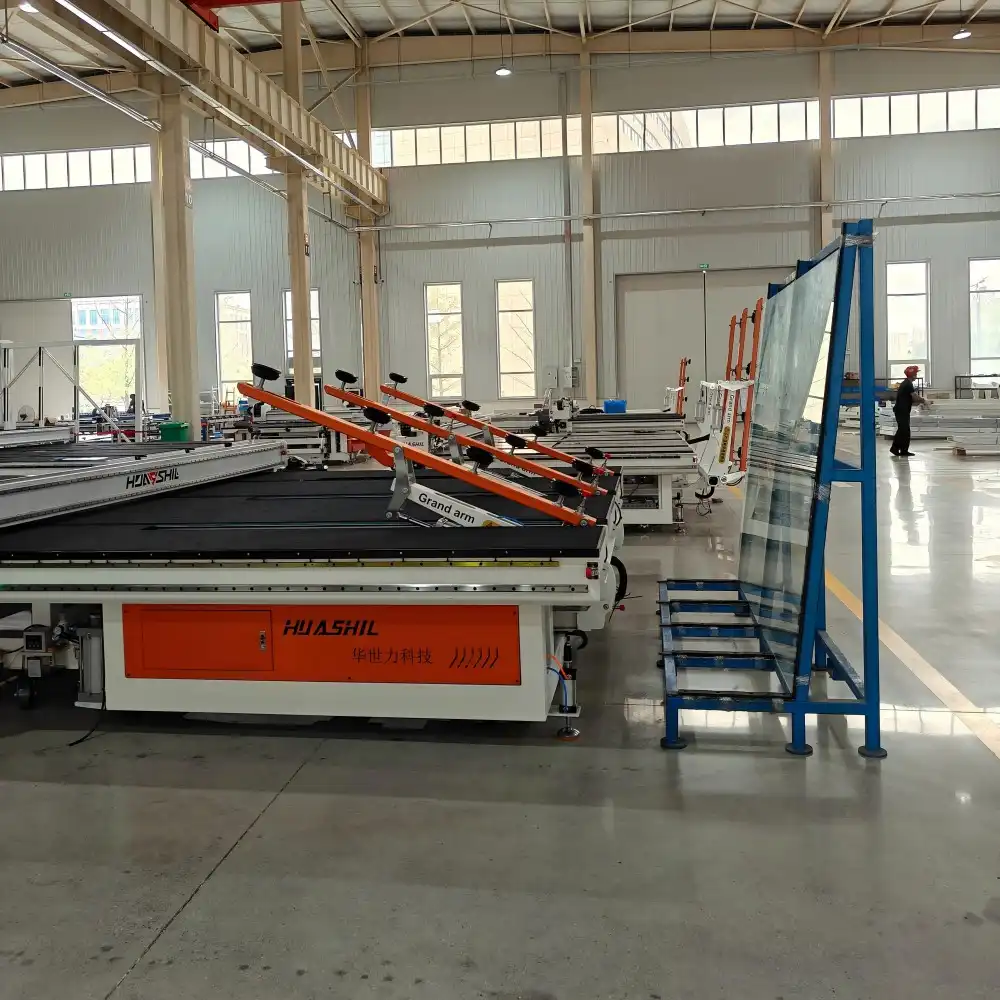
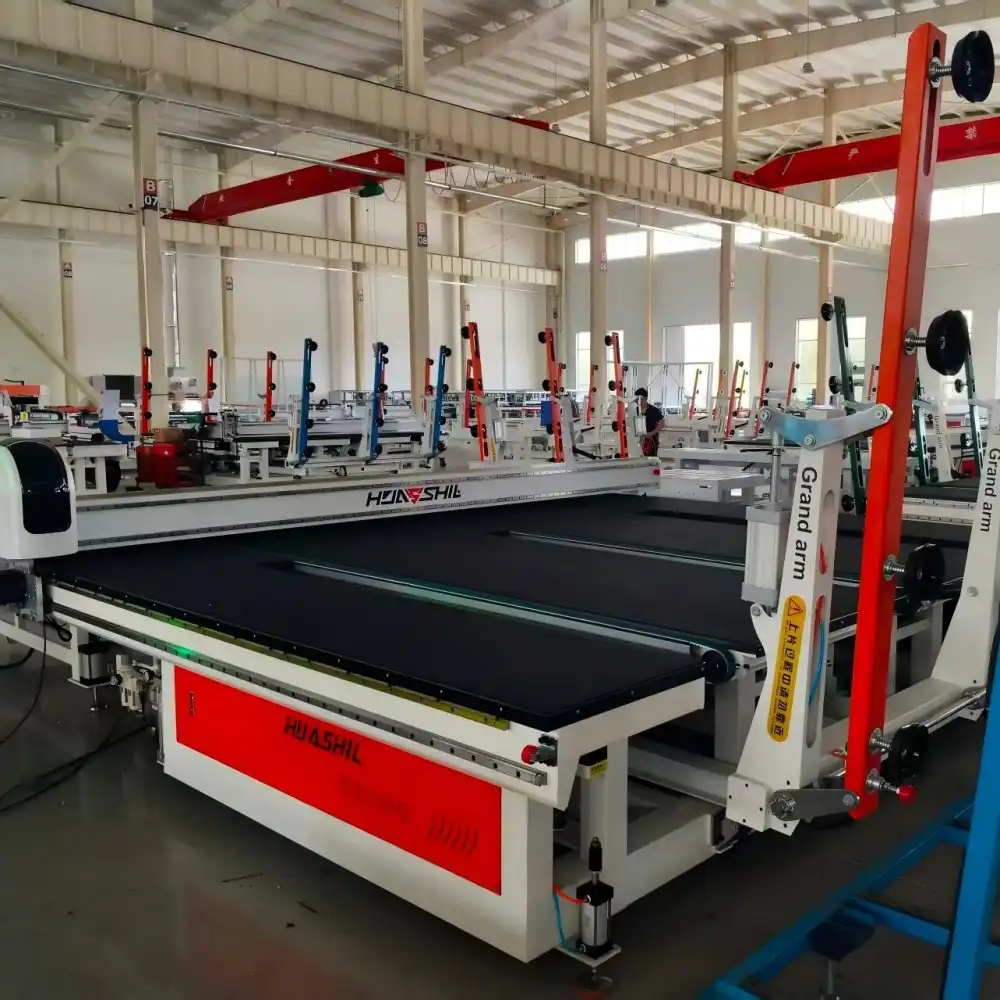
Computer Numerical Control systems operate large-scale operations most accurately and efficiently. Modern CNC platforms offer automated glass loading, pressure control, edge detection, and coordinated cutting operations. Complex designs with repeatability tolerances of less than 0.2 mm may be made on these machines for curtain walls and precision furniture items. This kind of machine can handle glass sheets up to 3660 × 2800 mm and 2–19 mm thick, such as the HUASHIL HSL-YTJ3829. In multi-step processes, its synchronous belt conveyors and air flotation technology maintain items in position and undamaged.
Laser and Waterjet Cutting Alternatives
Sometimes specialised jobs need laser or waterjet technology. Laser cuts can make precise designs in thin glass, but heat stress prevents them from cutting glass thicker than 6 mm. Waterjet systems can cut practically any glass thickness without hot spots, but they are too costly and sluggish for large production and only usable for tiny items. Rotary blade CNC systems are cheaper for stained glass window producers who prioritise production.
Technology choice depends on predicted production volume, design complexity, and operator experience. For factories that create conventional building glass, high-automation CNC systems work well, whereas laboratories that make custom glass may choose flexible semi-automated platforms.
How to Choose the Right Cutting Machine for Stained Glass Windows
When making choices about what to buy, it's important to make sure that the cutting machine for stained glass windows fits with how things actually work.
Production Volume and Throughput Requirements
Setting daily working goals in numbers sets the basic capacity needs. Manufacturers who work with more than 200 square meters of glass every day need automatic systems that can load glass continuously and have multiple cutting heads. The HSL-YTJ3829 has a 360-degree remote control walking feature that lets workers control the flow of materials without stopping production. This directly meets the needs of high-volume production. On the other hand, small fabricators who make 20 to 30 custom pieces a week might find that semi-automated bridge cutters are more cost-effective.
Precision Specifications and Quality Standards
To make sure that architectural glass installations fit correctly in metal frame systems, the tolerances must be within ±0.15mm. Automatic edge-finding technology in CNC machines makes up for changes in where materials are placed, so accuracy stays the same across production runs. When engineering teams look at specs, they should make sure of both the accuracy of static placement and the accuracy of dynamic cutting at full speed. Edge chipping in laminated or toughened glass is common in machines that don't have real-time pressure control. This causes rejection costs further down the line.
Versatility Across Glass Types and Thicknesses
It's important for fabricators who serve more than one market segment to be able to change how they make things. Different types of products, from 3 mm artistic panels to 19 mm safety glass for cars, can be made with equipment that can handle thickness ranges from 2 mm to 19 mm without having to change the tools. When combined with advanced cutting systems, the Optima optimization software figures out the best nested patterns to get the most material out of different projects, which directly improves profit performance.
Total Cost of Ownership Analysis
On top of the purchase price, operators must also think about the costs of installation, the time it takes to train new operators, upkeep plans, and the cost of replacement parts. Energy-efficient designs lower ongoing operating costs, which is especially important for plants that have more than one shift. Machines that are certified to CE and ISO9001 standards tend to have lower failure rates and make it easier to follow regulations in foreign markets, both of which affect the company's long-term profits.
Supplier Capability and Support Infrastructure
Manufacturer support communities play a role in how reliable the equipment is. Having direct ties with experienced manufacturers like HUASHIL makes it easier to get expert documents, spare parts, and help with fixing problems from afar. Purchasing managers should check the track records of suppliers at industry events like Glasstech exhibitions, where live demonstrations show how the cutting actually works in real production settings.
This organized way of evaluating lets people make choices that match the powers of tools with real operational needs, instead of over-specifying features that don't help much in real life.
Top Stained Glass Cutting Machines in 2026: Reviews and Comparisons
There is a clear separation in the current market for a cutting machine for stained glass windows between entry-level, mid-range, and premium industrial systems.
Industrial-Grade Automated Systems
The HUASHIL HSL-YTJ3829 satisfies contemporary industrial automation requirements with its many features. Its automated loading method eliminates the need to handle sheets up to 3660 x 2800 mm by hand, reducing labour hours and injury risk. The built-in breaking table accelerates scoring and separating without adjustments. Its 5780 x 4925 mm size suits most production floor designs and makes maintenance straightforward. Because of its adjustable pressure control algorithms that adjust the cutting force depending on material resistance, users report that the machine works with all types of glass.
Mid-Capacity Production Machines
Several companies make versions that are scaled down to handle 100 to 150 square meters per day. These usually have manual loading and automatic cutting processes that balance the cost of the machine with the time it saves the worker. Even tho they don't have as much throughput as flagship models, mid-tier machines work well for regional fabricators who work with local construction markets where project volumes change with the seasons. Some of the things that set them apart are how easy the software is to use (simpler interfaces mean less training time) and how easy it is to add automation in the future as production grows.
Budget-Conscious Entry Options
In the economy market, semi-automated bridge cuts start at about 30% of the cost of a premium system. These machines don't have as many robotic features as others, but they are accurate enough for less demanding tasks. This group has enough capabilities for fabricators who make normal rectangular cuts for replacing windows in homes. Manually loading and removing parts slows down the cycle time, which can be a problem when working with complicated shapes or meeting tight production schedules.
After-Sales Support Considerations
The longevity of equipment is strongly linked to the quality of manufacturer support. Companies that offer technical manuals in English, video libraries for troubleshooting, and quick email support show that they care about their customers' success after the sale. Most warranties last between 12 and 24 months, but for important parts like CNC controls and servo motors, you can get longer coverage. Logistics for spare parts are very important. Suppliers with US distribution centers can deliver parts within days instead of weeks, which cuts down on costly production downtime.
The premium segment is worth the extra money because it is more reliable, has more automation, and has a manufacturer support infrastructure that keeps production going.
Operational Best Practices: Using, Maintaining, and Troubleshooting Cutting Machines
To get the most out of a cutting machine for stained glass windows, you need to follow strict operational rules and do regular preventative maintenance.
Daily Operation Procedures
Operators should check air float system pressure before each shift to support the glass on the cutting table equally. Automatic edge-finding sensors are normally 50 mm from table edges, thus loading operations must put sheets within their ranges for proper material boundary detection. The layering algorithms in Optima software improve cut patterns, but operators should check proposed designs for issues like too many little leftovers that make transferring materials tougher. Walking features on remote controls ensure safe distances during automatic sequences, particularly with huge architectural panels.
Scheduled Maintenance Protocols
Cutting wheels should be checked once a week, and worn carbide wheels should be replaced before the quality of the edge gets worse. Synchronous belt tension directly affects how accurately the machine is placed; manufacturer-specified gauges are used for monthly checks to stop gradual drift. Linear guides and ball screws should be oiled according to the machinery instructions, which usually say to do it every 500 hours of use with approved oils that can handle glass particle contamination. Air filtration systems need to be cleaned every three months to keep them working well and keep the surface from getting scratched by debris that is recirculated.
Common Troubleshooting Solutions
Cutting depth that isn't consistent is often a sign of pressure calibration drift. Specification compliance is restored by testing automatic pressure control systems against known glass samples. If your cutting speed is too fast or too slow for the toughness of the glass, you may get edge chipping. For toughened glass, lowering the feed rates by 15-20% usually fixes the problem. If material positioning errors happen, glass dust usually clogs the edge-finding sensor. Cleaning it with compressed air fixes the accuracy of detection. When mechanical vibrations lower the quality of the cut, they are usually caused by worn guide bearings or loose table mounting bolts, which can both be fixed by systematically inspecting the machine.
Integration Into Production Workflows
Cutting tables should be next to edging and washing stations so that there is little movement between processes. Order fulfillment errors can be cut down by using barcode tracking systems that connect cut patterns to specific projects. Multiple workers should be trained on how to use the same piece of equipment as part of training programs. This way, there won't be any single-person dependencies that could cause schedule problems. Setting up clear ways for cutting operators to talk to stations further down the line makes sure that the flow of materials is coordinated to match the production rate.
These operational standards turn the power of equipment into consistent production performance. They protect financial investments by making equipment last longer and reducing unplanned downtime.
Where and How to Procure Stained Glass Cutting Machines: Smart Buying Tips
When making strategic sourcing choices for a cutting machine for stained glass windows, you have to weigh short-term price concerns against long-term practical ones.
Direct Manufacturer Relationships
Buying from well-known organisations like Shandong Huashil Automation Technology has several advantages. Direct communication simplifies technical specifics, customisation options, and delivery schedules without intermediaries. For installation and setup, manufacturers provide technical assistance and instruct operators in production-specific techniques. Direct sourcing generally includes complete warranty coverage and spare component supply chains, which are crucial for production operations. Attend trade exhibitions like Glasstech Asia to see tool quality, cutting demonstrations, and discuss terms with technical teams.
Evaluating Third-Party Distributors
Regional distributors are useful because they set up local service networks and can get emergency parts to you faster. When thinking about working with a distributor, check to see if they are authorized by the manufacturers and see how good their technical service is. When considering different types of equipment, distributors may give you unbiased help, but their incentives may sometimes lean toward higher-margin items. When you buy from a distributor instead of directly from the manufacturer, you may have more options for how to pay for things, and some distributors may offer financing options for equipment that make capital budgeting easier.
New Versus Refurbished Equipment Decisions
Because of limited funds, people sometimes have to think about buying used equipment. Even tho the prices may look good, buying used equipment comes with risks, such as an unrecorded working past, worn-out parts that are getting close to needing to be replaced, and old control systems that don't work with new software. For uses that are essential to output, new equipment with full guarantees is the best way to reduce risk. Refurbished machines may be good for backup or low-use tasks where some downtime is acceptable.
Customization and OEM Opportunities
Customized configurations that are made to fit the needs of a production line are helpful for large fabricators or system integrators. HUASHIL and other similar companies offer OEM partnerships that can meet specific size needs, handle materials in special ways, or connect to existing factory automation systems. Customization talks should happen early in the buying process, since changes to the engineering make delivery times 8 to 12 weeks longer than usual. When you buy a lot of units at once, you can save money and make sure that all of the sites have the same equipment. This makes training easier and keeping track of parts easier.
Negotiation and Contract Considerations
When purchasing from abroad, buyers must normally pay a 30% deposit when the order is approved and the remaining 70% before shipping. Letters of Credit, which cover both parties, enable this. Contracts should state acceptance criteria including accuracy, throughput, and software functioning. By explaining technical support response times, warranty claim processes, and replacement parts prices, operational misconceptions may be avoided. Logistics plans should include who clears customs, transports items inside the nation, and oversees installation. This uncertainty may increase expenses and project delays.
Effective procurement goes beyond price comparison. Supplier dependability, support infrastructure, and contractual safeguards ensure equipment integration and long-term operations.
Conclusion
To pick the correct stained glass window cutting machine for stained glass windows, assess technical skills against business reality and budget. Industrial CNC systems like the HUASHIL HSL-YTJ3829 provide architectural glass producers and high-volume manufacturers precision, speed, and reliability. Procurement teams benefit from systematic reviews of production demands, total ownership costs, and supplier support capabilities. Investing in modern cutting technology affects how effectively organisations manufacture things, utilise resources, and maintain product quality. These factors impact their competitiveness in glass manufacturing markets. Strategically purchasing from well-known firms with strong technical support networks preserves capital investments and manages production growth.
Frequently Asked Questions
1. What glass thickness can industrial cutting machines handle?
Most professional automated cutting systems can work with glass thicknesses from 2 mm for decorative panels to 19 mm for architectural safety glass without having to change the tools. The HUASHIL HSL-YTJ3829 works well across this whole range of thicknesses because it changes cutting power automatically based on the resistance of the material. When ordering equipment, manufacturers can tell you what kind of cutting head configurations are needed for specialty glass that is up to 25 mm thick.
2. How long does operator training take for automated systems?
To get good at using current CNC glass cuts, you usually need two to three days of hands-on training that covers things like loading materials, using software, and basic maintenance. Over two to four weeks of supervised production use, you learn how to use advanced optimization software and fix problems. Manufacturers usually give initial training when the equipment is installed, and users can get follow-up online help as they run into certain production situations.
3. What maintenance intervals do these machines require?
Daily checkups take about 15 minutes and check the state of the cutting wheels and the air system's pressure. Cleaning sensors and checking belt tension are weekly jobs that take 30 to 45 minutes. Full monthly maintenance, which includes lubrication and checking the calibration, usually takes two to three hours. Following these schedules keeps things running at their best and keeps production environments from having unexpected downtime.
Partner With HUASHIL for Your Glass Cutting Automation Needs
HUASHIL is ready to help you reach your goals for glass fabrication with cutting machines that have been tested and proven to work well. Our HSL-YTJ3829 model is designed to work in tough production environments because it automates everything from loading materials to precise cutting to controlled breaking. We know the technical needs and support standards of architectural glass plants, curtain wall integrators, and furniture fabricators across international markets because we are a cutting machine for stained glass windows producer with extensive export experience. Our engineering team can give you full technical specifications, an analysis of your output capacity, and customization advice that is unique to your needs. Email our sales team at salescathy@sdhuashil.com to talk about how our automated glass cutting systems can help you make more money, cut down on costs, and make sure that the quality of your products is always the same. We encourage plant managers and procurement professionals to look into partnership opportunities with us. These could include showing you how to use our equipment, visiting our factory, and getting full quotes that cover the whole scope of your project.
References
1. Anderson, M. (2023). Industrial Glass Processing Technology: Equipment Selection and Optimization Strategies. Manufacturing Engineering Press.
2. Chen, L., & Roberts, P. (2024). Automation in Architectural Glass Fabrication: Performance Metrics and ROI Analysis. Journal of Construction Materials Technology, 18(2), 112-128.
3. Glass Manufacturing Industry Association. (2023). Equipment Standards and Best Practices for Automated Glass Cutting Systems. Technical Publication Series No. 47.
4. Martinez, R. (2024). Precision Glass Cutting: Comparative Analysis of CNC Technologies. Advanced Manufacturing Review, 31(4), 203-219.
5. Thompson, J., & Wu, H. (2023). Total Cost of Ownership Models for Glass Processing Equipment. Industrial Equipment Economics Quarterly, 15(3), 78-94.
6. Wilson, S. (2024). Supply Chain Considerations in International Glass Machinery Procurement. Global Manufacturing Logistics Journal, 22(1), 45-62.