




If you manage a glass fabrication plant or run a window and curtain wall production line, you already know how costly mishandled or misplaced glass panels can be. The best intelligent glass storage system does more than hold glass—it tracks every panel in real time, positions each piece accurately for the next process, and delivers it to the right station without extra manual steps. For U.S. manufacturers looking to cut waste and raise throughput, understanding these features is the first step toward a smarter production floor.
What Is an Intelligent Glass Storage System?
Defining the Technology
In an intelligent glass storage system, mechanical storage racks, sensor arrays, and software controls work together to automatically handle glass panels from delivery to receipt. It gets rid of the need to sort and check each rack by hand, which slows down standard plants. It keeps track of each panel's size, thickness, and job order, and then it sends it automatically to the right slot.
How It Differs from Conventional Storage
With old-fashioned glass racks, workers have to remember where to find panels or use paper lists, which can cause scratches, breaks, and mistakes in the order of the panels. Every panel in a smart storage system has its own unique digital name. Sensors confirm where it is, and software guides recovery so that no one has to guess. A report from 2022 by the Glass Association of North America says that about 30% of glass breakage in plants is caused by people handling the glass by hand. Smart storage systems are designed to directly target this number.
Who Uses These Systems?
The main users are plants that make architectural glass, hollow door and window glass, and sintered stone panels. Curtain wall installers and furniture glass makers also use these systems to organize the steps needed to grind the edges, temper the glass, store the glass before it is hollowed out, and sort and match the films.
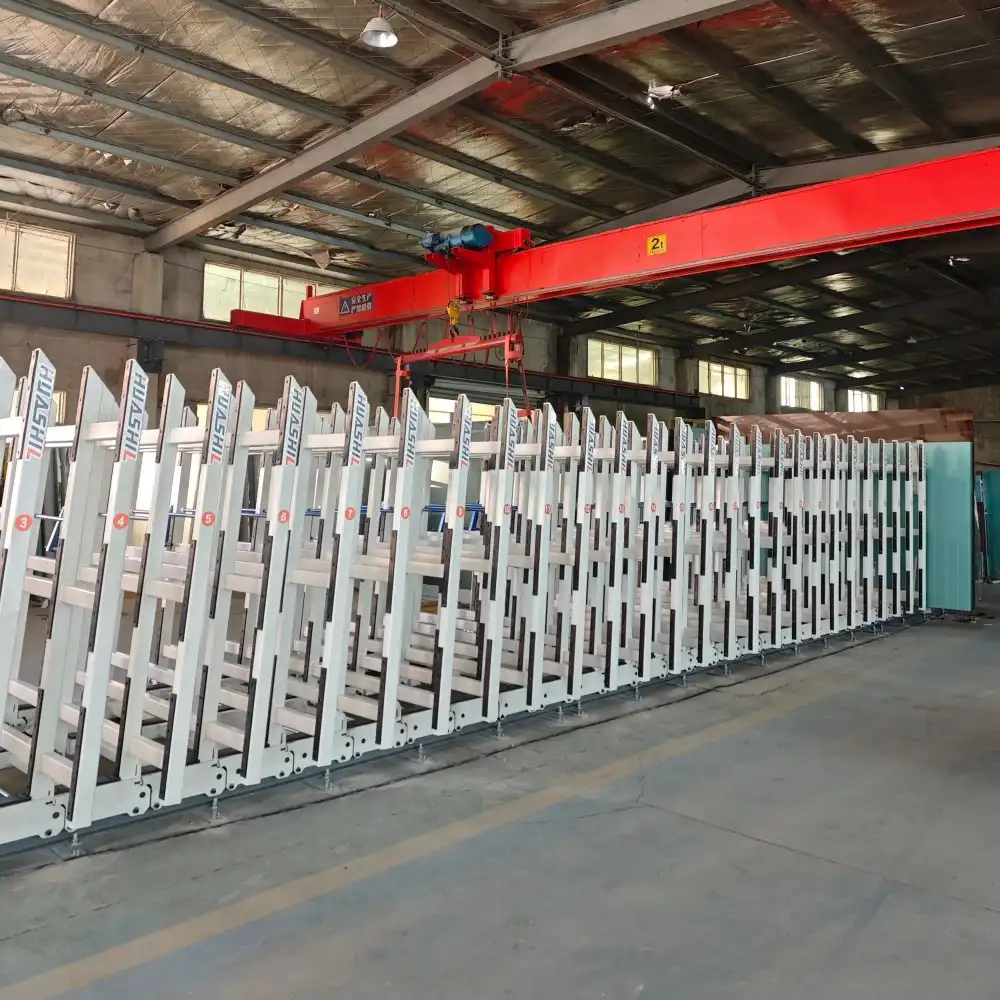
Top Features of the Best Intelligent Glass Storage Systems
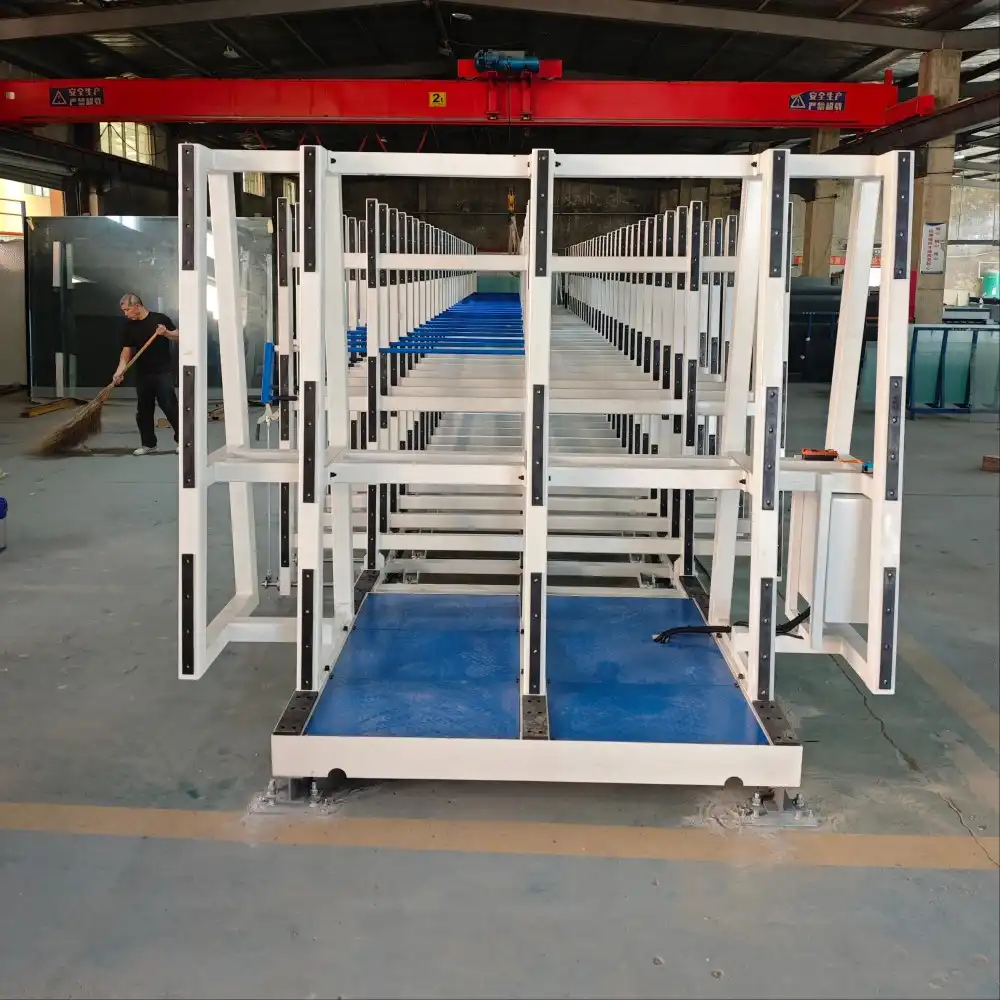
The best automatic glass storage system should be good at four main things: making the process easier to use, saving room, accurately placing items, and integrating the whole process. Here are the main things that make top systems different from simple rack-and-crane setups.
- Reduced Manual Handling Links: The whole system cuts the number of manual touch points between cutting and downstream processes such as edge grinding and tempering. Fewer handoffs mean fewer opportunities for scratches and breakage, directly improving yield rates on high-value laminated or low-e glass.
- Rapid Inspection and Accurate Positioning: Built-in sensors scan each panel upon entry, recording dimensions and defect flags. The intelligent glass storage system then assigns an exact rack slot, so retrieval is precise rather than approximate. This feature is especially valuable before hollow glass assembly, where panel sequence and cleanliness matter.
- Intelligent Classified Storage and Delivery: Panels are grouped by job order, glass type, or downstream process—whether that is film sorting, film matching, or tempering prep. When a workstation calls for a specific panel, the system retrieves and delivers it in the correct order, cutting wait time between process stages.
- Space Utilization Improvement: Vertical, high-density rack layouts replace sprawling flat storage, reducing the floor area occupied by semi-finished panels by a measurable margin. Plants running tight production schedules can reclaim floor space for additional processing equipment.
All of these parts work together to make a factory where glass goes through each step safely and regularly, with little help from the operator. It's easy to see the return on capital investment in the first year of operation when yield rates go up, and floor overcrowding goes down.
Comparing Smart Storage with Traditional Storage Solutions
A-frame racks or simple crane-and-sling systems are still used by many U.S. factories that make things. If the order isn't very complicated, these methods don't work. A factory that works with different kinds of glass—clear, tinted, laminated, and coated—needs a system that can keep track of and separate these products without workers having to remember.
Tracking is done automatically by smart storage systems. Because fewer people are needed to do actual sorting, labor costs go down. Breakage rates go down when handling things mechanically instead of by hand. The software keeps track of every move, which improves stock consistency and gives buying managers real data they can use to decide when to restock.
From the point of view of the total cost of ownership, the initial investment in equipment is balanced out by lower labor costs, fewer equipment breakdowns, and faster throughput. Automation usually makes the most financial sense for plants that work with architectural glass for curtain wall projects. This is because panels take a long time to make and cost a lot to repair.
Choosing the Right System for Your Production Line
Assess Your Glass Types and Process Flow
Start by making a list of the types of glass you work with and the processes that use those panels, such as film matching, edge grinding, tempering, and hollow assembly. For each step, the storage system has to put panels in the right order. When storage logic and process flow don't match up, problems are created instead of being solved.
Evaluate Capacity and Footprint Requirements
Find out how many semi-finished panels you have on hand at peak production. The intelligent glass storage system should be able to handle high loads without going over, and it should not take up too much space on your floor. Most of the time, high-density vertical configurations give you the most storage space for your money.
Verify Software Integration Capability
The program for managing storage should be able to connect to the ERP or production management tool you already have. Order data can flow straight into the storage system through this link. This means that panels can be prepared for delivery before the machine further downstream finishes its current task. Ask suppliers for information on the data interfaces and protocols that are supported.
Procurement Insights: Buying and Implementing a Glass Panel Storage System
Identify Qualified Suppliers Early
Look through business-to-business websites and trade show lists to find companies that make glass automation equipment and have installation examples that can be verified. Don't just ask for brochures; ask for detailed information as well. It is important for engineering managers to look at load ratings, cycle times, and software architecture before suggesting a supplier to procurement.
Understand Pricing Structure and Warranty Terms
Automatic glass storage system prices depend on the number of racks, the amount of automation, and the software that is included. Ask for quotes that break down the costs of mechanical parts, controls, installation, and training into separate items. Make sure that the warranty covers structural parts and software, and find out how long it takes to get spare parts. This is especially important for U.S. plants that can't afford to be down for long periods of time.
Plan Installation and Staff Training
Mistakes can be avoided by having the supplier's expert team install the system correctly. Before go-live, make a training plan for the workers and support staff. Systems with online troubleshooting help make it less likely that the system will be down for a long time after the installation team leaves.
Conclusion
Now, automated storage for intelligent glass storage system panels is not just a cool idea; it's a realistic way to deal with the growing complexity of glass manufacturing orders in the U.S. market. An intelligent storage system increases both yield and throughput by reducing the need for manual handling, making positioning more accurate, and organizing panels based on the needs of the process. The right system fits your workflow and grows with your output rate, no matter if your plant works with architectural glass, hollow window units, or specialty coated panels. Carefully evaluating features and picking a supplier with strong technical help are the first steps to a good implementation.
FAQ
1. What types of glass can an intelligent storage system handle?
Most automated glass storage systems accommodate flat glass panels used in architectural applications, hollow door and window units, laminated glass, and coated glass. Systems from experienced manufacturers can be configured for panel sizes and weights specific to your product mix, including oversized curtain wall panels.
2. How does the system support film sorting and matching?
The storage software assigns each panel a profile that includes coating type and film specification. When the film matching or lamination station calls for panels, the system retrieves them in the correct pairing sequence, eliminating manual sorting errors that cause costly mismatches.
3. Is maintenance demanding for these automated systems?
Routine maintenance covers sensor calibration, mechanical component inspection, and software updates. Most scheduled maintenance can be performed by in-house technical staff with supplier-provided documentation. Remote monitoring options allow the manufacturer's support team to detect anomalies before they cause failures.
4. Can the system integrate with existing ERP or MES platforms?
Yes. Leading glass storage system manufacturers provide data interface options that connect to common production management platforms. This allows order-driven sequencing, where the storage system stages the next job's panels automatically as the current job completes, reducing idle time between process steps.
5. What is the typical return on investment timeline?
ROI timelines vary by plant volume and current breakage rates. Plants processing high-value glass with frequent sorting requirements generally report measurable payback within 12 to 24 months, driven by reduced breakage, lower labor costs, and improved throughput consistency.
Ready to Upgrade Your Glass Storage? Contact HUASHIL for a Custom Solution
HUASHIL makes high-tech automation equipment and has a lot of experience sending smart glass storage systems to architectural glass plants, curtain wall installers, and furniture glass makers all over the world. Our systems take care of the whole process, from edge grinding and hardening prep to film matching and staging for hollow assemblies. This means that your production line can be precisely placed and delivered at all times. As a reliable provider of intelligent glass storage systems, we offer OEM and ODM configuration, technical documentation for engineers to look over, and clear business proposals for finance and procurement teams. Get in touch with us to talk about your plant's needs and get a quote. Please email salescathy@sdhuashil.com.
References
1. Glass Association of North America (GANA) — Glazing Manual, 2022 Edition.
2. Glass Industry Magazine — "Automation Trends in Flat Glass Processing," 2023.
3. International Journal of Advanced Manufacturing Technology — "Sensor-Based Inventory Management in Glass Fabrication," Vol. 118, 2022.
4. Buildings Journal (MDPI) — "Energy and Material Efficiency in Curtain Wall Production Systems," 2023.
5. Manufacturing Engineering Magazine — "Smart Storage Solutions for High-Mix Glass Production Lines," 2022.
6. Society of Manufacturing Engineers (SME) — Handbook of Industrial Automation, 2021 Edition.