




When evaluating glass cutting loading machine options for high-volume plants, the right choice directly affects throughput, labor cost, and product consistency. Automated loading systems eliminate manual handling errors, reduce cycle times, and integrate seamlessly into full processing lines. Whether you run an architectural glass fabrication plant, a curtain wall integrator, or a furniture glass operation, understanding the core differences between machine types—and knowing what specifications actually matter—puts you in a stronger position to invest wisely and scale confidently.
Understanding Glass Cutting Loading Machines in High-Volume Plants
A glass cutting loading machine moves and positions big sheets of glass onto cutting tables automatically. This saves time and reduces the risk of breaking the glass. In high-volume settings, this function is a must—handling by hand can't keep up with the cycle speeds that modern production needs.
Machine Categories You Should Know
The market is mostly made up of three types of systems: fully automatic, semi-automatic, and manual. Because the user has to tell the loader where to go, manual loaders can only be used for low-volume or specialized work. Semi-automatic systems help the user physically, but they still need help from a person at some points. Machines that load and cut glass automatically, like the HUASHIL HSL-LSX5133, do everything from picking up the sheet to breaking it out without any help from a person. This makes the process uniform and repeatable at high speeds.
The Glass Processing Equipment market study (Smithers, 2023) says that fully automatic lines can cut labor costs by up to 40% per unit compared to semi-automatic configurations. This makes the investment case strong for plants that handle more than 500 sheets per shift.
Comparing Manual, Automatic, and Robotic Glass Sheet Handling Systems
There are three things that determine whether to load by hand, automatically, or robotically: the throughput goal, the floor space needed, and the budget.
The lowest cost to start using is a manual system, but it can only handle a certain amount of work at once. Standard building sizes allow a trained person to handle between 80 and 100 sheets per hour without any problems. Cutting deviation happens when placement isn't uniform, which raises the amount of scrap and repair that need to be done later.
This gap is closed a lot by fully automatic machines. Here are the main changes in performance that you should look into:
- Manual loaders suit low-volume decorative or custom shops where batch sizes are small and glass dimensions change frequently. Labor dependency remains high, and fatigue-related errors accumulate over long shifts.
- Automatic CNC systems handle large-format sheets—up to 5100×3300mm on machines like the HSL-LSX5133—with programmable loading sequences, optimized nesting via software like Optima, and multi-station configurations that keep the cutting table continuously fed.
- Robotic loading arms offer the highest flexibility for irregular shapes and mixed-size batches. They work well alongside smart mirror and decorative glass lines where geometry changes are frequent, though their capital cost and integration complexity are notably higher.
These differences will help you figure out your ROI for a glass cutting loading machine. A fully automatic system with specialized loading, cutting, and breaking tables gives the best return for a plant that works with a lot of ornamental window glass. Robotic arms are better used when a variety of products is more of a problem than high throughput.
Selecting the Ideal Automated Glass Cutting Line for Your Plant
There is more to the decision process than just looking at spec sheets side by side. I've seen plants buy machines with fast advertized speeds only to find that the configuration didn't work with their floor plan or upstream rack system. These are the things that really matter when it comes to whether a machine works as planned in your building.
Production Capacity and Sheet Size
Equipment sizes are based on the largest glass sheet size you can use. If your business often works with big sizes for things like curtain wall panels or big windows for buildings, you need a machine that can handle those sizes right away. The HSL-LSX5133 can handle glass up to 5100x3300mm, which is big enough for most architectural and curtain wall uses in the U.S.
Station Configuration and Floor Integration
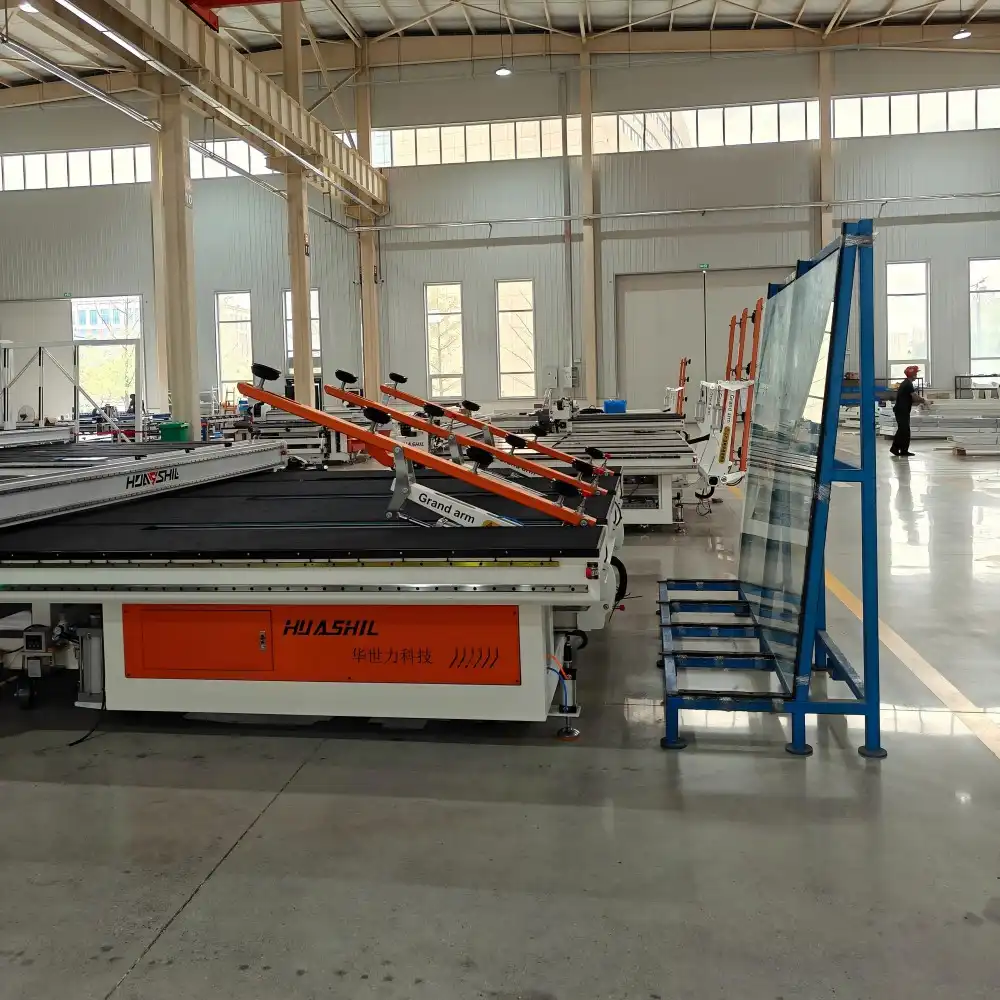
The HSL-LSX5133 has a 2+2 station setup that can be changed to fit your output schedule. The rail system comes in both above-ground and below-ground versions, which is useful for plants that already have floor infrastructure or don't have a lot of room. Each side has five suction arms for safe sheet transfer. The three-table setup (loading table, cutting table, and breaking table) keeps the flow of materials straight and cuts down on the amount of sheet handling that needs to be done between steps.
Software and Low-E Glass Compatibility
Cutting pattern packing is managed by optimization software like Optima to keep raw material waste to a minimum. In real life, better nesting on float glass cuts down on cullet by a measured amount per shift. One feature that stands out for U.S. buyers is the low-E deletion function. Low-emissivity coatings on energy-efficient glazing must be removed at the cut edge to make sure that insulated glass units seal properly. Adding this function to the cutting line gets rid of the need for a separate manual process and keeps the coating intact where it matters.
Maintenance, Common Issues, and Safety in Glass Processing Equipment
Regular repair for a glass cutting loading machine will tell you if your investment lasts as long as it's supposed to. The main reasons why automated glass lines break down that could have been avoided are lubrication points that aren't checked, suction cups that are worn out, and scoring wheels that aren't calibrated.
Practical Maintenance Priorities
Structured inspections should include checking the condition of the suction cups before each shift, the alignment of the rails once a week, the replacement of the scoring wheels based on the number of linear meters cut instead of the time on the calendar, and the calibration of the software every three months. Sensor mistakes, especially in sheet-detection systems, are often caused by glass dust building up on optical parts instead of hardware failure. Most of these problems can be fixed without having to call for help by cleaning the sensor housings regularly with compressed air.
Modern CNC glass loading machines have safety features like two-way emergency stops, guards around the loading arms, and light curtains at places where operators can access the machine. The basic requirement for equipment used in U.S. plants is that it must meet ANSI B11 machinery safety standards and OSHA general industry regulations.
Top Glass Cutting Loading Machine Options: HUASHIL HSL-LSX5133 Overview
The HUASHIL HSL-LSX5133 is the top of HUASHIL's line of automatic glass-making machines right now. Shandong Huashil Automation Technology Co., Ltd. is a high-tech company that designs and makes glass processing equipment and exports it all over the world. They have experience in the architectural, furniture, and curtain wall glass industries.
The HSL-LSX5133 is designed for plants that care most about uptime stability and sheet-size range. Its three-table system—loading, cutting, and breaking—works together to keep the working flow going smoothly, which cuts down on moving time between stations. The low-E deleting unit can handle coated glass without needing a separate workbench, and the Optima cutting optimization software makes sure that each sheet is nestled efficiently.
When engineering teams are looking at specifications, the 2+2 station layout with five suction arms on each side makes it easy to handle heavy jumbo sheets, and the above/below-ground rail option makes it easier to integrate into both new-build and retrofit line projects. Plants that have adopted this model say that they have cut down on the number of steps that need to be done by hand and can cut big architectural pieces more accurately.
Conclusion
To choose the best glass cutting loading machine, glass sheet loading and cutting system for a high-volume plant, you need to be honest about your throughput goals, the range of sheet sizes you need to work with, the layout of your floor, and the total cost of ownership. There are times when manual systems are useful, but fully automatic CNC lines give architectural, curtain wall, and large-format furniture glass operations the consistency and output volume they need. With its three-table layout, Optima software, low-E deletion feature, and adaptable station setup, the HUASHIL HSL-LSX5133 meets the realistic needs of demanding production settings without adding extra complexity.
FAQ
1. Is a fully automatic glass cutting loading machine suitable for plants with frequent size changes?
Yes. Machines like the HSL-LSX5133 that have programmable CNC controls and optimization software like Optima can change sizes without having to physically rearrange themselves. Instead, they do it by making changes to the software. Because of this, plants that make both building and artistic glass can use them during the same shift.
2. What maintenance routine keeps automatic glass loading machines running reliably?
The main tasks are to check the sticky cups every day, the rails once a week, and the score wheels every so often based on usage meters. Most unplanned stops can be avoided by calibrating the software every three months and cleaning the sensors during each maintenance cycle.
3. Does the HSL-LSX5133 support low-E coated glass processing?
Yes. As part of the cutting process, the built-in low-E deletion function removes the coating from the cut edges. This means that there is no need for a separate deletion step that has to be done by hand, and the edge quality is kept for the insulated glass unit assembly.
4. What glass sizes does the HSL-LSX5133 handle?
Glass sheets up to 5100 x 3300 mm can fit in the machine. It can handle standard jumbo and oversize formats used in architectural glazing, curtain wall panels, and large furniture glass applications.
Connect with HUASHIL for a Custom Glass Cutting Line Consultation
HUASHIL offers automatic glass processing systems that have been tested and are designed to handle large amounts of output. As a reputable company that makes glass cutting loading machines, we offer detailed paperwork, factory tours, and a range of flexible payment terms, such as L/C for orders from outside of China. You can email our team at salescathy@sdhuashil.com to get specifications, installation case studies, or a quote that is specifically made for your plant's needs.
References
1. Smithers. Glass Processing Equipment Market Report. Smithers Apex, 2023.
2. Glass International. Automation Trends in Flat Glass Processing. Quartz Business Media, 2022.
3. Pilkington. Technical Guide to Low-Emissivity Glass Processing. NSG Group, 2021.
4. American National Standards Institute. ANSI B11 Safety Standard for Machinery. ANSI, 2022.
5. Freedonia Group. World Flat Glass Demand and Equipment Forecast. Freedonia Group, 2023.
6. Glass Machinery Plants & Accessories (GMPA). CNC Cutting Line Technology Review. GIMAV, 2022.