




Across glass fabrication plants in the United States, labor costs consistently rank among the highest operational burdens. A fast speed glass cutting machine directly addresses this challenge by automating repetitive, skill-intensive cutting tasks that previously required multiple trained operators. When automated glass cutting equipment handles scoring, breaking, and material conveyance with minimal human intervention, plants experience measurable reductions in headcount requirements, overtime spending, and error-related rework. For plant managers and production directors evaluating capital investments, the labor savings alone often justify the equipment cost within the first two years of operation.
Understanding the Challenge: Labor Costs in Glass Cutting Operations
In the U.S., glass processing plants rely on trained workers to keep cutting lines running smoothly. Cutting glass by hand requires accuracy, physical endurance, and constant attention. All of these things directly lead to higher wages, training costs, and the risk of getting hurt on the job.
Why Manual Processes Are Costly
Three to five operators are needed per shift on traditional cutting lines to load materials, score, break, and check for quality. The U.S. Bureau of Labor Statistics says that the typical hourly wage for people who work with glass and glazing is more than $22. Plants with two or three shifts make these costs even higher. In addition to pay, handling things by hand raises the number of breaks and scrap losses, which further cuts into profits. Any plant that is still using old-fashioned methods is paying more for less output and more operational risk.
How Fast Speed Glass Cutting Machines Revolutionize Glass Cutting
Modern automatic glass cutting systems use CNC control, air float transport, and precise scoring technology to change the way a lean production line looks. These tools don't just cut things faster; they change the way work is organized on the shop floor in a fundamental way.
Key Capabilities of the HUASHIL HSL-YTJ3826
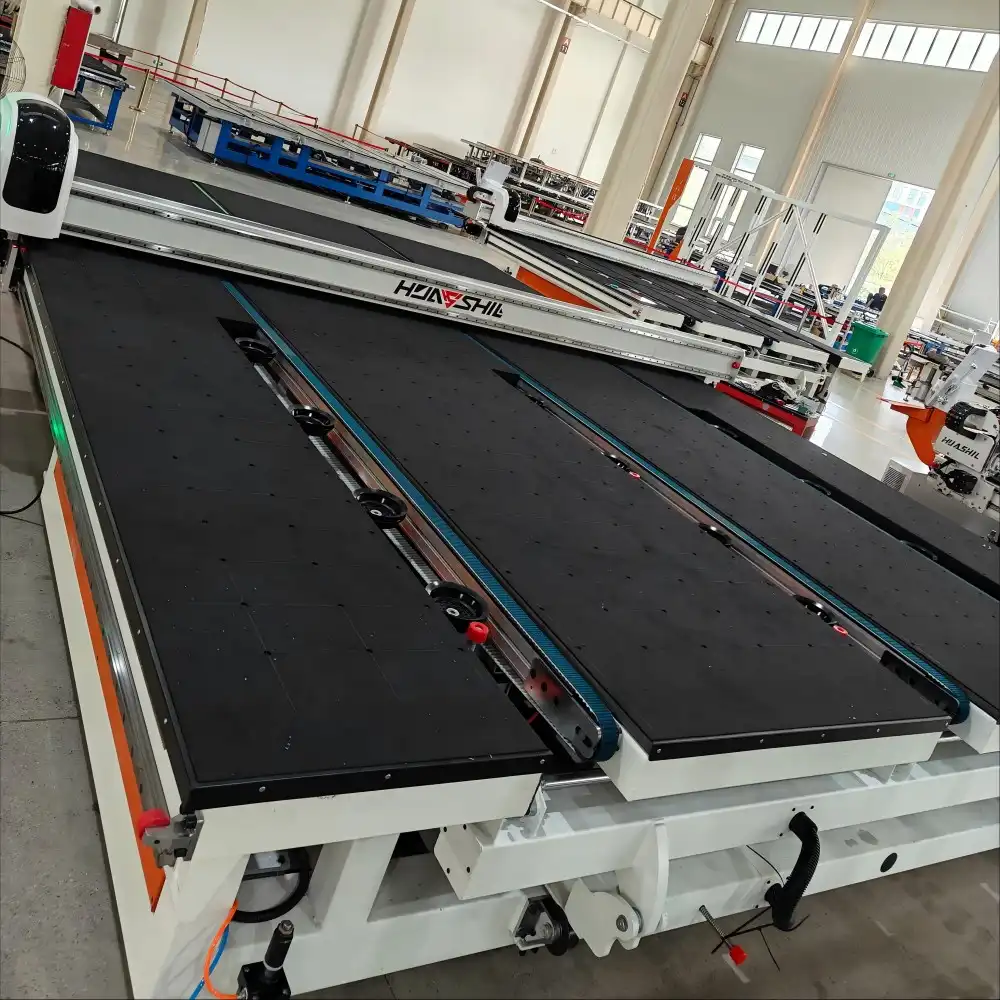
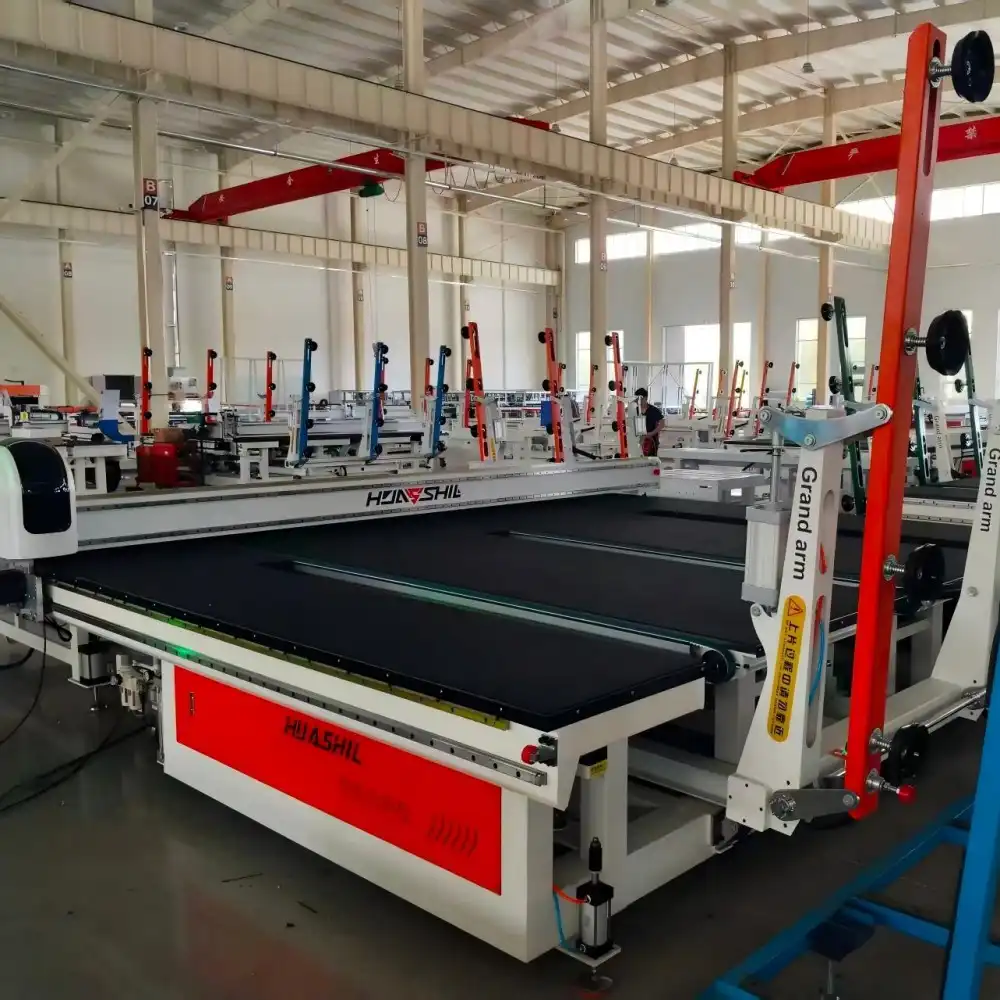
The fast speed glass cutting machine HSL-YTJ3826 was made by Shandong Huashil Automation Technology Co., Ltd. to cut a lot of architectural, furniture, and curtain wall glass. Here are the main technology features that make this model stand out:
- Automatic loading and edge finding: The machine independently locates glass edges and initiates the cutting sequence without manual positioning, eliminating the need for a dedicated setup operator.
- Automatic pressure control: Cutting pressure adjusts dynamically based on glass thickness (2–19 mm), reducing scoring errors and material waste without operator intervention.
- Air flotation system with breaking table: Glass sheets float on an air cushion during conveyance, reducing surface contact damage and allowing smooth, consistent material flow from the cutting bridge to the breaking section.
- 360-degree remote control walking: The operator controls the full cutting bridge remotely, removing the need for direct physical proximity during active cutting cycles.
- Synchronous belt glass conveying: Precision belt conveyance maintains consistent positioning across the full 3,660 × 2,440 mm cutting table, supporting high-throughput production without positional drift.
- Optima optimization software: The integrated Optima layout software maximizes yield from each glass sheet, reducing off-cuts and minimizing the calculation time that previously required a dedicated planning technician.
Automatic loading and finding of edges: The machine finds the edges of the glass on its own and starts the cutting sequence without any manual positioning. This means that it doesn't need a separate operator to set it up.
Because of these features, the number of active operators per shift drops from the normal three to five to one or two, depending on how the lines are set up. The HSL-YTJ3826 has CE and ISO 9001 certifications, which show that it was made according to strict standards that buying teams and plant engineers can trust when evaluating suppliers.
Direct Impact on Labor Costs: Efficiency, Accuracy, and Safety Improvements
When you install an automatic glass cutting line, you save money on labor costs in three different areas of operation: processing speed, cutting accuracy, and safety in the workplace.
Throughput and Accuracy Gains
Automated cutting processes are much faster than human ones. A two-person manual station might make 80–100 cuts per shift, but an automated line with CNC-driven scoring can keep up a steady output well above that level without any changes caused by fatigue. Cutting more accurately cuts down on repairs and quality holds, which take time from operators and don't add value to the production.
Safety and Compensation Cost Reduction
Automation keeps workers from coming into direct contact with glass edges and cutting tools, which lowers the risk of cuts and strains. In the U.S. industrial sector, injuries at work in the glass and glazing industry cause costs such as hospital bills, OSHA reports, and lost work time. Keeping operators out of busy cutting zones lowers their risk and the costs of insurance and benefits that come with it.
Comparative Analysis: Automated Glass Cutting vs. Traditional Methods
Lifecycle cost comparisons by production leaders and financial teams always show that automatic fast speed glass cutting machine equipment has a lower total cost of ownership than long-term manual operations.
A normal hand-cutting line has ongoing costs like salaries, training for new employees, waste from wrong cuts, and downtime due to mistakes made by people. With an automated line, most of the costs are incurred during the purchase and initial installation phases. After that, ongoing costs become much more stable. Studies in the economics of manufacturing automation show that in medium- to high-volume production settings, capital equipment that replaces repetitive human jobs usually pays for itself within 18 to 36 months.
The HSL-YTJ3826's Optima software integration gives it a measurable yield edge. The software lowers the amount of raw materials needed for each order by computationally optimizing cut plans before production starts. This saves a lot of money over the course of a busy manufacturing plant's year. Less material loss means that operators don't have to spend as much time dealing with scrap and arranging new sheets.
Procurement Considerations: Selecting and Implementing the Right Automated Cutting Line
There's more to choosing a seller for a glass cutting machine than just checking the specs on a datasheet. Along with technical success, plant managers and procurement officials need to look at the long-term support system.
What to Evaluate Before Purchase
Before making a final decision about a buy, hiring teams should look at a few important areas:
- After-sales support and spare parts lead time: Automation equipment downtime without available spare parts can quickly offset months of labor savings. Confirm that the supplier maintains an accessible parts inventory and documented support channels.
- Certification and compliance: CE and ISO 9001 certifications, as held by HUASHIL's HSL-YTJ3826, confirm that the machine meets internationally recognized safety and quality management standards — essential for U.S. facilities with OSHA compliance obligations.
- Customization and OEM capability: Curtain wall integrators and furniture glass producers with non-standard sheet sizes or cutting patterns benefit from suppliers offering configurable line setups rather than fixed configurations.
- Installation and operator training: A phased installation plan with hands-on operator training reduces the transition period and maintains production continuity during line changeover.
These evaluation criteria help procurement teams avoid common mistakes when sourcing and make sure they invest in equipment that will lower labor costs over a long period of time.
Conclusion
In the glass industry, labor costs are not set; they change based on how much technology is used on the production floor. Automated glass cutting tools like the fast speed glass cutting machine HUASHIL HSL-YTJ3826 replace labor-intensive manual processes with exact, consistent machine performance. This cuts down on the need for extra workers, reduces the amount of work that needs to be redone, and lowers the risk of injuries on the job. When plant managers are thinking about what equipment to buy, the data consistently show that automation is the best way to keep labor costs low. The upfront investment in capital will lead to measured, ongoing savings that will improve the plant's finances every year.
Frequently Asked Questions
1. What glass thicknesses can the HSL-YTJ3826 handle?
The HSL-YTJ3826 processes glass ranging from 2 mm to 19 mm in thickness, covering the full range used in architectural glazing, furniture glass, shower enclosures, and curtain wall panels.
2. How many operators does an automated glass cutting line require?
Depending on the line configuration and production volume, most automated cutting lines require one to two operators per shift, compared to three to five operators typically needed for equivalent manual output.
3. What is the lead time for equipment delivery?
Lead times vary based on order specifications and customization requirements. Buyers seeking full production line configurations should initiate discussions early, as complex projects typically involve a 3–6 month procurement and delivery cycle.
4. Is the HSL-YTJ3826 suitable for sintered stone cutting as well?
HUASHIL also manufactures sintered stone and artificial stone cutting and edging machines. If your production facility handles both glass and sintered stone, the team can advise on the appropriate equipment configuration for your application.
Get a Direct Quote from HUASHIL — Fast Speed Glass Cutting Machine Supplier
HUASHIL makes automated glass cutting equipment that fabrication plants on six continents trust. For sale is the HSL-YTJ3826 fast speed glass cutting machine, which is CE-certified, reliable, comes with Optima software optimization, and comes with full after-sales support. You can contact the HUASHIL team at salescathy@sdhuashil.com to get technical information, help setting up a line, or a business proposal that is tailored to your plant's output goals.
References
1. U.S. Bureau of Labor Statistics — Occupational Employment and Wage Statistics: Glass and Glazing Workers, 2023.
2. McKinsey Global Institute — A Future That Works: Automation, Employment, and Productivity, 2017.
3. Glass Magazine — State of the Industry: Fabrication Technology Trends, 2022.
4. International Journal of Advanced Manufacturing Technology — CNC Automation in Flat Glass Processing: Productivity and Cost Analysis, 2021.
5. Manufacturing Engineering Magazine — Total Cost of Ownership in Capital Equipment Investment, 2020.
6. Occupational Safety and Health Administration (OSHA) — Glass and Glazing Industry Safety Guidelines and Incident Cost Data, 2022.