




A small CNC glass cutting machine can fit into a 200 m² workshop (about 2,150 square feet) if you plan the whole operating area, not only the machine body. The HUASHIL HSL-CNC2721 measures 3660*3185 mm, roughly 11.7 m², or under 6% of the floor. The rest of the space must hold raw-glass storage, loading, operator access, breakout, inspection, and dispatch. In this guide, I explain how I would divide the floor, check specifications, plan safe handling, and estimate total cost.
Plan the 200 m² Workshop Layout Before You Buy
Divide the Floor Into Production Zones
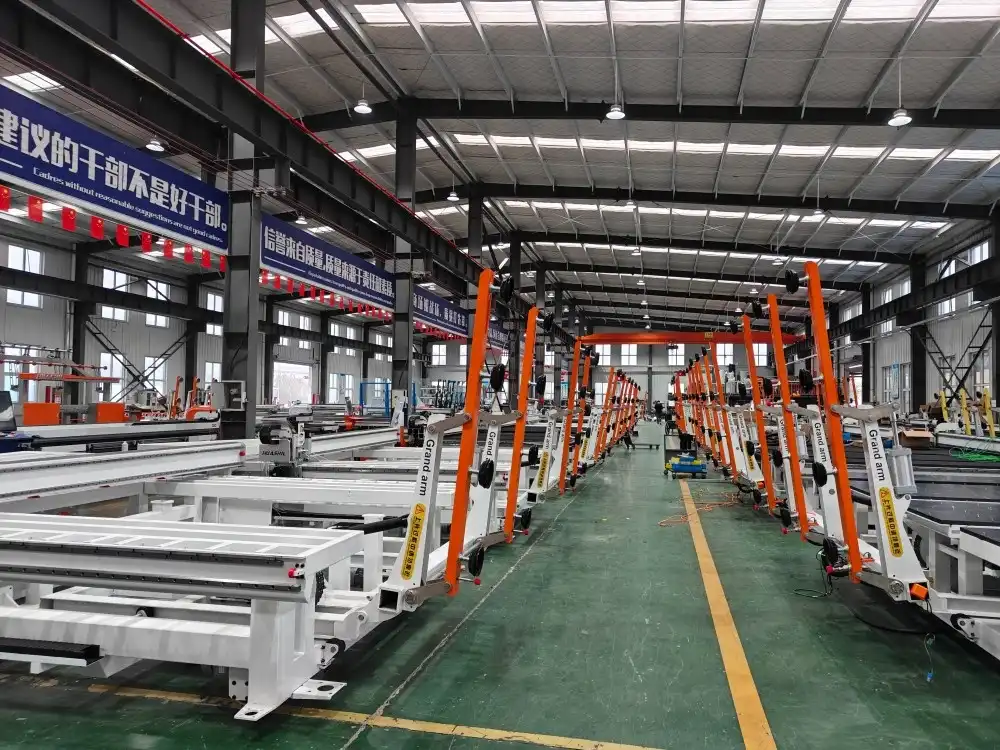
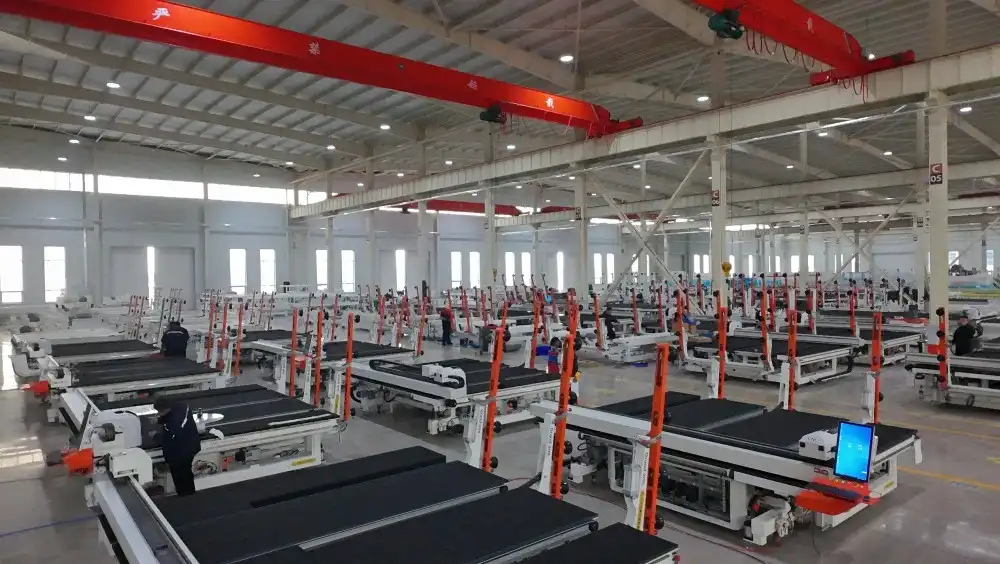
For starters, I start with getting and storing raw glass, then I cut and break it out, check it, do some extra processing, pack it up, and send it. Put the cutter away and work further down the line because every extra move makes it more likely to break. The next step is usually done by shops that make shower walls and doors. People who make windows can keep adjusting. Draw each area on a scaled drawing before you put the machine away. Moving a line on paper doesn't cost anything, but moving a base does.
Count the Full Operating Envelope
The machine fits in a space that's 3660 mm x 3185 mm, but you also need room around it. Make sure there is enough space to load sheets up to 2700 mm x 2100 mm, move the operator and the trolley, and give the worker access to the cutting head and the power cabinet. Find out how wide the doors are and how high the roof is before the delivery. People often only measure the body of a machine when they buy one, only to find that a rack is in the way. Lay the real envelope on the ground and pass a full-size sheet through it.
Follow a One-Direction Material Flow
The cutter should be in the middle, the vertical racks next to the loading side, and receiving should be close to the main door. Breakout and inspection should happen right after the cutter. They go in order after being cut, cleaned, packed, and sent. It's easier for people and carts to walk when there is only one-way flow. After some time, you can add new tools by leaving a strip open. Also, make sure there is space at all of the emergency exits.
Match the HSL-CNC2721 Specifications to Your Orders
Check Size, Thickness, and Footprint
First, look at the numbers. The HSL-CNC2721 can cut glass up to 2700 mm x 2100 mm and has a cutting width of 2 to 19 mm. The machine is 3660 mm long and 3185 mm wide. Put these limits next to the jobs you do most often, like shower door panels, tabletop blanks, partition glass, or window lites. A bigger line might help you if you cut a lot of big sheets. A small machine will leave a small mark if most of your work is in this range.
Review the Automatic Functions
Automatic pressure control, automatic edge finding, an air floating system, and the ability to walk in all 360 degrees can all be done by remote control on the HSL-CNC2721. Automatic pressure control keeps the cutting pressure steady and helps keep the score lines straight. The edge of the sheet is found automatically, so workers don't have to spend as much time setting up the glass. With air float, the glass can move around on the table while it is being set up. Before the quote stage, show your engineering manager a video of a demo that shows how each feature works.
Verify Software and Certificates
The small CNC glass cutting machine is equipped with Optima software, which, according to HUASHIL's product page, supports glass shape scanning, automatic cutting pattern optimization, and raw glass inventory management. The product information also displays CE and ISO 9001 certification marks, although buyers should verify the relevant documentation and its applicability to the specific machine. For workshops planning installation in the United States, it is advisable to consult qualified technical professionals and local inspectors regarding electrical requirements, compressed air supply, and necessary compliance documentation. Since CE marking relates to European regulatory requirements, it does not automatically establish compliance with applicable U.S. codes and standards. Buyers should request detailed technical drawings, installation manuals, and utility specifications early in the purchasing process so that procurement, engineering, facility management, and finance teams can evaluate the same information before approving the investment.
Compare Cutting Technology Options for a Compact Shop
Manual Cutting vs. CNC Cutting
Some easy squares can be cut out by hand for less money. Cutting with a CNC machine makes things more consistent, speeds up programming, and lowers the chance of measuring wrong. In furniture glass, shower doors, and mixed special orders, these wins often show up as fewer hours of work and less waste. Even if your shop only cuts a few sheets a day, you should still be honest when you get prices. What's best depends on how often shaped glass is ordered, how skilled the operator is, and how much glass is ordered every day.
Compact Machine vs. Larger Line
A small machine costs less and takes up less floor space than a fully automated line. Capacity is what you give up. The HSL-CNC2721 can cut sheets up to 2700 mm x 2100 mm, but it's not great for cutting big plates. Bigger lines make sense when the amount or size of the sheet goes up. Because HUASHIL also does OEM and ODM work, customers who are growing can talk about how to get custom equipment later on instead of buying a new machine that doesn't fit.
Mechanical CNC vs. Waterjet
As the heading says, waterjet cutting can be used on a lot of different materials and forms. However, it needs a water source, filtering, regular pump upkeep, and the ability to work with slurry. There is extra work to do because that equipment is on the floor of a 200 m² shop. If you don't have water, a Small CNC Glass Cutting Machine that scans itself can cut flat glass into both straight lines and curves. You can get away with smaller metal CNC cuts if most of your work is on 2–19 mm thick flat glass.
Design the Workflow Around Safety and Productivity
Store and Move Glass Safely
Heavy glass that can break needs a stable place to be kept. Use clear signs, vertical or A-frame racks, vacuum lifts, or other lifting aids to keep your things safe. I make all glass shops follow the materials handling guidelines from OSHA. It tells us how to safely move and store things. Set aside separate paths for people and carts. Don’t move the racks around the shop. Instead, keep them close to the side where people load. Make sure the guards, emergency stops, and electrical safety meet NFPA 79 and any neighborhood rules before you make the first cut.
Use Software to Cut Waste and Setup Time
The productivity of a small CNC glass cutting machine depends on more than cutting speed alone. Production delays can also result from manual measurement, inefficient software workflows, and poor offcut management. When using Optima software, operators can enter glass dimensions into a computer, allowing the system to generate optimized cutting layouts and corresponding processing data. Automatic edge detection can further reduce the need for manual positioning and improve workflow efficiency. To evaluate overall performance, manufacturers should monitor key indicators each week, including the number of glass sheets processed per shift, material utilization rates, glass breakage, rework frequency, and equipment downtime. These metrics help plant managers assess whether the cutting layout and production process are operating efficiently while providing useful data to support future equipment investment decisions.
Reserve Maintenance Access
When you're making plans, it's simple to forget about service access. Leave space around the cutting head, drives, guides, pneumatic parts, and control cabinet so the technician doesn't have to move the racks. Labeled shelves should be kept close to the machine for parts that wear out quickly. Every day, do a quick check of the air supply, oil level, cutting pressure, and emergency stops. Routines that are written down make it easier for new workers to learn quickly and fix things more quickly.
Estimate Total Cost and Choose the Right Supplier
Budget Beyond the Quoted Price
A quote doesn't tell you the full price. You also have to pay for shipping, insurance, taxes, duties, electricity preparation, compressed air, lifting tools, setup, training, spare parts, and maintenance. Then think about how much stuff you want to get done faster, with less waste and mistakes, and with more output. Two common ways to pay are the down payment and the final payment. For sales in other countries, a Letter of Credit is used. I think you should ask all of the suppliers for the same line items so that the finance team has a clear picture of the total landed cost.
Ask for Documents Before You Decide
Plans, instructions, and drawings are what engineers need. When you buy something, you need to know when it will be delivered, what the warranty covers, and how long you'll have to wait for replacement parts. Ask for installation guides, training videos, and, if possible, a tour of the plant or a demo at a trade show. Shandong Huashil Automation Technology Co., Ltd. thinks up new mechanical tools, makes them, and sells them. It's been a long time since they made and sent goods abroad. It might take a few weeks to get approval for a single machine, but it might take three to six months for the whole line.
Use a Final Buying Checklist
Before you place an order, look over three sets of requirements. To make sure it fits, measure the workshop's length, width, height, depth, load capacity, utilities, and exits. Make sure the fit is right by checking the software, example data, sheet size, thickness, type of glass, and software. For business fit, find out about shipping, installation, training, warranty, and customer service after the sale. Send these details along with the floor drawing you made. Then the service provider won't have to guess if the machine will fit in your room.
Conclusion
A 200 m² workshop isn't big enough for a small CNC glass cutting machine. You need to think about more than just the size. The HSL-CNC2721 takes up less than 6% of the floor space, but how well it fits depends on things like how much space there is for storage, loading, and repair. It comes in sheets that are 2700 mm x 2100 mm in size, and they are 2 mm to 19 mm thick. These have to match real orders. A CNC machine cuts more consistently than a person, and it doesn't need the water infrastructure that waterjet systems do. Software, safety planning, and making it easy to keep track of performance all help to keep output steady. Deliveries, setup, training, and spare parts are all included in the price, and seller papers make it simple to find the best deal.
FAQ
1. Can a Small CNC Glass Cutting Machine fit in a 200 m² workshop?
Yes, as long as you plan the whole area where you'll work. The HSL-CNC2721 takes up about 11.7 m² of space based on its size. Still, you need to leave room for packing, storing, paths, service access, and getting out.
2. What glass size and thickness can the HSL-CNC2721 cut?
It can cut glass that is up to 2700 mm x 2100 mm and 2 mm thick up to 19 mm thick. To be sure of what kind of glass you're getting, either ask the supplier or cut a piece.
3. What should I send for a quotation?
Send measurements of the workshop, the entrance, the layout, the types of glass, the range of thicknesses, the volume that is expected, the voltage in the area, and the place where the glass is going. That way, the service provider can make sure it fits well and set a fair price.
Request a Workshop-Fit Quote for Your Small CNC Glass Cutting Machine
Send HUASHIL an email at salescathy@sdhuashil.com with your floor plan, door sizes, glass types, and monthly volume. We look at the HSL-CNC2721 and your room to figure out the best way to set it up because we make small CNC glass cutting machines. Afterward, we give you a quote that covers delivery, training, spare parts, and a promise.
References
1. Materials Handling and Storage (OSHA Publication 2236), 2002
2. Safeguarding Equipment and Protecting Employees from Amputations (OSHA Publication 3170), 2002
3. NFPA 79: Electrical Standard for Industrial Machinery, 2021
4. ISO 9001: Quality Management Systems – Requirements, 2015
5. ANSI Z97.1: American National Standard for Safety Glazing Materials Used in Buildings, 2015
6. Directive 2006/42/EC on Machinery (European Parliament and Council), 2006