




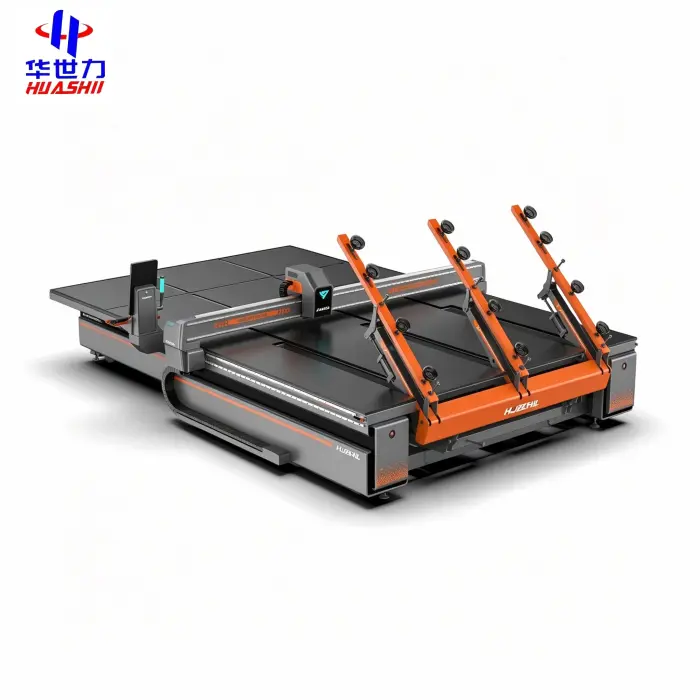
A mobile glass cutter machine automates the measuring, positioning, scoring, and breaking of flat glass, so your team spends less time on manual layout and more time on finished panels. Unlike handheld tools, it follows a digital cutting file and repeats the same motion on every sheet. Our HSL-LSX6133 handles glass up to 6100 × 3300 mm and uses three tables for loading, cutting, and breaking. I wrote this guide for plant managers, engineers, and buyers in the United States who want to understand how automated glass cutting works and what to check before they buy.
How a Mobile Glass Cutter Machine Works
What Automated Glass Cutting Includes
The score-and-break approach is the one that is used when cutting flat glass. You may cut the sheet along that narrow line by applying pressure on it with a sharp wheel and then cutting along that line. A mobile glass cutting machine is responsible for carrying out the tasks that must be completed before that can take place. Putting the paper on the machine, aligning it, cutting it following a digital file, scoring it, and breaking it are all things that it does.
Because the straightedge, the tape measure, and the person cutting by hand all play a part, the outcome is different for each individual as a consequence of these factors. The dimensions of the first panel are taken from a file, and as a result, the tenth panel is able to accommodate the first panel. It functions most effectively in establishments that specialise in the production of bespoke items such as shower doors, walls, and mirrors. If there are fewer variances in size, then there will be fewer instances of customers complaining and requesting remakes.
Cutting Versus Breaking, Edging, and Tempering
It is not the final thing that needs to be done, but rather the first thing that has to be done as well. When a goal is scored, the sheet is allowed to be broken. Following that, you will be required to end, polish, and drill the material. Either the paper will be laminated or tempered as the following phase in the process.
Due to the fact that heat-toughened glass makes it impossible to cut, this sequence is of utmost significance. It disintegrates into pieces. ANSI Z97.1 outlines the requirements that must be met by safety glazing that is installed in buildings, while ASTM C1048 discusses flat glass that has been heated from the inside out. Before placing the glass in the furnace, I usually advise those who purchase it to inspect the holes, diameters, and edge work. This is because of the reason stated above. This is an additional step that must be taken when dealing with laminated glass since it is necessary to separate the plies and the interlayer. Before you decide on a machine, you should consider the variety of products that you produce.
Software, Files, and Material Flow
To tune the HSL-LSX6133, you can use Optima tools. The software stacks parts on top of each other on a sheet so that more glass is used and less is wasted. A better setup can help a plant that cuts sheets into many sizes save money on every order.
When evaluating a mobile glass cutter machine, ask suppliers which file formats their software supports, such as DXF, and whether operator training is available. Buyers should also confirm the availability of remote technical support and the languages supported by the machine's control interface. Beyond software compatibility, it is important to assess how the equipment fits into the overall production workflow. A well-designed cutting station should allow efficient material transfer between glass storage racks and downstream processes, such as edging and washing lines. Proper equipment positioning and workflow integration can help reduce unnecessary handling, minimize waiting times, and improve overall production efficiency.
HSL-LSX6133 Configuration and Applications
Core Configuration
The HSL-LSX6133 is put together with a loading table, a cutting table, and a broken table. Adding the next sheet doesn't have to stop the current cut because each table is in charge of a single stage.
Other features include:
- a network of trains that go above or below ground;
- a 2+2 station layout that you can change to suit your needs;
- six big arms on each side;
- software that makes computers run better.
It can hold glass that is up to 20 feet long and 10.8 feet wide, or 6100 × 3300 mm. Big building sheets can be made in that size. How the floor is prepared depends on where the rails are placed, so please let our team know as soon as possible how your plant is set up. Then, we can match the rail option and station set-up to your space.
Where This Machine Fits
The mobile glass cutter equipment that we have is capable of cutting through a variety of glass types. In the building industry, it is used to cut glass for use in doors, windows, and curtain walls. When it comes to automobiles, it manufactures windows and windscreens that come in a variety of forms. Cutting smart mirror glass, ornamental glass, and furniture panels are all possible applications for this tool.
We sell to four primary categories of customers: those that manufacture architectural glass and windows, curtain walls and other construction systems, furniture and interiors, and shower doors or walls. These are the different sorts of customers we serve. This sort of huge machine is ideal for situations in which you need to cut a large number of sheets or when you have enough work to fill three tables entirely. When it comes to establishments that don't conduct a lot of business, a compact setup can be the ideal option. Both of these topics are up for discussion.
Benefits Compared With Manual and Other Cutting Methods
When compared to a human, a machine is able to cut more precisely and more quickly, and it also requires less effort to complete each panel. When you nest items, there is less waste, and workers are able to swiftly modify patterns using a digital file using the digital file.
When using a mechanical CNC, a lot of individuals are able to get normal flat glass. It is true that laser cutting is the most effective instrument for some tasks, but it is not always the best option. When first seen, used equipment could seem to be a better value. Find out about its warranty, the version of the software, the history of repairs, and the replacement parts that are available before making a decision. To prevent a machine from being utilised while it is waiting for a part is more expensive than to reduce the amount of money that is saved on the bill. When you purchase new machinery from a firm that provides transparent support terms, the outcomes are more likely to be in accordance with what the company claims they will be.
How to Choose, Buy, and Maintain Your Machine
Match Specifications to Your Real Work
Pick a mobile glass cutter machine not just based on how fast it says it works. Start with the things you sell, like the different kinds of glass, the range of thicknesses, and the sizes, shapes, and tolerances of the sheets. Then you need to find out how long it takes to load, align, score, break, unload, and change tools.
Also, think about the practical things, like the size of the footprint, the condition of the floor, the power supply, and the space for safety. The US has rules about machine guards called 29 CFR 1910.212, which cover stuff like this. You should ask for a sample cut and send your own drawings and pieces of glass. This step is the most helpful. It says more about your work than any brochure if you can show results.
Price, Total Cost of Ownership, and Supplier Checks
The price varies according to the size of the workspace, the configuration, the software, the amount of automation, the level of customisation, and the support. If a person from another country wants to purchase anything, they should also consider the amount of money that will be required to pay for shipping, setting up, and training, as well as taxes and fees.
When it comes to running a company, the lowest bill does not always represent the lowest cost of conducting business. Over the course of the last several years, there has been a significant reduction in the amount of waste, time, service response, and effort that has occurred. It will take more time to complete the procedure when you purchase a whole manufacturing line as opposed to purchasing just one machine instead. mainly due to the fact that the site visits, the technical evaluation, and the authorisation of the funds all require more time. The most popular methods of payment are a charge and the remaining amount. There is also the possibility of using a letter of credit to pay for an order that comes from another nation.
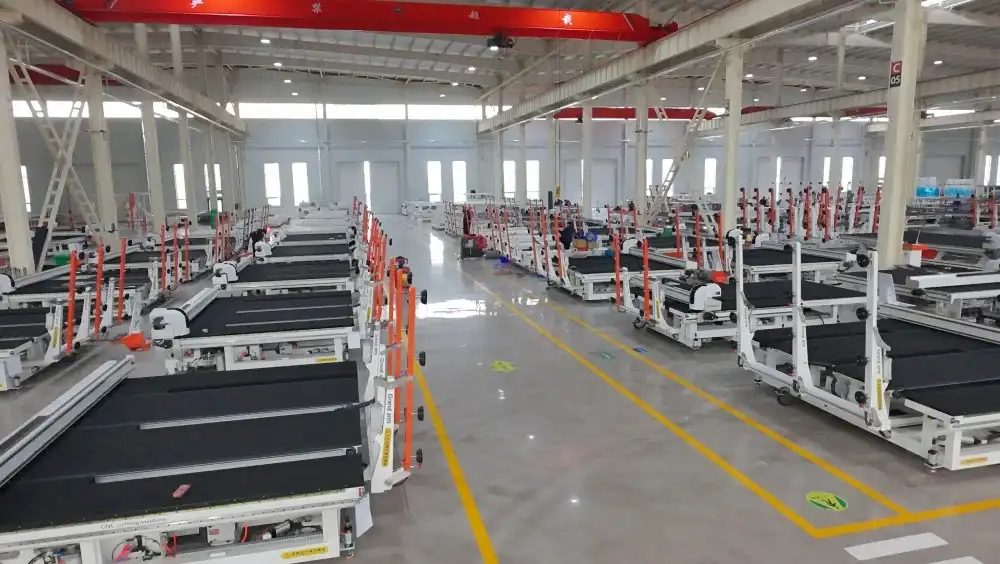
Locate a Chinese manufacturer and enquire about access to a video tour of the manufacturing facility. Moreover, you have to enquire about the possibility of seeing instances of previous installations, documented warranty conditions, and a strategy for acquiring replacement parts. Verify if the company is in fact the one that they call themselves.
Installation and Maintenance Basics
Even before the delivery day, everything is going swimmingly. An even floor, electricity lines, and safety regulations should be established. Ensure that individuals are able to enter and exit the building. People should be instructed on how to prepare files, load them, trim them, check them, and clean them, as well as get instructions on what to do in the event of an emergency.
With consistent attention, there are no alterations made to the correctness. As per the plan, prepare the tables by cleaning them, greasing the parts that move, and ensuring that they are level. Before the cutting wheels, belts, bearings, and sensors fail, you need to make sure that they are all recently manufactured. Make sure that the pressure is correct, that the machine is positioned correctly, that the glass is clean, and that the wheel is free of any wear and tear. First, check to see whether the sizes have changed before you proceed with the positioning and calibration.
After the machine has been put into operation, it is important to monitor scrap, cycle time, tool usage, rework, and uptime, respectively. You can determine whether or not the machine is able to pay back what you have set out to perform by looking at these data. Examine to see whether there are replacement parts available and that you are able to examine everything from a distance before you make your purchase.
Conclusion
The score-and-break step is done automatically by a mobile glass cutter machine instead of by hand. The process is more uniform, there is less waste because of stacks, and each panel needs less work. Getting the sizes, holes, and edges ready ahead of time is important for safety because cutting has to happen before hardening. For big projects, the HSL-LSX6133 can handle glass sizes up to 6100 × 3300 mm and comes with Optima software. It also has a 2+2 station setup and six grand arms on each side. It has tables for cutting, loading, and breaking as well. You shouldn't judge a machine by its price or speed alone. People who are buying should instead look at sample cuts, full cycle time, total cost of ownership, source verification, and assistance for upkeep.
FAQ
1. Why Is Tempered Glass Cut Before Tempering?
If you heat glass that has been cut, drilled, or ground, it breaks into little pieces. The glass is cut, edged, and drilled first, and then it is put in the kiln.
2. How Does a Mobile Glass Cutter Machine Differ From a Handheld Cutter?
A handheld cutter works best when the person using it is skilled and careful. A digital file and machine movement that is directed make sure that every sheet goes in the same direction. This means that the results are the same from shift to shift between a handheld cutter and a mobile glass cutter machine.
3. What Information Do You Need to Prepare a Quotation?
Send over the type of glass, how thick it is, the sheet size, shapes, daily output, required tolerance, destination country, power standard, and some drawings to show that you are who you say you are. That way, our team can suggest a good setup and look into the delivery and warranty terms.
Request a Mobile Glass Cutter Machine Quote From HUASHIL
Are you ready to look at settings side by side? In Shandong, HUASHIL is a business that makes mobile glass cutter machines. We can look at the HSL-LSX6133 and your glass shapes, widths, and output goals. Email your plans and drawings to salescathy@sdhuashil.com, and we'll get back to you with configuration choices, delivery terms, and information about our guarantee.
References
1. ASTM International, Standard Specification for Heat-Treated Flat Glass (ASTM C1048), 2018
2. ASTM International, Standard Specification for Flat Glass (ASTM C1036), 2021
3. Safety Glazing Certification Council, American National Standard for Safety Glazing Materials Used in Buildings (ANSI Z97.1), 2015
4. U.S. Consumer Product Safety Commission, Safety Standard for Architectural Glazing Materials (16 CFR Part 1201), 1977
5. Occupational Safety and Health Administration, Safeguarding Equipment and Protecting Employees from Amputations (OSHA 3170), 2007
6. Varshneya, Arun K., Fundamentals of Inorganic Glasses, 2006
