




Choosing the right industrial glass cutting table size is fundamental to maximizing production efficiency and profitability in glass fabrication operations. This decision directly impacts material handling, cutting precision, waste reduction, and overall throughput. Whether you're processing oversized architectural panels or standard commercial glass, understanding how your portfolio composition influences equipment sizing ensures you invest in machinery that serves your actual production demands—not just theoretical capacity. The journey from jumbo to standard table selection requires careful analysis of your current glass inventory, future growth projections, and operational constraints to avoid costly mismatches that lead to bottlenecks or underutilized capital.
Understanding Glass Portfolio Needs and Cutting Table Sizes
Your glass portfolio helps you choose the right equipment. The best size for your industrial glass cutting table can be found by listing the types and sizes of glass pieces you work with most often. Before you do a portfolio analysis, you should look over all of your regular sales from the last twelve months.
Portfolio Composition Analysis
Glass fabricators usually take care of a wide range of projects, from small to large. Architectural glass makers often work with huge sheets that are up to 6100x3300mm, while furniture makers mostly work with sheets that are between 2000 and 3000mm in size. If you know how your business is spread out across these categories, you won't have to buy equipment that sits idle or be forced to use expensive workarounds.
Take the example of a curtain wall builder whose orders are made up of 60% large architectural glass, 30% medium-sized commercial panels, and 10% unique shapes. For this portfolio, a jumbo-capable cutting system is needed instead of a standard table, which would need to be used for more than one cut and would take more time to handle. The HSL-LSX6133 model can handle glass sizes of up to 6100x3300mm, which means it can be used for large-scale jobs while still being flexible enough for smaller runs.
Glass Thickness and Specialty Variations
Table needs are affected by more than just the size of the surface. Glass thickness and specialty coatings also play a role. Low-E building glass, laminated safety glass, and tempered pieces are all difficult to cut and handle in their own ways. Tables with many suction arms, like ones with six grand arms on each side, give you the stability you need to hold different kinds of glass securely while you cut them precisely.
Specialty glass usually costs more, but it needs to be handled more carefully and cut more precisely to keep the material from breaking. The amount of specialty glass in your portfolio should be taken into account when making choices about automation. This is because advanced cutting optimization software like Optima, which uses smart nesting algorithms to reduce waste, works best with these types of goods.
How to Choose the Right Industrial Glass Cutting Table Size for Your Business
To choose the right industrial glass cutting table, you need to use a methodical evaluation process that balances your current wants with your ability to grow in the future. The method we suggest helps procurement teams make important choices while keeping the total cost of ownership in mind.
Defining Your Production Scenarios
First, write down your three most common output possibilities. A company that makes windows might be able to tell the difference between large architectural projects that need jumbo sheets, normal residential window production using mid-sized glass, and special orders with odd sizes. Each situation calls for a different table size, output, and level of automation.
Production volume has a big effect on table choice. Fully automatic systems with built-in loading, cutting, and breaking tables help operations that work with more than 500 square meters of space every day. This three-table setup makes it easier to move materials and requires less manual labor, which is a direct response to worries about rising labor costs that lead to many machine upgrades.

Core Evaluation Metrics
Table size agreement goes beyond the largest cutting measurements. In real life, productivity is affected by things like the effective working area, the bridge span, and the accuracy of the positioning. A table that can hold sheets measuring 6100x3300mm needs enough floor space around it to store materials. This is especially true if it is set up with above-ground or underground rail systems that make the equipment's size bigger.
Another important measure is the amount of automation. Specialty fabricators that don't make many things should use manual tables, while mid-sized businesses should use semi-automatic systems that balance flexibility with efficiency. Fully automatic cutting lines with 2+2 station configurations give high-volume manufacturers the most throughput by letting them load, cut, break, and unload at the same time, so there is no downtime.
Market Comparison and Supplier Options
There are a lot of different kinds of commercial glass processing tools on the market, from simple manual tables to high-tech, fully integrated production lines. The quality standards of china automatic glass cutting table makers have gotten a lot better while keeping prices low. This means that mid-market fabricators can now use advanced technology instead of manual processes.
Different providers offer a wide range of customization options. Standard catalog equipment might need to be changed to fit specific glass cases or space limitations. Custom engineering usually adds 4 to 8 weeks to delivery times, but manufacturers that offer OEM and ODM support can change table sizes, loading mechanisms, and control systems to fit specific operational needs.
Advantages of Selecting the Correct Cutting Table Size – Productivity and Efficiency Gains
When you match the size of your industrial glass cutting table to your glass collection, you can make big operational improvements that add up over time. The benefits cover many areas of performance, from increased throughput to small quality improvements that cut down on rework further down the line.
Breaking Production Bottlenecks
When tables are too small, they limit throughput right away. When the most common size of glass is bigger than what the table can hold, workers have to make several cuts and take breaks to handle the glass in between. This fix causes alignment problems, raises the risk of breaking, and wastes time that could be used for other things.
Conversely, tables that are too big waste money and floor space. A factory that mostly works with 2400x3300mm residential glass won't benefit much from a jumbo system that can handle 6100x3300mm architectural sheets. The extra capacity wastes money that could be better spent on complementary equipment, such as automatic edging lines or packing systems that deal with real bottlenecks.
Precision and Waste Reduction
The accuracy of measurements is improved by using the right-sized cutting tools, which support the material better and improve the cutting processes. When you cut glass sheets that are fully supported across their entire surface, they stay flat, which means you get cleaner scores and more predictable breaks. This stability is very important for thin glass (less than 4 mm) and big building pieces, because even a small bend can cause stress fractures.
Optimization software, such as Optima, figures out the best way to cut a sheet of material across all of its lengths to get the most out of it. When the software can use the whole cutting surface of the table, it makes layouts that reduce the amount of trim waste. After correctly fitting equipment and putting in place advanced nesting software, operations report a 3-8% drop in waste. These savings have a direct effect on material prices, which make up 40 to 60 percent of all production costs.
Energy Efficiency and Workflow Optimization
Equipment that is sized to the real needs of production uses less energy than options that are too big. Vacuum systems, servo motors, and control electronics all need power that is related to the size of the table. A cutting table that is the right size and an efficient workflow design, like loading, cutting, and breaking stations that are set up in a certain order, make it possible for materials to flow smoothly, which cuts down on staging delays and the need for handling equipment.
Exploring Types and Features of Industrial Glass Cutting Tables by Size
There is a wide range of processing levels and sizes for industrial glass cutting tables. Knowing how features relate to table dimensions helps procurement teams figure out which features really make their operations better and which are just marketing tricks that add cost without adding much value.
Automation Types and Size Relationships
Specialty makers who work with odd forms and small batches can still use manual cutting tables. Most of the time, these systems can handle glass up to 3000x2000mm, and the skill of the user determines where to place the glass and how to score it. Even though the cost of capital stays low, the need for workers limits both output and regularity.
With powered cutting heads and programmable positioning, semi-automatic tables improve accuracy and speed better. These medium-sized systems work well with sheets up to 4000x3000mm, making them useful for furniture makers and fabricators who work with medium numbers. The mix between mechanization and operator control lets different production runs happen without having to buy a whole new production line.
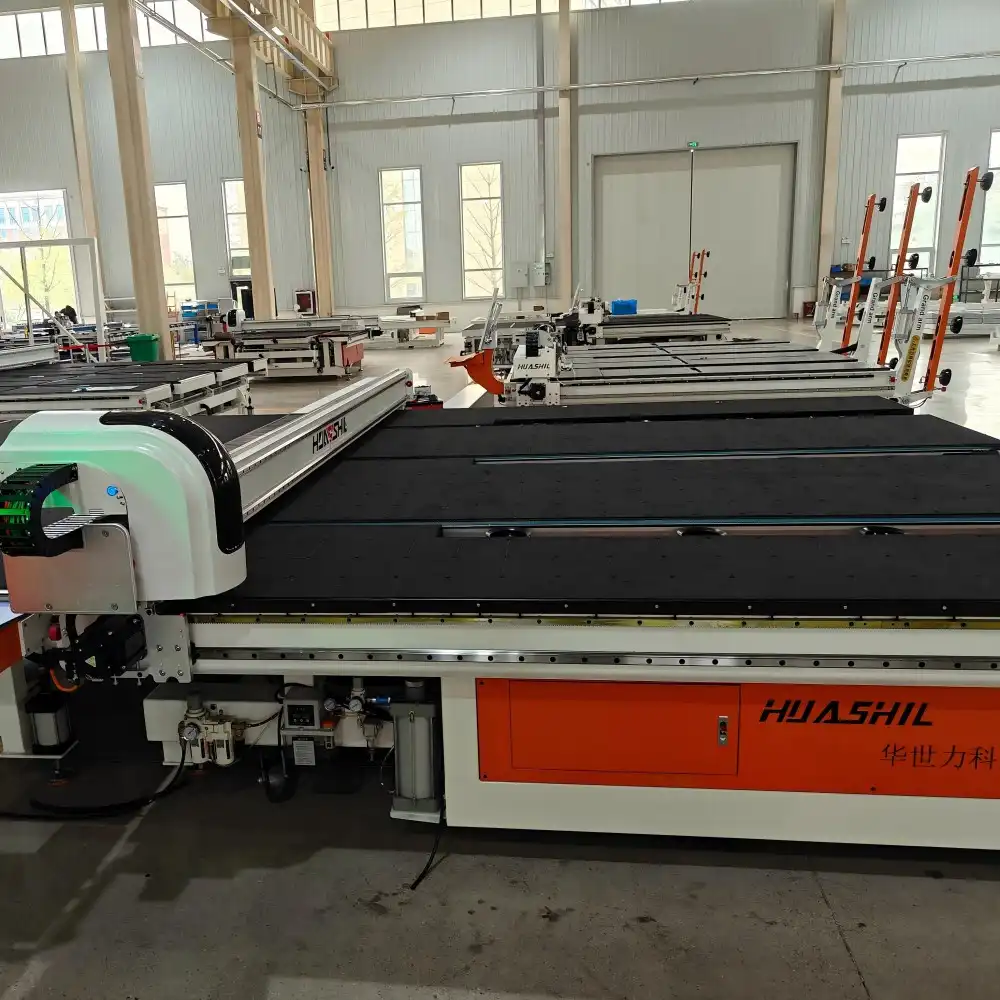
Fully automatic cutting lines represent the most sophisticated option, integrating multiple stations with computerized control systems. These configurations excel in high-volume environments processing standardized products like architectural panels and automotive glass. The HSL-LSX6133 exemplifies this category with its three-table layout, configurable station options, and capacity for maximum 6100×3300mm sheets. Such systems require skilled technical staff but deliver unmatched throughput and consistency.
Essential Components Across Size Categories
The construction of the frame on an industrial glass cutting table gets stronger as the table gets bigger. For jumbo-capable systems to keep their positioning accuracy across larger work areas, they need frames made of strengthened steel and guide rails that are carefully machined. Long-term accuracy is directly affected by the structural integrity, since even small frame deflections make positioning mistakes bigger over longer cutting distances.
Cutting boards are made of different materials based on the size of the table and the type of glass that will be used. For smaller tables, plastic strips that can be replaced may be used. For bigger systems, more lasting cushioning materials are used to hold heavy architectural glass in place without warping. The surface needs to be just the right amount of hardness and padding to keep the glass from breaking while cutting.
Control Systems vary from basic numeric displays on manual tables to sophisticated touch-screen interfaces on automated lines. Advanced systems integrate with optimization software, allowing operators to upload cutting patterns directly from CAD programs. This digital workflow eliminates manual programming errors and accelerates changeovers between different production runs.
Modular Design and Maintenance Considerations
Modern cutting tools are becoming more and more flexible, which means they can add more capability as portfolios grow. Instead of making whole new tables, manufacturers can add longer rails, more loading stations, or better control systems to the ones that are already out there. This staged investment method lowers the amount of initial capital needed while keeping the paths for upgrades.
The amount of technology and the size of the table affect how hard it is to maintain. Larger tables have more moving parts, longer vacuum lines, and more complex positioning systems that need to be calibrated on a frequent basis. Correct sizing, on the other hand, lowers the total maintenance load by getting rid of makeshift solutions that put too much stress on equipment beyond what it was designed to handle. A table that is working at full capacity stays accurate for longer and has fewer surprise failures.
Procuring Your Industrial Glass Cutting Table: Size, Supplier, and Support Considerations
It is during the buying phase that technical needs are turned into long-term contractual obligations when purchasing an industrial glass cutting table. It's not enough to just look at the specs of the equipment; you also need to look at the supplier's skills, the infrastructure for support, and the total ownership experience.
Supplier Selection and Differentiation
Reputable manufacturers stand out by having a history of success in automating the glass processing process. Shandong Huashil Automation Technology is a good example of this type of company because it has been making things for a long time, has high quality standards, and can provide a wide range of services. Their portfolio includes different table sizes and levels of automation, so procurement teams can get solutions that are the right size from a single vendor who understands how their needs change over time.
Pricing Structures and Financial Considerations
The costs of equipment are strongly linked to the size of the table and the amount of automation. Standard-sized manual tables start at about five figures, while fully automated production lines that can handle jumbo glass cost a lot more than six figures. Because of this wide range, it is important to define the specifications in detail before asking for quotes, because vague requirements lead to proposals that either go over budget or fail to deliver on important features.
Financing options have grown beyond just buying capital goods. There are now a lot of suppliers who offer leasing plans, payment plans that are broken up into stages based on installation milestones, or performance guarantees that put off some payments until throughput goals are met. These structures help fabricators who are growing get the right tools without using up their working capital, which is needed for inventory and running the business.
After-Sales Support and Service Networks
The quality of after-sales support is an important factor in purchasing because it directly affects production revenue. Full support includes supervision during the initial installation, training programs for operators, access to spare parts, and quick expert help when problems appear. When compared to manufacturers far away who need to fly internationally for service calls, suppliers with established service networks in your region can respond faster and charge less for on-site repairs.
Warranty terms vary significantly across suppliers and equipment categories. Standard coverage usually lasts between 12 and 18 months for major parts like frames and motors, but only for a shorter time for consumables like cutting wheels and vacuum cups. Extended warranty packages are a great way for businesses that can't do their own maintenance to protect themselves. Making sure you know when spare parts will be delivered before you buy them keeps production from stopping when parts need to be replaced. Some sellers may charge more if they promise that parts will come within 72 hours.
Conclusion
Matching industrial glass cutting table size to your portfolio composition represents a strategic decision with lasting operational and financial impacts. The process requires honest assessment of current production patterns, realistic growth projections, and a clear understanding of how different equipment configurations address specific bottlenecks. Jumbo-capable systems like the HSL-LSX6133 deliver maximum flexibility for architectural and specialty glass fabricators, while more compact alternatives serve focused portfolios efficiently. Success lies not in acquiring the largest available equipment but in selecting machinery that aligns with actual production demands while preserving scalability paths. Careful supplier evaluation, comprehensive total cost analysis, and attention to support infrastructure ensure your investment enhances competitiveness rather than creating new operational challenges.
FAQ
1. How do I determine the minimum cutting table size for my glass portfolio?
Calculate the 90th percentile dimension of your typical orders over the past year. If 90% of your sheets measure 3000×2500mm or smaller, a table rated for 3500×3000mm provides adequate capacity with reasonable safety margins. This approach prevents oversizing while accommodating occasional larger orders through adapted cutting patterns.
2. What automation level makes sense for mid-volume operations?
Semi-automatic systems typically suit fabricators processing 200-400 square meters daily with moderate product variety. These configurations balance investment costs against labor savings while maintaining operational flexibility. Fully automatic lines become cost-effective above 500 square meters daily with standardized product ranges that benefit from optimization software.
3. Can I retrofit a standard table to handle larger glass sheets?
Physical retrofits face severe limitations due to frame structural requirements and control system constraints. Extended rails might add modest capacity, but jumbo sheets require fundamentally different frame engineering. Most operations find replacing undersized equipment more economical than extensive retrofitting once portfolio demands exceed current table capacity by 20% or more.
Contact HUASHIL for Industrial Glass Cutting Table Solutions
HUASHIL delivers cutting-edge glass processing automation designed specifically for architectural fabricators, curtain wall manufacturers, and furniture producers seeking industrial glass cutting table solutions that match their exact portfolio requirements. Our HSL-LSX6133 system combines jumbo capacity with intelligent Optima optimization software, configurable station layouts, and robust construction proven across thousands of installations worldwide. Each equipment configuration undergoes rigorous quality validation, ensuring consistent performance from installation through years of demanding production cycles.
As a leading industrial glass cutting table manufacturer, we provide comprehensive support from initial specification consultation through installation supervision, operator training, and ongoing technical assistance. Our engineering team collaborates directly with your production managers to configure table dimensions, automation levels, and software parameters that address your specific bottlenecks and growth plans. Reach our specialists at salescathy@sdhuashil.com to discuss how properly sized cutting equipment can transform your operational efficiency.
References
1. Glass Manufacturing Industry Council. (2022). Equipment Sizing Guidelines for Glass Fabrication Plants. Industrial Press.
2. Morrison, J., & Chen, L. (2021). Automation in Architectural Glass Processing: Efficiency and Quality Metrics. Journal of Industrial Manufacturing Technology, 45(3), 127-145.
3. European Glass Processing Association. (2023). Total Cost of Ownership Analysis for Glass Cutting Systems. Technical Report Series 18.
4. Richards, P. (2020). Material Optimization Strategies in Glass Fabrication. Advanced Manufacturing Quarterly, 34(2), 89-107.
5. International Society of Glass Technology. (2022). Safety and Operational Standards for Automated Glass Processing Equipment. Standards Publication Vol. 12.
6. Thompson, R., & Zhang, W. (2023). Comparative Analysis of Manual, Semi-Automatic, and Fully Automatic Glass Cutting Technologies. Production Engineering Research, 28(1), 56-78.