




Glass processing technology moves from manual to lights-out production in stages. Fabricators first replace hand measuring and scoring with CNC machines. They then connect cutting, edging, washing, and inspection through software, sensors, and conveyors. Finally, they reduce routine operator intervention. Lights-out does not remove people, because technicians still program, maintain, and solve exceptions. I wrote this guide for plant managers, engineers, and buyers in the United States who want faster output, steadier quality, and lower labor strain. Below, I walk through each stage and show where our HSL-YTJ3829 cutting line fits.
From Manual Glass Processing to Automated Production
Where Manual Production Falls Short
Handheld cuts, tape measures, and the operator's perception are used to work with glass processing technology by hand. Things change with each step. Different people can score the same sheet with different amounts of force, and a big, expensive light can be ruined by a single wrong measurement. Also, big sheets are dangerous to handle because they are heavy and have sharp ends. I never tell a shop to give up the freedom to do things by hand for repairs, experiments, and one-time sales. But repeat purchases show that it's not good enough. What gets done changes with each shift. As people get tired, more scrap is made, and it takes a while to figure out where a defect came from.
How CNC and Digital Programming Changed the Floor
Because they are computerized, CNC machines don't need people to make decisions. CAD/CAM files now set the cutting paths, and layout software arranges the parts on each sheet to reduce waste. Sensors tell you how the machine is running and help you keep track of sheets and orders. Rollers move glass between stations. These tools help make sure things are right and give records that managers can look over. That bigger shift toward output that is linked and driven by data is talked about in Klaus Schwab's 2016 book on the Fourth Industrial Revolution. Each part of the glass plant has the same idea. Every change gets rid of one choice made by a person and adds a setting that can be used over and over.
Why ERP and MES Connectivity Matter
A machine that does things on its own is useful, but tools that are tied to data make a process. When ERP sends out an order, MES keeps track of it, and the cutting station does the job itself; planners can see real progress instead of guesses. Engineers look at what was done and compare it to what was planned. Purchasing teams keep track of which goods run out first. When people want to buy something, I tell them to think of automation as a style change, not a shopping list. As soon as possible, find out if the new tools can read standard file formats and export production records. The answer will tell you how easy it is for your future lines to join together.
The Modern Glass Processing Technology Workflow
From Order Entry to Cutting and Breaking
Modern glass processing technology often begins with a production order that is converted into an optimized cutting plan through specialized software. The system then transfers cutting instructions to the production line and determines how individual glass pieces should be arranged on each sheet to improve material utilization. Errors during cutting or glass breaking can affect subsequent processes such as edging, drilling, and tempering. Common risks include edge chipping, inaccurate positioning, and deviations in scoring lines. Accurate pressure control, reliable edge detection, and stable material movement help minimize these issues and improve cutting consistency. When the initial cutting stage produces clean, accurately sized glass pieces, downstream workstations can spend less time correcting defects and more time completing finished products, improving overall production efficiency and reducing material waste.
Edging, Drilling, Washing, and Tempering
The edges are smoothed out, CNC-drilled and filed, and washed after the pieces are cut. It's possible for edges to not be straight, holes to be in the wrong place, and residue to show up after tempering. ANSI Z97.1 sets performance standards for safety glass that is used in a lot of building projects in the U.S. These standards must be met by tempered glass. The next steps for special things are to bend and laminate them. The soundproofing glass is then put on top of cleanlites and sound seals that are the right size. You should plan the whole route before choosing a machine, because each station takes over the output of the one before it.
Inspection, Packaging, and Traceability
Inspection ends the loop. Cameras or people check for things like sizes, scratches, bubbles, damage to the coating, and the state of the edges. The system then records the results and compares them to the order number. Users can compare quality standards with ASTM C1036, which is a standard for flat glass. The records you keep should match what your users say they are. The finished goods are then packed to keep them safe while they're being shipped. Each rack has a number that tells you where and when it was made. Traceability may sound like a pain, but it saves time when a customer reports a problem because you can quickly find the sheet, machine, and shift that caused it.
Manual, Semi-Automatic, and Lights-Out Production Compared
Choosing an Automation Level
Fully automatic, semi-automatic, and lights-out types can all work well in some shops. You can fix things by hand and do one-time jobs with your hands. Fabricators can use semi-automatic systems to make their processes more repeatable without having to rebuild their plants. When orders come in often, and in large amounts, fully automatic lines make it easier to get to data, deal safely, and get through the system faster. At the very end, lights-out must be planned, items must be named, recipes must be picked, and inspection and maintenance alerts must be linked. If you want to pick a level, I think you should look at your product mix, volume, working capital, and staff. A store that moves too quickly often has to pay for features it hasn't used yet.
What Lights-Out Actually Requires
Lights-out manufacturing is not simply about replacing workers with machines; it requires reliable automation, monitoring, and process control. Advanced glass processing technology can support unattended operations by identifying individual glass sheets, selecting the appropriate processing programs, detecting abnormalities, and generating maintenance alerts before equipment faults cause production interruptions. Quality requirements must be translated into measurable parameters that automated systems can consistently monitor and apply. A stable material supply is also essential for maintaining uninterrupted production. Skilled technicians remain necessary for troubleshooting, programming, preventive maintenance, and continuous process improvement. In practice, many manufacturers begin by automating clearly defined tasks and gradually reducing the need for direct supervision during selected shifts. A phased implementation approach is generally more practical and reliable than attempting to establish a fully unattended factory from the outset.
The HSL-YTJ3829 as a Practical Automation Step
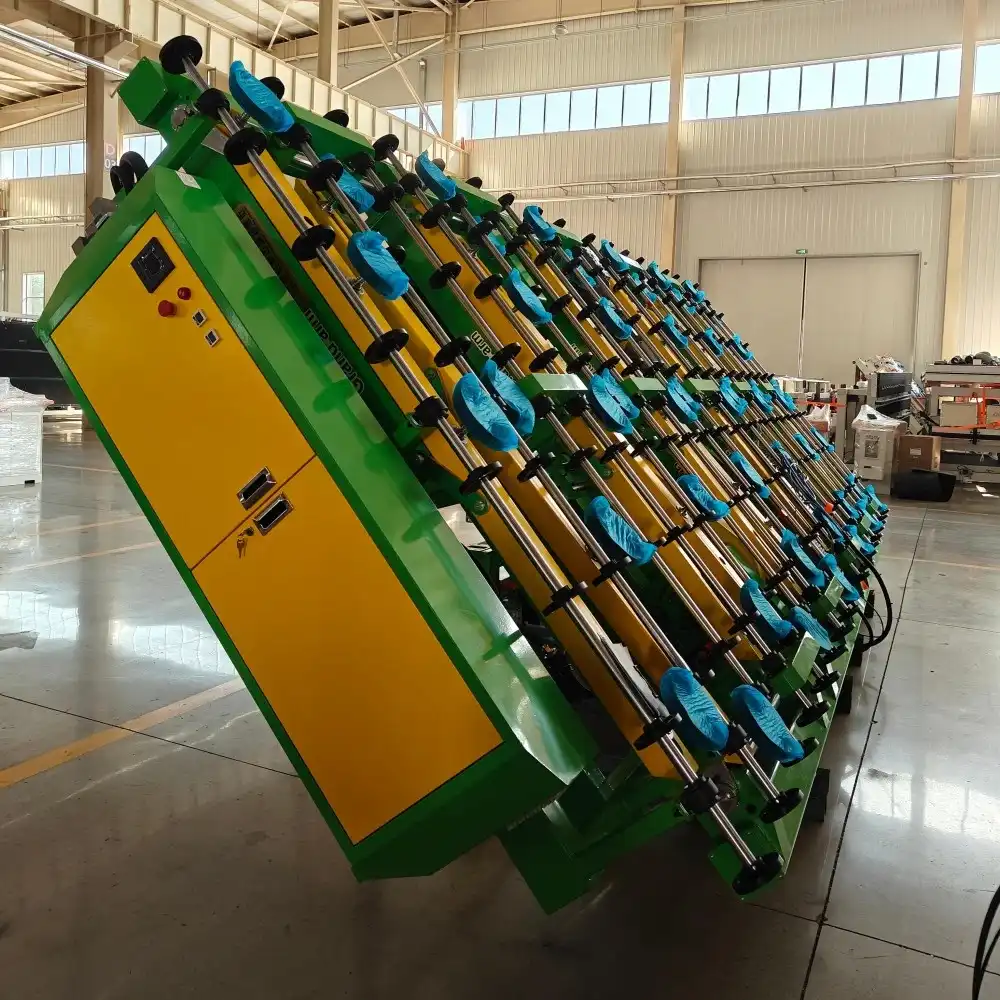
For the cutting stage, our HSL-YTJ3829 is in charge. It has an air flotation system, a breaking table, automatic edge finding, and automatic pressure control. This machine can cut glass that is 2 mm to 19 mm thick. It can also hold sheets that are up to 3660 × 2800 mm and move them along on two belts at the same time. The Optima program plans the cutting layouts, and the machine has a handle that you can move around in any direction. It's 1280 mm x 4925 mm and has CE and ISO9001 marks on it. For many fabricators, it's the first step away from cutting by hand.
How to Select Glass Processing Equipment and Suppliers
Define Your Production Scenario First
Start with facts that can be measured, like the floor space, the types of glass, their thicknesses and coatings, the amount of glass made each day, the batch sizes, and how often they are changed. Then add growth plans, since a machine that can handle orders now might not be able to handle orders next year. The mix of your real order, not your best-case order, should be used to compare the specs. If most of your work is between 2 mm and 19 mm thick and falls between 3660 mm and 2800 mm, then a cutting line with those limits will work great. Give all of the suppliers this information in the same way so that it's easy to compare quotes.
Evaluate Total Cost of Ownership
The price of something only tells you a small part of the story. Part of the total cost of ownership is also the time it takes to set up, train people, replace parts, do maintenance, use energy, break down, and work one shift. The finance team wants a clear way to pay, like a Letter of Credit or a deposit plus the last payment. The people in charge of the plant look at uptime and throughput. The engineers make sure it works and is accurate. Don't forget to get written terms for the guarantee and when extra parts will be delivered. A hand saw fix that is done late costs less than a line that is down. You can compare machines that work alone, output cells, and full lines that all have the same expected return.
Questions to Ask a Machine Supplier
Ask each provider a question straight up. Could you give me a film, an installation case, or a tour of the factory? Is the supplier able to show proof that they are CE and ISO-9001? The Machinery Directive 2006/42/EC says that most machines in Europe have to have the CE mark on them. In ISO 12100, there are general rules for figuring out how safe a machine is. What kind of setup help, training, and guarantee do I get when I place my order? How quickly do you send parts to the US? Can they meet OEM or ODM needs? Written answers help people trust you more quickly than ads. To get full-line jobs accepted, you should start early because it usually takes three to six months.
Conclusion
Glass processing technology has evolved from measuring and scoring by hand to CNC cutting and related processes, and for some jobs, operation without the operator being present. Because each unit builds on the one before it, the end quality is affected by how well the pieces are cut, the records of inspections, and the data from ERP or MES. The manual, semi-automatic, fully automated, and lights-out models can all work with a range of budgets and numbers. At every stage, you still need techs. When people buy something, they do better if they explain how they plan to use it, compare the total cost of ownership, check for safety standards and certifications, and ask for written support. When you want to start, the HSL-YTJ3829 is a good choice. It has an automatic cutting stage with set size, thickness, and control features.
FAQ
1. What is glass processing technology?
It talks about the hardware, software, and methods used to make things out of flat sheets of glass. A lot of the time, people cut, edge, drill, wash, temper, laminate, put together insulated glass, and check with glass processing technology.
2. Is automation suitable for smaller fabricators?
Sure, just take your time. Several little shops begin with just one machine that cuts paper. They buy more tools to edge, wash, and software tie as their business grows. It is easier to deal with the investment if you start with the biggest problem.
3. What cutting range does the HSL-YTJ3829 cover?
It can cut glass that is up to 3660 × 2800 mm in size and 2 mm to 19 mm thick. On top of that, it can load itself, control the pressure itself, and find the edges itself.
4. Does lights-out production remove all workers?
No, experts are still needed to set up, fix, and program things. While "lights out" doesn't mean "zero people," it does mean that there will be less regular help.
Request a Glass Processing Technology Consultation
Are you ready to switch from cutting glass by hand to connected production? HUASHIL can help you find the right glass processing technology for your sizes, thickness range, and output goals. Glass processing technology is made by Shandong Huashil Automation Technology Co., LTD. They can help with OEM and ODM requests, as well as training and setting up the technology. You can email salescathy@sdhuashil.com with your needs to see our products and get a quote.
References
1. The Fourth Industrial Revolution, Klaus Schwab, World Economic Forum, 2016
2. ASTM C1036 Standard Specification for Flat Glass, ASTM International, 2021
3. ANSI Z97.1 Safety Glazing Materials Used in Buildings, American National Standards Institute, 2015
4. ISO 9001 Quality Management Systems – Requirements, International Organization for Standardization, 2015
5. Directive 2006/42/EC on Machinery, European Parliament and Council, 2006
6. ISO 12100 Safety of Machinery – General Principles for Design – Risk Assessment and Risk Reduction, International Organization for Standardization, 2010