




A glass transport table line transports, places, and transfers glass from one processing station to the next without the need for human lifting. It connects loading, cutting, and breaking in automated glass manufacturing, so sheets follow a regulated course and workers handle less weight. This is how plants cut architectural, furniture, and ornamental glass to minimize scratches, breakage, and wait time between processes. We design automated glass cutting lines in HUASHIL, for example, HSL-LSX4228, based on a three-table arrangement. The tutorial describes how a transport table line works, what the HSL-LSX4228 provides, and how to choose a provider.
How a Glass Transport Table Line Works in Automated Processing
Why Manual Handling Falls Short
The same issues come up again and again from plant managers: edge chips, damaged surfaces, and workers waiting for a crane or a second pair of hands. Manual transfer also ties output to the availability of man-power. Another concern is the lifting. NIOSH has been recommending limits to manual lifting since 1981. Sheets of glass are clumsy, heavy, and sharp. A glass transport table line replaces many of those handoffs with a predetermined, repeated path. All sheets have the same route, so quality fluctuates less from shift to shift. Your workers could spend more time examining and less time transporting.
Core Components and Operating Sequence
Mechanical conveying, sensing, and control are one single line. Typical elements include support surfaces, drives, alignment guides, sensors, and PLC controls. The process starts with sensors detecting a sheet at the infeed. Once the position is verified, the table moves the sheet to the next station it’s at. Some of the lines use machinery to lift or turn large panels. The specific mix depends on the size of the glass, its weight, surface quality, speed, and the level of automation you want. Every plant is distinct. We recommend tailoring the table design to your actual sheet sizes and not a generic catalog category.
Transport Methods Compared
There are several methods of moving glass, and each approach is suited to a different function. The roller mechanism is a standard one and may be used for typical flat glass. Belt systems are gentler, which is good news for sensitive surfaces. Vacuum devices lift, spin, and stack heavy panels, while air buoyancy cuts down on friction. A lifting table raises and lowers glass and a transport table carries it down the line; therefore, the two often work together. Supports the sheet through a cycle of loading, cutting, and breaking in all phases of the cutting process. Choose the technique by taking into account touch sensitivity, speed, capacity, and floor space, and then confirm the choice with a layout drawing.
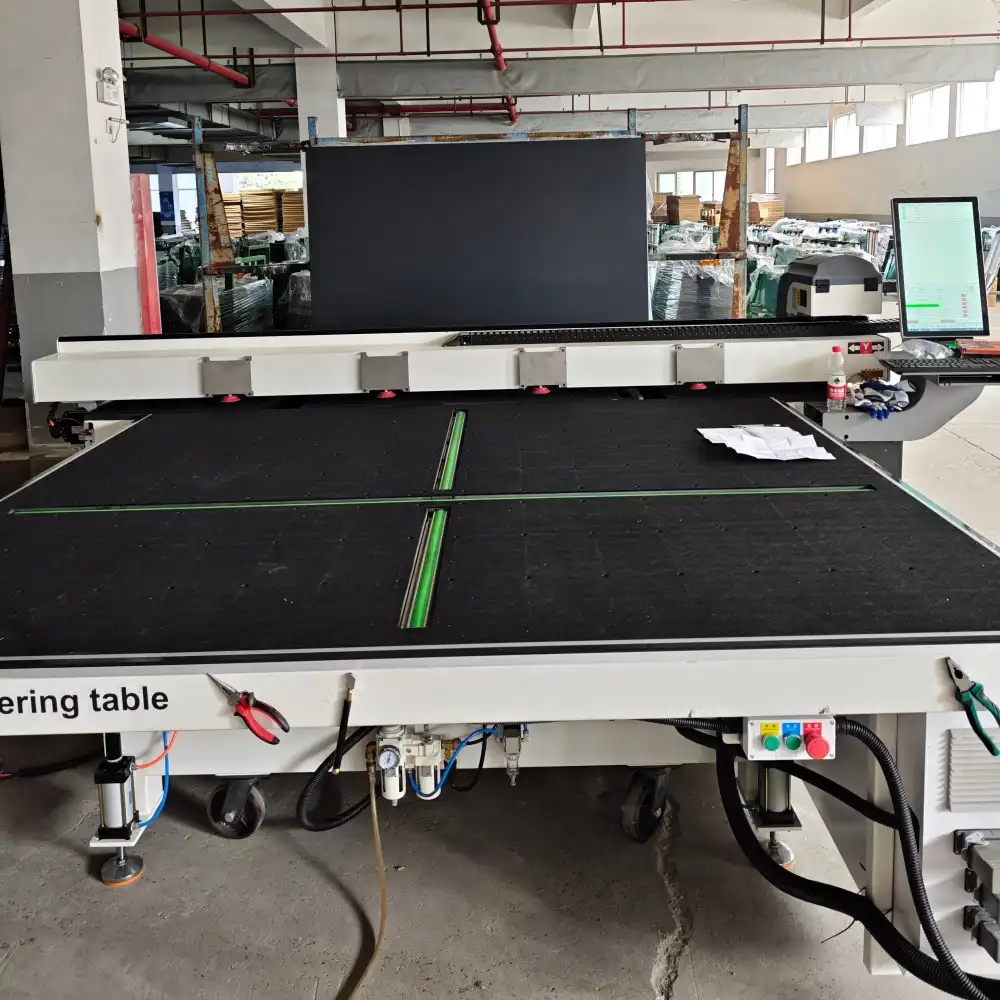
HSL-LSX4228: Automatic Glass Cutting Line Specifications
The HSL-LSX4228 shows how a glass transport table line works inside a cutting line. Here are its main features, one at a time.
Three-Table Layout: Loading, Cutting, and Breaking
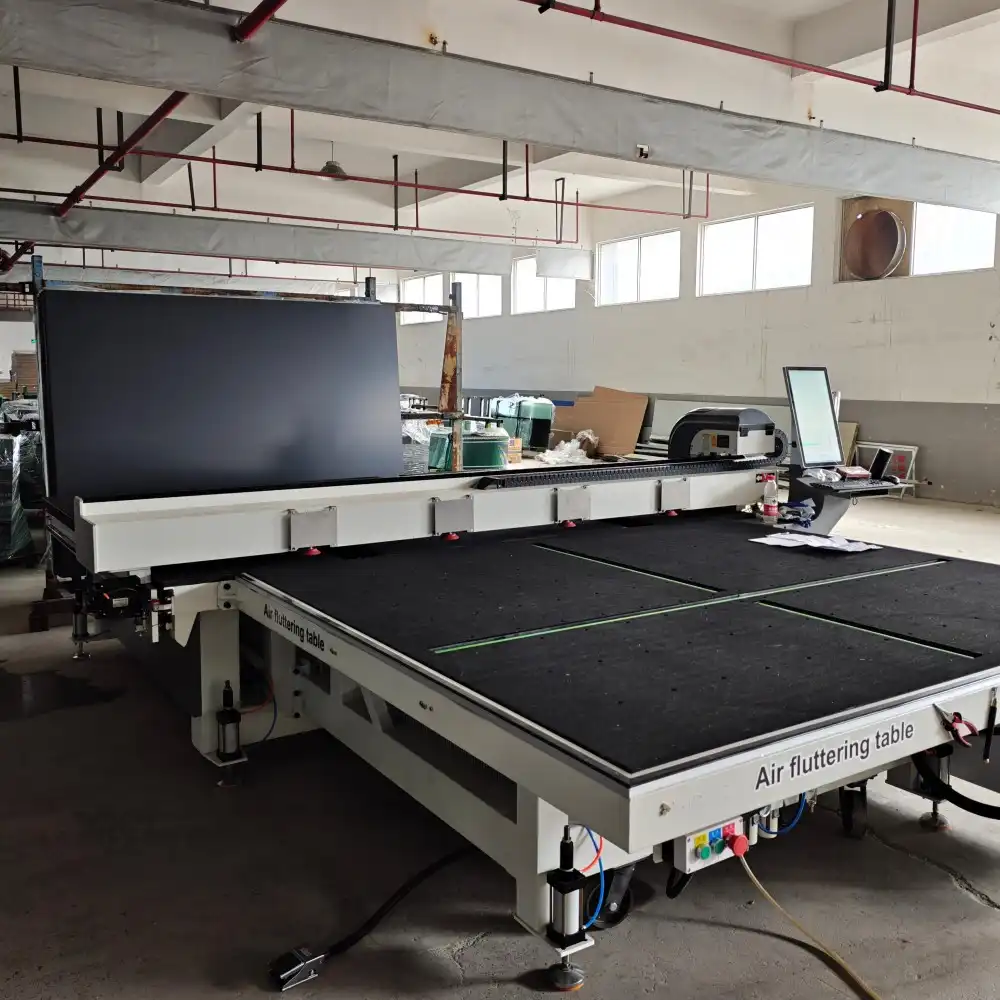
The HSL-LSX4228 features three tables in succession: a loading table, cutting table and a breaking table. The sheet is then fed to the loading table 2 and positioned. The glass is on the cutting table, and it is scored. The chopped bits are separated by the breaking table. Each stage has its own table, so that the sheet passes from one to the other in sequence and the operators need not move glass from step to step. Layout suitable for makers processing architectural glass for windows, doors, curtain walls. It is also applicable to automobile glass, intelligent mirrors, beautiful furniture glass, and so on, which are often required to be cut in curves.
Optima Optimization Software
The line is run with the use of the Optima optimization program. This program calculates where each page needs a form, which helps to decrease offcuts and cutting time. This is critical if you are cutting different sizes from the same stock, as is frequent in the architectural and furniture industries. Material cost does matter in glass production; thus, the way the layout is designed might have a direct influence on your waste statistics. Before you commit yourself to any equipment, we would urge you to e-mail us a typical order mix, and we can explore how Optima might fit your pattern of production.
Rail Options, Stations, Arms, and Maximum Glass Size
The HSL-LSX4228 has an above-ground or underground rail, so you may adapt the installation to your floor design. The station has a 2+2 configuration. You may change it to your method. There are four arms on each side. The maximum size of glass for big format sheets is 4200 x 2800 mm. Take the biggest sheet you have and check whether you meet this criterion. Measure before you start creating. In your facility, measure aisle width and ceiling clearances. If your idea is different from the standard layout, send us your design, and we may discuss it with our experts.
Safety, Selection, and Supplier Support
A good machine still needs the right safety design, a clear buying process, and dependable service. These three topics decide whether the line performs well after installation.
Safety Features to Check Before You Buy
Safety is included in the mechanical, electrical, and control architecture. Ask the supplier about emergency stops, protective guarding, safety interlocks, overload protection, glass transport table line sensors, and automatic shutdown on a fault. ISO 12100 covers the general concepts of risk assessment of machinery, and ISO 13849-1 covers the safety-related parts of control systems. Suppliers often quote additionally the EU Machinery Directive 2006/42/EC. In the US, OSHA has standards on storage and handling of commodities. Before commissioning, any compliance claim requires documented proof. Train staff on procedures and safety gear.
Selection Checklist and Total Cost of Ownership
First of all, write out the facts: glass size, thickness, weight, surface treatment, daily production, equipment to be connected, the desired level of operator involvement. ASTM C1036 dictates the requirements for flat glass in the U.S. Be careful to verify it against the kind of glass you have. They determine the load capacity, speed, and arrangement. Then check for compatibility with your power supply, PLC, and possible expansion. Then compare estimates by total cost of ownership, including purchase price, installation, training, maintenance, replacement parts, energy, labor savings, and reduced breakage. Finance teams want these stats in one proposal; engineers want technical data; therefore, ask for both. Terms of payment are a deposit and final payment, or a letter of credit at sight for overseas transactions.
Installation, Maintenance, and Supplier Evaluation
Delivery is less than installation. Ensure the floor is strong enough, level, and has access to electrical power, compressed air, and network connections before the equipment arrives. Scheduled routine maintenance will be carried out to clean contact surfaces and to inspect rails, bearings, motors, sensors, and safety devices. Store critical spares on site to reduce downtime. When you look at a supplier, ask for similar project references, export experience, warranty terms, replacement parts lead times, and support channels. Shandong Huashil Automation Technology Co., LTD has great experience in manufacturing and exporting. We supply equipment, documentation, and after-sales support to customers all over the world.
Conclusion
A glass transfer line provides a glass manufacturer with a controlled, repeatable passage from loading to cutting to breaking, minimizing manual lifting, scratches, and wait times. A correct approach depends on the size, weight, and arrangement of the sheet and roller, belt, air flotation, and vacuum, all of which are suited to the particular glass transport table line and speed requirements. The HSL-LSX4228 is the embodiment of this idea with loading, cutting, and breaking tables, Optima optimization software, above-ground or underground rail, a settable 2+2 station arrangement, four arms on each side, and a maximum glass size of 4200 x 2800 mm. Safety design, standards documentation, total cost of ownership, and maintenance planning complete a good purchase decision.
FAQ
1. What does a glass transport table line do?
It moves, aligns, and passes glass between stations. Operators lift less, and each sheet follows the same path, which helps limit scratches and breakage.
2. What is the maximum glass size for the HSL-LSX4228?
The maximum glass size is 4200 × 2800 mm. The line includes loading, cutting, and breaking tables, and the 2+2 station layout can be set.
3. What information do I need to request a quotation?
Provide glass dimensions, thickness range, maximum weight, daily output, factory layout, connected machines, and electrical standards. This lets engineers prepare an accurate design.
4. Does a transport table replace a lifting table?
Not always. A transport table moves glass along the line, while a lifting table raises or lowers it. Many plants use both, depending on the process.
Request a Glass Transport Table Line Proposal from HUASHIL
Planning a new cutting line or an upgrade? HUASHIL can review your glass sizes, output targets, and layout, then propose a glass transport table line that fits your plant. As a glass transport table line manufacturer, we support OEM and ODM requests and export orders. Email salescathy@sdhuashil.com for details.
References
1. ISO 12100: Safety of Machinery – General Principles for Design – Risk Assessment and Risk Reduction, 2010
2. ISO 13849-1: Safety of Machinery – Safety-Related Parts of Control Systems, 2023
3. Directive 2006/42/EC on Machinery, European Parliament and Council, 2006
4. ASTM C1036: Standard Specification for Flat Glass, ASTM International, 2021
5. Materials Handling and Storage (OSHA 2236), Occupational Safety and Health Administration, 2002
6. Work Practices Guide for Manual Lifting, National Institute for Occupational Safety and Health, 1981