




Heat, pressure, and speed decide whether an automatic cutting machine for laminated glass produces clean edges or costly scrap. Heat softens the interlayer so the two glass plies separate without tearing. Pressure sets the score and break force, which protects edges from chips. Speed controls cycle time, but a fast cut only helps when the score stays continuous. I recommend judging all three together, using your own glass and film during sample testing. Below, I explain how each variable works, which specifications matter, and how the HUASHIL 3+3 to 8+8 mm model fits plant and integrator needs.
How an Automatic Laminated Glass Cutting Machine Works
From Loading to Breaking: The Workflow
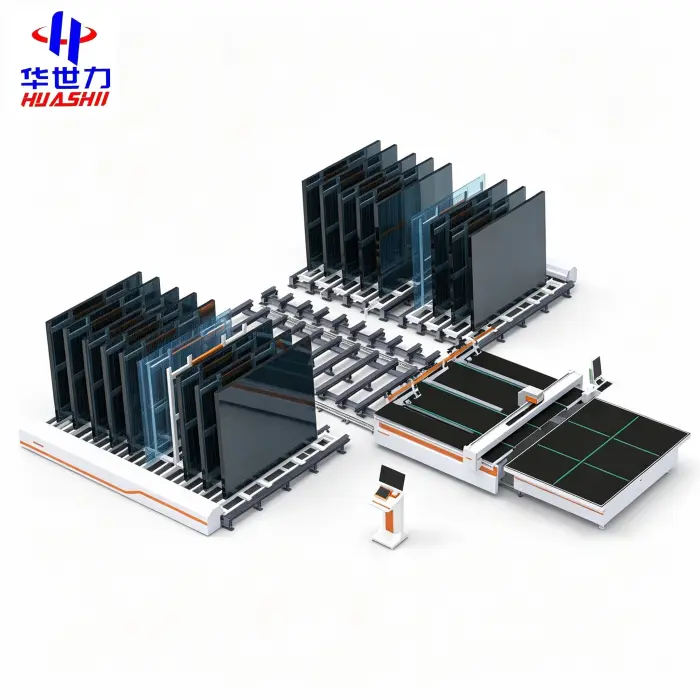
When you have laminated glass, two sheets of glass are joined together by a polymer film. This means that a simple "score and snap" doesn't work very often. The person who works the HUASHIL automatic cutting machine for laminated glass sets it up and presses a button to load the glass rack automatically. The vacuum keeps the sheet in place, and the cup puts the glass on the cutting table. The machine moves forward. Photoelectric positioning finds the glass. The machine scans the shape of the glass before cutting it. The table fan creates an air cushion that makes it easy to slide after the sheet is cut, and a foot switch activates a pneumatic break bar that separates the large plates.
PVB and EVA: Why the Interlayer Changes the Cut
The interlayer is the main thing that does not behave like monolithic glass in laminated glass. Most of the time, polyvinyl butyral (PVB) film is used in architectural laminated glass. Architectural flat glass that is laminated is covered by ASTM C1172. You can also layer with EVA, which has different responses to heat and force. Laminated safety glass in the US also has to follow rules like ANSI Z97.1 and 16 CFR 1201. Films that are 0.38 mm to 1.52 mm thick can be used with the HUASHIL machine. Before setting a recipe for an EVA line or an automatic cutting machine for laminated glass, you should make test cuts with real glass and film. This is because different film makers use different formulas.
CNC Control and Nesting
It costs less to cut by hand at first, but the results depend on how skilled the person is, and curves or mixed orders quickly show where they are weak. A CNC automatic cutting machine for laminated glass reads CAD/CAM files and always moves in the direction that was set. The HUASHIL machine works with CAD/CAM tools such as Type3, Castmate, Wentai, and ArtCAM. Auto-typesetting is also used to make better use of the glass. When the power goes out, it can start cutting again after a break. It can also estimate how long processing will take, which helps planners set delivery dates. When plants that cut shaped glass for walls or furniture nest, the cost of raw glass goes down directly.
Heat, Pressure, and Speed: How Each Variable Shapes the Cut
Heat: Softening the Interlayer Without Damaging the Glass
Once the film has been scored and still holds the plies together, heat is important. If you warm one up, it will easily soften and separate. If you cool one down, it will stretch and tear. It can bubble, change color, or peel off at the edges if you heat it too much or not evenly. When I look at a project, the film type, film thickness, and method of separation are the three things that tell me how much heat is needed for an automatic cutting machine for laminated glass. The HUASHIL machine can handle films that are 0.38 mm to 1.52 mm thick, so the thickest film in your range should be fine no matter how you heat it. To make sure that each configuration works well, you should check its temperature uniformity, response time, and overheating protection.
Pressure: Clean Scores, Breaks, and Separation
The score tool, the hold-down, and the break bar are all places where stress can be used. The tool doesn't last as long, and the surface gets chipped when you don't use enough force. The tool wears out faster if you use too much force. The right setting changes based on how thick the glass is. From 3+3 mm to 8+8 mm, the HUASHIL machine can handle laminated build-ups. This means that a thin sheet and a thick sheet need different care. Big plates that have been cut are kept apart by the air break bar, and the vacuum keeps the sheet steady while it is being added. Look at a few different thicknesses and rate how good the edges are, how accurate the measurements are, and how many times you can do it.
Speed: Balancing Throughput, Quality, and Equipment Life
The cutting speed is 100 m/min, but cutting is only a part of the cycle. The steps to load, place, score, break, split layers, and remove take longer. If you go too fast, you might miss scores, chip corners, or take the wrong turn. If you go too slow, you'll be in the heat for longer. It stands up straight while cutting at high speeds thanks to the cutting parking system. Find out how long each vendor's cycle time is based on the sizes of your sheets and the types of products you sell. Then, compare the output per shift instead of the headline number.
Laminated Glass Cutting Machine Specifications Buyers Should Compare
HUASHIL Core Specifications
The HUASHIL automatic cutting machine for laminated glass has these general specs. It's 4700 mm long, 3100 mm wide, and 840 mm tall. It can cut things as short as 300 mm and as long as 3800 mm. It's between 0.38 mm and 1.52 mm thick for films and between 3+3 mm and 8+8 mm thick for laminated glass. Photoelectricity can be used to place the glass, and the cutting speed is 100 m/min. The work table is 820 mm (plus or minus 50 mm) high. Engineers can match these numbers with the space on the floor, the size of the sheets, and the height of the racks and conveyors that are already there.
Structure and Motion System
For years of use, pick the right frame and drive to get the most accurate results. The frame of the HUASHIL machine is made of welded steel that has been heated to high temperatures and freed from vibration stress so it doesn't bend. Taiwan-made straight guide rails move all three axes. An American or German ball screw is used in the Z-axis. These are faster and have more cutting force than ball screws. The X and Y axes, on the other hand, have spiral rack and pinion drives. It's easier to do regular maintenance when there are both manual and automatic oil-injection systems.
Choosing the Right Machine
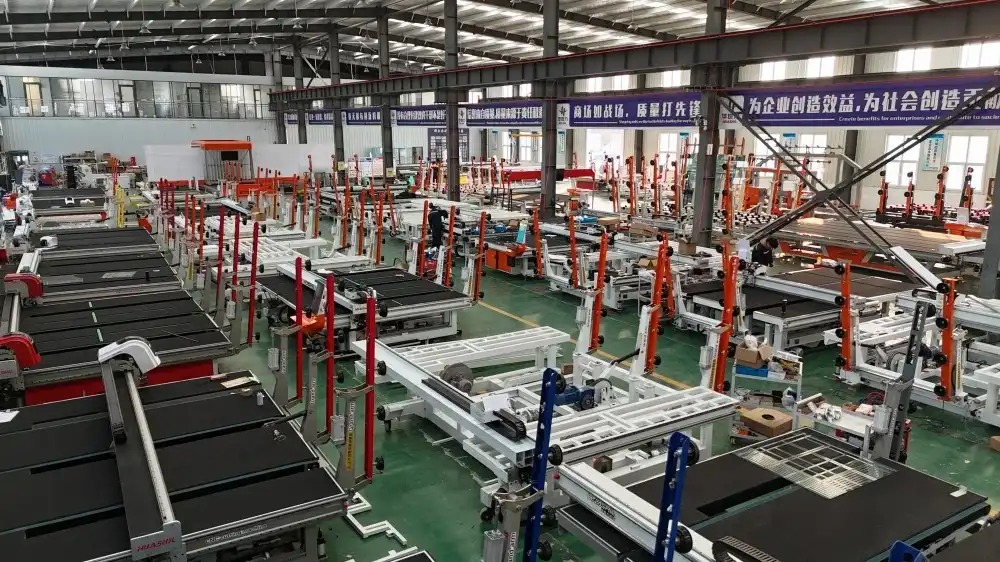
When selecting an automatic cutting machine for laminated glass, consider your daily processing volume, maximum glass sheet size, thickness range, interlayer material, required product shapes, and expected business growth over the next three to five years. Develop a weighted evaluation system covering equipment performance, warranty terms, after-sales service, production speed, safety features, software capabilities, and total cost of ownership. Ask each supplier to demonstrate the machine using your actual glass samples and technical drawings. During testing, evaluate edge quality, dimensional accuracy, cycle time, material waste, and operator workload. For smaller workshops, production flexibility and ease of operation are often key priorities. High-volume manufacturers, however, may place greater emphasis on consistent throughput and integration with downstream washing or inspection equipment. The most suitable cutting solution is one that has been tested and verified using your specific laminated glass materials and production requirements.
Cost, Delivery, Support, and Troubleshooting
Total Cost of Ownership and Quotation
It only has one line for price in the budget. A part of the total cost of ownership for an automatic cutting machine for laminated glass is also the cost of setup, training, energy, materials, repairs, downtime, and scrap. If you print on glass automatically, it costs less, and you don't have to do as much work to make sure the cuts are straight. So that you can get a correct quote, send the glass size, thickness, film type, product drawings, daily output, destination, and AC standard. Be sure to write down the guarantee terms, the wait time, the plant acceptance tests, and the commissioning. A Letter of Credit or a deposit plus the last payment is usually what finance teams look at. Set the payment terms early on to make sure the approval process stays on track.
Common Problems and Fixes
For example, there are clean glass edges with stretched film, uneven sizes, low output even though the speed is high, and results that are different from what was tested in the plant. This can happen because of things like the wrong speed, the wrong heat, worn tools, bad clamping, mistakes in the calibration, and test material that doesn't match production. I believe you should make one setting change at a time while you check the tools, clamps, and CNC safety. Note down the amount of time spent on scrap, repair, cycle time, and downtime every week. That record tells you if the issue is with the machine, the person using it, or the materials it is made of.
Why a Specialized Supplier Matters
If a supplier knows about PVB, EVA, and other layers in between, they won't always order monolithic glass of those types. Shandong Huashil Automation Technology Co., LTD works on mechanical tool research and development, makes them, and sells them. It's been a long time since they made and sent goods abroad. Buyers should ask for clear specs, instructions on how to install and use the product, troubleshooting guides, plans for spare parts, and quick help from experts. For OEM and distributor projects, the software may need to be changed, or the sizes may need to be made to order. This is what you should know before you sign.
Conclusion
Force, speed, and heat all work together to cut automatic cutting machine for laminated glass products. To keep the quality the same, the cycle is sped up only when the interlayer stays separate. The score and break are controlled by pressure. You should make test cuts with real materials because PVB and EVA films behave in different ways. This machine can cut between 0.38 and 1.52 mm film, go at a speed of 100 m/min, and be placed photoelectrically. Its specs help people choose the right machine for their needs. CNC control, stacking, a stable frame, and linear guides all make it possible to get the same results over and over again. How much something is worth in the long run depends on how much it costs to own, repair, and replace parts.
FAQ
1. How should I cut toughened safety glass the best?
The output, shape, type of interlayer, and thickness of the glass all play a role. Most of the time, heat is used to score both layers, break them, and separate the film. For mixed orders, the most reliable results come from an automatic cutting machine for laminated glass with CNC that loads and nests itself.
2. Should the settings for PVB be different from those for EVA?
Yes. Each film needs its own tried-and-true recipe because force and heat can change them in different ways. Test cuts should be made with your production glass and film before you give the go-ahead.
3. How do I write something to get a quote?
Tell us about the size, thickness, type, and thickness of the film, models, daily output, where the glass is going, and the electricity standard. A HUASHIL engineer will then check to see if the 3800 mm cutting length and the range of 3+3 to 8+8 mm will work for your project.
4. How fast does the machine cut?
It cuts at 100 m/min. It also matters how the sheets are loaded, placed, broken, and mixed, so get cycle-time data from your own samples.
Request a Technical Recommendation for Your Laminated Glass Line
You can email HUASHIL at salescathy@sdhuashil.com with information about the glass sizes, films, drawings, and amounts you want to print. Before giving you a quote, the company that makes automatic cutting machine for laminated glass units looks at your samples to make sure the machine will work with your process. We then give you a quote that covers delivery, setup, training, and any extra parts you may need. OEMs and integrators can also ask us to do things.
References
1. ASTM C1172 – Standard Specification for Laminated Architectural Flat Glass, ASTM International, 2019
2. ASTM C1036 – Standard Specification for Flat Glass, ASTM International, 2021
3. ANSI Z97.1 – Safety Glazing Materials Used in Buildings, American National Standards Institute, 2015
4. Safety Standard for Architectural Glazing Materials (16 CFR Part 1201), U.S. Consumer Product Safety Commission, 1977
5. Structural Use of Glass, International Association for Bridge and Structural Engineering (IABSE), 2008
6. Glass in Building: A Guide to Modern Architectural Glass Performance, Butterworth-Heinemann, 1993