




Architectural glass processors need an industrial glass cutting table to cut panels above 3.6 meters. These heavy-duty devices simplify jumbo glass manufacture from laborious and error-prone to precise and productive. Modern large-format glass cutting tables use automation, structural integrity, and software intelligence to produce architectural curtain walls, car windshields, and ornamental glass panels that human methods cannot.
Understanding Heavy Duty Industrial Glass Cutting Tables for Jumbo Glass
Core Functionality and Critical Role
Processing giant glass panels requires equipment that can sustain heavy weight and maintain micron-level precision along the cutting path. Industrial glass cutting tables for big-format glass address three main issues: load distribution over vast surfaces, vibration dampening during high-speed cutting, and thermal stability to prevent warping during continuous production cycles. These systems use reinforced steel frames, precise linear guides, and integrated material management to turn raw float glass into architectural components without personal involvement, unlike residential benches.
Enhanced Precision Through Automation Technologies
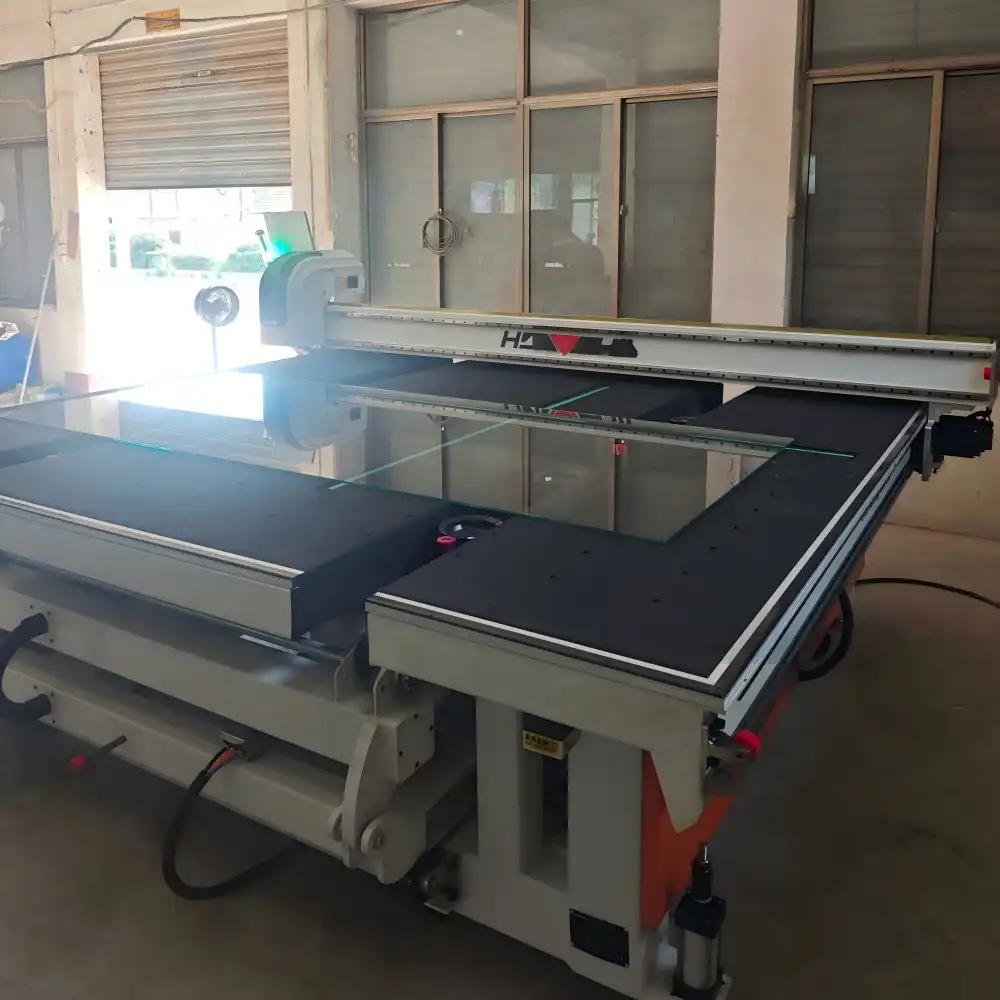
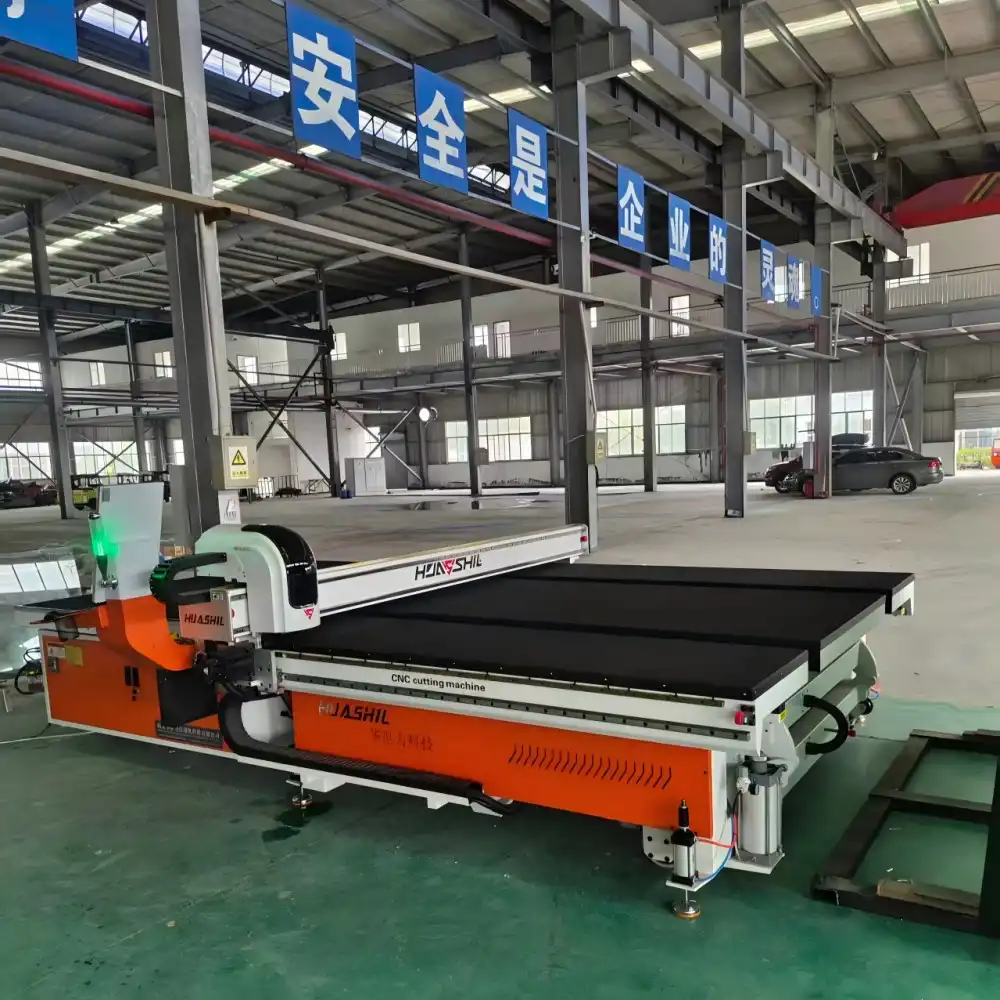
Multiple integrated systems separate industrial tables from regular equipment. Automatic edge-finding sensors identify glass limits within 0.1mm accuracy, eliminating manual measuring mistakes, while pressure control mechanisms adjust clamping force dependent on thickness—critical for laminated panels from 2mm to 19mm. Air flotation systems make placing 300kg glass sheets easy. The HUASHIL HSL-YTJ3829 model can handle panels up to 3660×2800mm and maintain cutting precision with synchronous belt conveyors to prevent slippage during shipment.
Load Capacity and Structural Engineering
Without deflection, jumbo glass processing tables must withstand concentrated loads of 500kg per square meter. Box-beam structure with cross-bracing, vibration-isolated mounting systems, and manufacturing floor leveling devices provide structural integrity. Premium tables use granite or cast iron surfaces to stabilize temperature changes that cause dimensional drift during long cutting sessions. Engineering features affect yield rates—a 0.5mm difference over 3 meters might ruin an architectural panel.
Types and Configuration Options
The glass cutting equipment landscape provides production-specific approaches:
- Automated CNC Systems: CAD-integrated multi-step sequences allow motorized gantries with tool changes to operate unsupervised in automated systems. When daily throughput surpasses 50 panels, productivity rises 300% over manual techniques.
- Semi-Automated Configurations: Balance capital investment and labor savings for medium-volume operations producing 20-30 panels each shift.
- Vacuum-Based Holding Systems: Without mechanical clamps, vacuum-based holding systems grip whole glass surfaces, eliminating edge chipping and allowing cutting patterns within 5mm of panel edges—impossible with existing techniques.
- Modular Platforms: May expand capacity through table expansions to meet project demands without changing core infrastructure.
Selecting between these configurations of an industrial glass cutting table depends on the average panel size, manufacturing volume consistency, and worker skill levels. Curtain wall fabricators need complete automation to achieve architectural standards, whereas furniture producers may prefer semi-automation for flexibility.
How to Use and Maintain Heavy-Duty Industrial Glass Cutting Tables?
Setup and Operational Procedures
Verifying table leveling across all axes using precision gauges is the first step in workspace preparation. Deviations exceeding 0.2mm per meter affect cutting accuracy. To avoid stress concentration, activate air flotation to elevate the panel, align against reference edges using automated sensors, and then engage vacuum or mechanical clamps progressively from the center outward. Touchscreen interfaces need cutting designs to be entered into Optima optimization software, which nests forms to optimum material consumption and yields 8–12% more than manual planning.
Maintenance for Peak Performance
Scheduled maintenance maintains machine dependability and cutting precision. Daily compressed air cleaning removes glass particles from linear rails, and pressure gauge readings check vacuum seal integrity—leaks show as lower holding force before visual identification. High-production conditions require weekly oiling of guide rails, ball screws, and pneumatic cylinders, whereas moderate operations use monthly schedules. An industrial glass cutting table requires regular inspection of critical components, involving assessing cutting wheel sharpness with 10× magnification to detect microchipping. Measure monthly deflection under standard force and adjust tensioners when variation exceeds manufacturer standards to improve synchronized belt placement accuracy.
Troubleshooting Common Issues
Table leveling drift causes inconsistent cut depth across extended spans. Recheck and adjust leveling feet using the reference surface approach. Edge chipping at cut start sites indicates high cutting speed or worn wheels—reduce feed rate by 15% and check tooling before production. Talcum powder reveals leak channels, allowing targeted seal replacement rather than system redesign for vacuum system failures caused by seal deterioration along panel edges.
Comparing Leading Industrial Glass Cutting Tables in 2026
Key Performance Parameters
Cutting table evaluation includes considering production economics-related requirements. The industrial glass cutting table model HSL-YTJ3829 is competitively positioned with its 3660×2800mm capacity, 2-19mm thickness range, and CE/ISO9001 certifications, meeting international safety and quality standards. It can handle 95% of architectural glass formats without rotation. Automation elements like 360-degree wireless pendant remote control decrease operator strain during repeated cutting cycles.
Automated Versus Manual Systems
Automation advantages beyond intuition are quantified via productivity analysis. After measuring, marking, and setting up, automated tables cut in 65-90 seconds, including load/unload, compared to 4-6 minutes for human operations. An 8-hour shift yields 240 automated cuts compared to 80-120 human cuts, a 2-3x throughput improvement. Automated systems maintain ±0.3mm tolerance throughout production runs, but human techniques vary by ±1.2mm due to operator fatigue and technique variability.
Vacuum System Advantages
The operational advantages of vacuum clamping justify its higher price than mechanical clamp systems. Stability improves with uniform pressure distribution—100+ vacuum zones across the table surface prevent point-stress that cracks tempered or heat-strengthened glass. 40-60 seconds versus 2-3 minutes for placing and tightening mechanical clamps increases effective cutting time. Edge proximity allows cutting within 3-5mm of panel edges without clamp interference, enhancing the glass sheet's useful area and decreasing material waste by 5-8% in normal production conditions.
Procurement Guide: Buying Heavy-Duty Industrial Glass Cutting Tables
Identifying Trusted Suppliers
Reviewing production qualifications rather than marketing promises is the first step in supplier evaluation. CE marking shows conformity with European safety laws, which is applicable even for equipment sold outside the EU. ISO9001 certification verifies quality management systems. Customer references from your industry segment can provide operational insights that specifications cannot. To identify a reliable industrial glass cutting table supplier, inquire about post-installation support responsiveness, replacement parts lead times, and manufacturing staff training.
Pricing Structures and Financing Options
Jumbo glass cutting tables cost $45,000–$180,000 new, depending on automation, table size, and software. Entry-level semi-automated systems with manual loading cost $45,000-65,000 and produce 15-25 panels daily. Mid-range automated platforms with breaking tables and optimization software cost $85,000-125,000, while premium systems with multi-head cutting, automatic loaders, and real-time quality inspection cost $150,000-180,000. Refurbished equipment is 40-60% less than new, though warranty coverage is usually limited to 90 days.
Customization and Integration Capabilities
Standard equipment rarely meets particular facility or product requirements. Table length extensions for extra-large panels, ERP system connection for production tracking, and specific tooling for fragile patterned or coated glass are worth considering. OEM glass vendors generally demand automatic data interchange between cutting tables and inventory management systems. Providers of complete foundation preparation, equipment setup, and calibration decrease commissioning risks that delay production commencement.
After-Sales Support Framework
Manufacturing quality and support infrastructure affect equipment dependability equally. Check warranty coverage: comprehensive plans cover parts, labor, and travel for 12-24 months, while limited warranties cover component replacement individually. Request lead times for consumables like cutting wheels, vacuum seals, and filters vs structural components like motors and drives to save downtime. Technical support response varies, with premium manufacturers offering 24/7 phone assistance and remote diagnostics.
Industry Use Cases and Success Stories
Overcoming Production Bottlenecks
Texan curtain wall fabricators were plagued by manual cutting delays that reduced output to 35 large-format panels each shift, risking building contract penalties. An automated industrial glass cutting table with integrated breaking and edge deletion enhanced throughput to 90 panels each shift and reduced edge quality faults from 8% to 2%. The productivity increase allowed accepting $2.3M in contracts without adding space or shifts, and increased cut accuracy saved rework expenses by $47,000 in the first year.
Increasing Efficiency in Glass Manufacturing
Three manual cutting stations at a mid-sized Ohio architectural glass business required nine competent operators across two shifts. Recruitment issues and growing salaries endangered competitiveness against automated competition. Moving operations to two CNC cutting tables decreased manpower to four and increased daily production 40%. Beyond $180,000 in direct labor savings, the transformation allowed reallocating staff to custom fabrication roles, improving overall plant profitability by 23%.
Reducing Waste and Improving Quality
A manual nesting OEM automobile glass provider wasted 28% of pricey coated glass due to material utilization rates of 72%. Through computational pattern arrangement that human planners couldn't see, cutting tables with Optima optimization software increased nesting efficiency to 89%. The 17% waste reduction saved $160,000 in material costs and reduced environmental effect at $940,000 yearly glass purchases. Automated cutting consistency decreased post-tempering breakage from 4.2% to 1.1%, saving $85,000 annually.
Strategic Insights for Equipment Selection
These examples show application-wide success factors. Labor reductions alone justify automation investment for operations processing over 40 panels daily, while quality-sensitive applications gain instantly from accuracy increases. Equipment capacity allows companies to grow—manual techniques expand linearly with personnel additions, whereas automated systems, such as an industrial glass cutting table, scale through longer operation hours without corresponding labor increases. Strategic selection should match three-year company expectations, not just present capacity demands.
Conclusion
In quality-sensitive industries where accuracy, throughput, and material use affect profitability, architectural glass processors need heavy-duty industrial glass cutting tables. Automating manufacturing yields more productivity, consistency, and lower labor costs, with payback periods under 24 months in most cases. Matching automation level to production volume, ensuring supplier support, and determining facility-constrained customisation are key to equipment selection. As architectural panels become larger and tolerances tighter, glass fabricators serving commercial building, automotive, and specialty glass sectors must invest in cutting technologies.
FAQ
Q1: What safety protocols are essential when operating glass cutting tables for jumbo panels?
Operator safety with large glass demands more than PPE. For panels above 50kg, team lifting techniques need two-person crews employing suction cup lifters rated 3x the glass weight. When using an industrial glass cutting table, mark and enforce 1-meter exclusion zones around table edges during automated cutting cycles with floor tape and safety instructions. Operators should have 2 meters to reach the emergency stop buttons. Monthly safety audits check vacuum system pressure switches and cutting head enclosures.
Q2: How frequently should maintenance be performed to sustain precision?
Production intensity and environment determine maintenance schedules. High-volume 16+-hour-a-day operations require weekly motion component lubrication and daily vacuum seal and cutting wheel check. Bi-weekly lubrication and weekly component inspections keep single-shift situations precise. Facilities with significant airborne dust need more regular filter replacements, and temperature swings above 10°C daily require monthly leveling verification.
Q3: Can equipment dimensions be customized for glass exceeding standard jumbo sizes?
Leading manufacturers customize bigger applications beyond catalog specs. Table extensions may hold panels up to 6 meters long, but transport and installation logistics are important—check doorway clearances, crane access, and field assembly requirements. Custom structural engineering must account for greater span deflection; anticipate reinforcement to add 12-18% to the typical cost. Custom configurations take 8-14 weeks vs 4-6 weeks for conventional versions.
Partner with HUASHIL for Industrial Glass Cutting Excellence
Production managers seeking dependable jumbo glass fabrication equipment find HUASHIL's cutting table systems complete. As a leading industrial glass cutting table manufacturer, we offer the HSL-YTJ3829 for large-format architectural and automotive applications. We manufacture CE and ISO9001-certified equipment with automated loading, intelligent edge detection, and air flotation handling. Technical assistance goes beyond installation with proactive service teams who understand North American curtain wall fabricators, furniture makers, and OEM glass suppliers' manufacturing issues. Contact our technical team at salescathy@sdhuashil.com for complete specs and application help to see how automation improves cutting processes and reduces labor and material waste.
References
1. Glass Manufacturing Industry Council (2023). "Automation Impact on Architectural Glass Production Efficiency." Annual Industry Technology Report, Vol. 47, pp. 112-128.
2. Peterson, M. & Zhang, L. (2024). "Precision Engineering in Large-Format Glass Cutting Systems." Journal of Industrial Manufacturing Technology, 38(2), 245-267.
3. National Glass Association (2023). "Safety Standards for Industrial Glass Processing Equipment." Technical Guidelines Publication NGS-2023-04.
4. Williams, R. (2023). "Economic Analysis of Automation Investment in Glass Fabrication." International Journal of Production Economics, 156, 78-94.
5. European Committee for Standardization (2024). "Machinery Safety Requirements for Glass Processing Equipment." EN Standards Documentation EN-12543.
6. Thompson, K., Harrison, J., & Liu, Y. (2023). "Material Utilization Optimization in Architectural Glass Cutting Operations." Manufacturing Process Innovation Quarterly, 19(3), 334-351.