




If you own a glass fabrication facility or curtain wall manufacturing line, you already know the demand to lower costs, increase productivity, and maintain consistent quality. How much automation can an automatic double glass processing machine processing machine really provide? This is one of the questions I regularly hear from plant managers and purchasing departments. The answer varies by model and configuration — but with today's technology, the amount of automation is astounding. A good automated double glass processing machine can do the glass loading, cutting, breaking, and optimizing with little human intervention, hence decreasing the reliance on labor and enhancing the dimensional accuracy for each shift.
Understanding Automation in Double Glass Processing Machines
Before evaluating possibilities, it is helpful to grasp what “automation” really implies in glass production. It’s not simply hands replaced by motors; it’s PLC-controlled sequences, sensor feedback loops, and software-driven decision-making.
What Defines Automation in Glass Processing
Here, automation involves the ability of the machine to take a cutting plan, place the glass, make cuts, and transfer the glass to the next station without a human directing each step. The amount of control shows how much attention from people is still needed in the process.
Semi-Automatic vs. Fully Automatic Systems
Semi-automatic devices need an operator to load the glass or to start the breaking manually. The HUASHIL HSL-LSX5133 and similar fully automated machines do the loading, cutting, and breaking in one continuous operation. Each step is sent to the next without any human interaction.
The Role of PLC and Optimization Software
Today’s glass cutting lines combine PLC controls with optimization software. Before the machine starts, the HUASHIL HSL-LSX5133 determines the most material-efficient cutting pattern using Optima software. This cuts down on glass waste and shortens cycle time on each task.
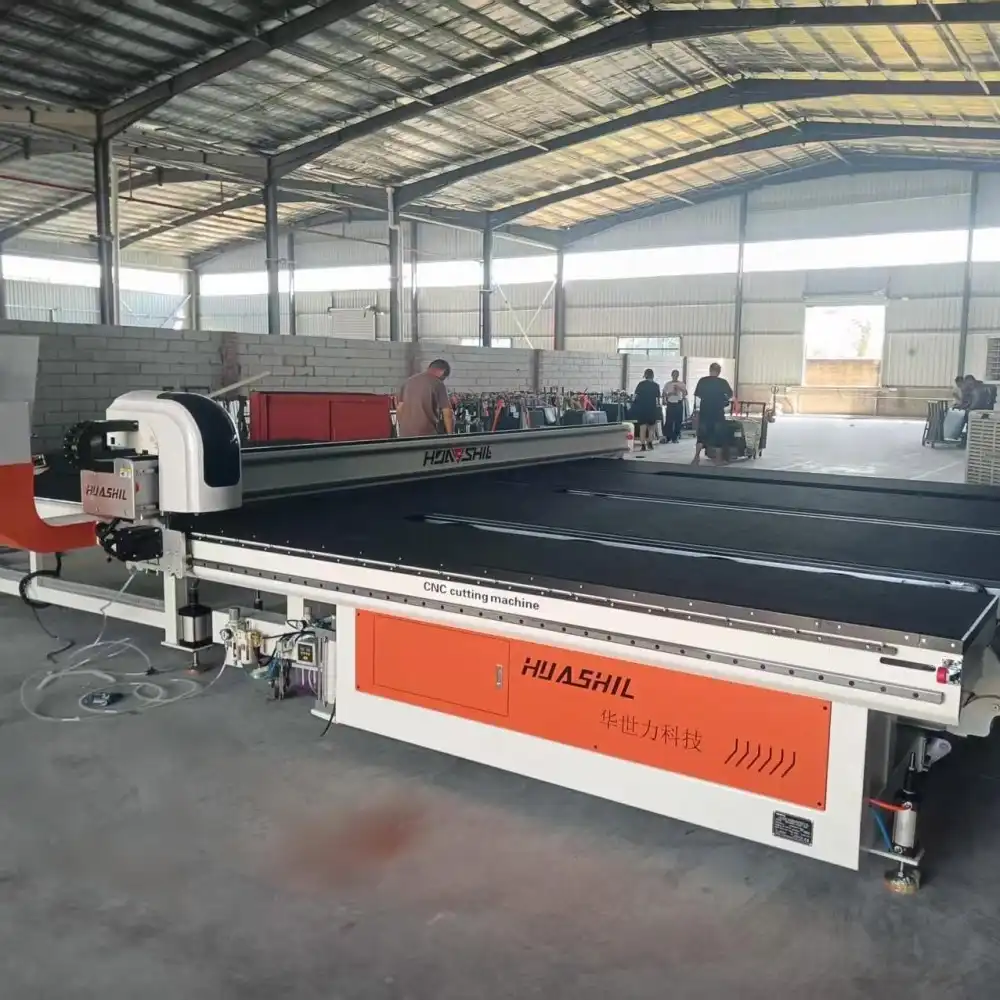
Core Features and Benefits of Highly Automated Double Glass Processing Machines
To me, the difference between a high-automation machine and a basic cutter is the fact that there are integrated subsystems that operate together. The HUASHIL HSL-LSX5133 is an excellent reference in this context.
Three-Table Workflow: Loading, Cutting, and Breaking
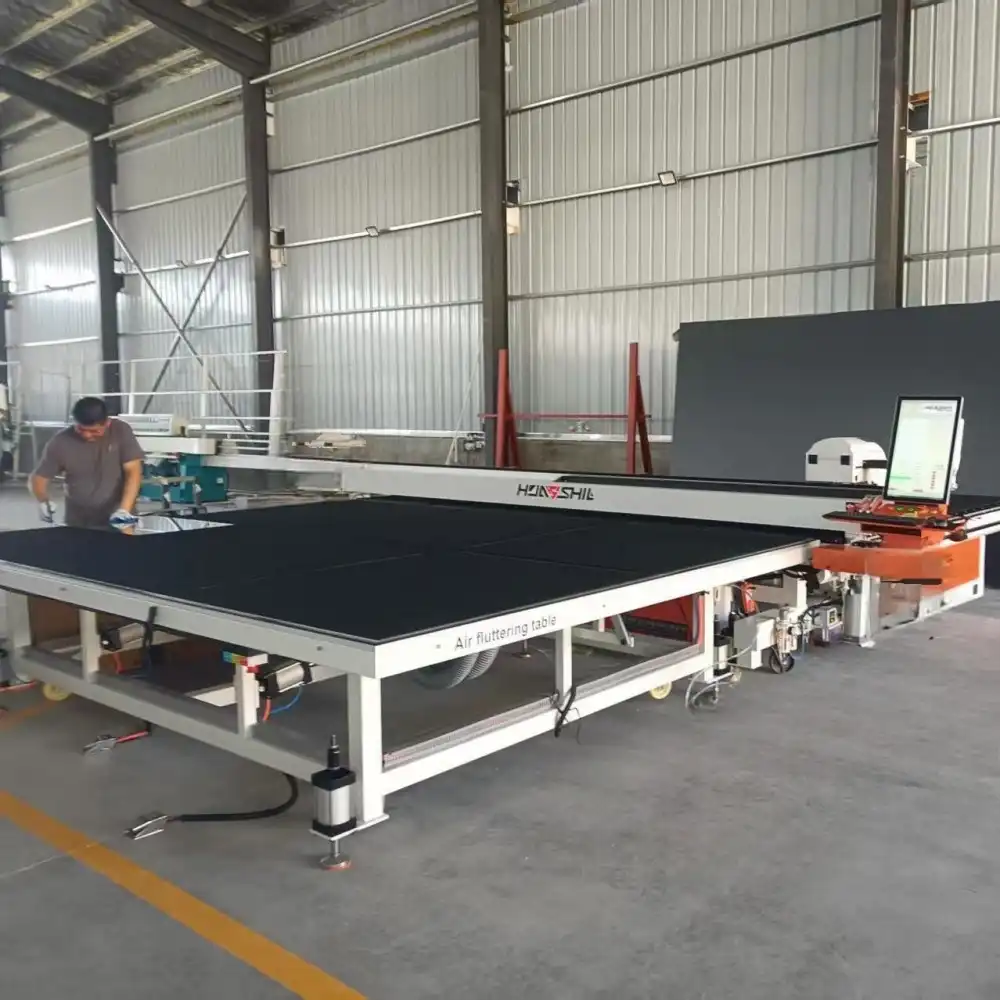
The HSL-LSX5133 is equipped with 3 special work tables in a sequence line: loading table, cutting table, and breaking table. The automatic double glass processing machine is mechanically fed from one station to the next. The three-table setup allows things to go from one stage to the next without bottlenecks.
Five-Arm Handling and Dual-Side Station Design
Five grand arms on each side of the machine for glass transfer spread the load and limit the chances of breakage during movement. The machine provides a 2+2 station configuration (configurable per production requirement), and runs on either above-ground or subterranean rail systems — providing plant engineers flexibility in floor layout design.
Large-Format Capacity and Material Throughput
The HSL-LSX5133 handles glass sheets up to 5100 x 3300 mm – a size range that represents most architectural and curtain wall applications. This capability means that glass fabricators working with huge panels for commercial windows or facades no longer need to pre-cut larger sheets manually.
Here are some of the key benefits this machine brings to production teams:
- Optima software integration generates ideal cut routes prior to processing, decreasing material waste throughout manufacturing cycles.
- A sequential three-table arrangement minimizes idle time between stages as glass goes from loading to breaking.
- It has five grand arms per side and handles huge or heavy glass sheets in a steady, dispersed way and requires no human help.
- Plant managers may reconfigure 2+2 stations to change the line arrangement according to order volume or product type.
- The choice of overhead or underfloor rail systems allows engineering teams to incorporate the machine into the configuration of an existing facility without substantial floor renovation.
The benefits immediately address the everyday production difficulties that U.S. glass fabrication plant managers face – the expense of labor, the restrictions of floor space, and consistent output quality.
Comparing Manual, Semi-Automatic, and Fully Automatic Machines for B2B Procurement
Choosing the correct amount of automation is not simply a technological choice, but a financial and a capacity decision. Here’s a realistic summary for procurement teams analyzing their options:
Manual Machines: Low Entry Cost, High Labor Dependency
Skilled workers are required to score, shatter, and place the glass on cutting tables used for manual processes. Labor expenses add up rapidly, and dimensional uniformity is all operator skill. Manual equipment still works for specialist work in low volumes – but it doesn’t scale.
Semi-Automatic Systems: A Middle Ground
Semi-automatic lines are automated for cutting but still require people at the breaking or loading step. They are less expensive to install than fully automated systems and are ideal for mid-sized fabricators with modest production. Labor reductions are modest, but throughput is restricted by the slowest manual step.
Fully Automatic Lines: Built for Scale
The HSL-LSX5133 fully automated glass cutting line is the best investment return for businesses with large volume. The Glass Processing Equipment market segment data indicates that automated glass cutting lines may lower labor expenses per unit by 40-60% compared to manual processes, while increasing dimensional accuracy to within ±0.1 mm. The ROI case is easy for curtain wall integrators or window fabrication operations producing thousands of pieces each week.
Maintenance and Troubleshooting in Automated Double Glass Processing Machines
Automation provides capabilities, but it also adds parts that need to be attended to. Knowing what upkeep is required before you buy is as vital as knowing the features.
Routine Preventive Protocols
Scheduled maintenance is the best approach to keep the line working reliably. On an automatic double glass processing machine cutting and breaking line, routine maintenance includes rail alignment, drive component lubrication, sensor calibration checks, and PLC software updates as released by the manufacturer. HUASHIL offers complete technical documentation of the HSL-LSX5133 to facilitate in-house maintenance teams.
Common Fault Scenarios and Resolutions
Sensor misalignment, which often results in positioning mistakes or false stops, is one of the most common problems on automated glass lines. Most issues resolve with recalibration without part replacement. Program issues that occur while uploading cutting plans are usually caused by incompatibility of file formats, which is resolved by the Optima program using conventional import procedures.
When to Contact Supplier Support
If there is a defect in the PLC logic or a mechanical component is worn beyond the ability to be corrected by calibration, then it is appropriate to contact the equipment provider directly. HUASHIL provides worldwide technical assistance for customers, and replacement parts are a standard service promise. This is a detail that procurement managers should establish in writing before concluding any transaction.
Future Trends and Innovations in Double Glass Processing Automation
The market for glass processing equipment is developing toward smart and linked production systems. Buyers contemplating a capital expenditure now need to consider where the technology is going.
AI-Driven Predictive Maintenance
Machine learning techniques can now monitor vibration, temperature, and cycle data to warn of component deterioration before it fails. This translates into fewer unscheduled pauses and more predictable maintenance scheduling for high-volume glass lines – a genuine operational benefit versus reactive repair solutions.
Industry 4.0 Integration
Increasingly, new glass production lines are being connected to factory-wide management systems via IoT protocols. This means that production data like yield rates, downtime events, and material consumption may go directly into ERP or MES systems, offering plant managers real-time access throughout the whole floor.
Sustainability and Energy Efficiency
Automation in the cutting process reduces glass waste compared to human techniques, since optimization software makes the most of each sheet. As the prices of energy and raw materials go up in U.S. manufacturing, this efficiency advantage becomes a meaningful cost savings that finance teams can measure and report.
Conclusion
Float automatic double glass processing machine manufacturing has been automated to the point that one production line can process big format glass from loading to breaking with minimum operator input. A good example of this is the HUASHIL HSL-LSX5133, which, with Optima software, a three-table arrangement, five-arm handling per side, and a maximum glass size of 5100 × 3300 mm, satisfies the basic needs for architectural glass fabrication, curtain wall production, and window manufacture. If you’re a plant manager considering a line update or a procurement team looking at vendors, today’s level of automation should be enough to have you thinking about a major investment.
FAQ
1. Does automated glass cutting actually improve quality over manual methods?
Yes. Automated systems cut to programmed dimensions with consistent repeatability — typically within ±0.1 mm. Manual cutting introduces variation based on operator skill and fatigue. For fabricators producing architectural glass or curtain wall panels where tolerances matter, the quality difference is measurable and significant.
2. Is a fully automatic glass cutting line suitable for mid-sized companies?
It depends on volume. If your plant processes several hundred to several thousand glass sheets per week, a fully automatic line can deliver labor savings that justify the investment within a reasonable payback period. For smaller operations, a semi-automatic configuration may offer a better cost-to-output balance initially.
3. What does routine maintenance look like for a fully automated glass processing line?
Typical maintenance includes weekly rail and guide inspections, monthly lubrication of mechanical drive systems, periodic sensor calibration, and software version checks. HUASHIL provides maintenance documentation and remote technical support to help international clients manage upkeep without specialized local technicians on standby.
Ready to Upgrade Your Glass Processing Line? Contact HUASHIL Today
HUASHIL is a high-tech manufacturing enterprise with years of experience producing and exporting automated glass processing equipment to clients worldwide. The HSL-LSX5133 automatic double glass processing machine represents the kind of reliable, production-tested equipment that plant managers trust for high-volume output. As a direct automatic double glass processing machine manufacturer, HUASHIL offers technical consultations, detailed specifications, and competitive pricing. Reach out to the team at salescathy@sdhuashil.com to request a quote.
References
1. Glass Processing Equipment Market Report — Grand View Research, 2023
2. Automation in Flat Glass Manufacturing — Glass Worldwide Magazine, 2022
3. Industry 4.0 Applications in Glass Fabrication — International Journal of Advanced Manufacturing Technology, 2021
4. Energy Efficiency in Glass Processing Operations — U.S. Department of Energy Industrial Technologies Program, 2020
5. PLC-Based Control Systems for Industrial Glass Lines — Journal of Manufacturing Systems, 2022
6. Optimization Algorithms for Glass Cutting Layout — Computers & Operations Research, 2021