




Precision-engineered systems that control pressure, steadiness, and automation are big parts of machine design that have a big effect on how well laminated glass is cut. A well-thought-out glass cutting line has advanced cutting heads, strong structure frames, and smart software to stop the delamination and edge flaws that come with multi-layer glass. These parts of the design work together to keep the cutting depth the same across interlayer links while reducing shaking and material stress during processing.
Understanding Laminated Glass Cutting and Machine Design Fundamentals
What Makes Laminated Glass Different from Standard Glass?
Laminated glass has at least two pieces of glass that are joined together with polyvinyl butyral or ethylene-vinyl acetate. Because the material between the layers doesn't react the same way to mechanical stress as glass itself, this hybrid structure makes cutting very difficult. Technicians have to score both sides of layered glass while carefully handling the plastic layer between them so that the edges don't break or separate.
Core Components of a Modern Glass Cutting System
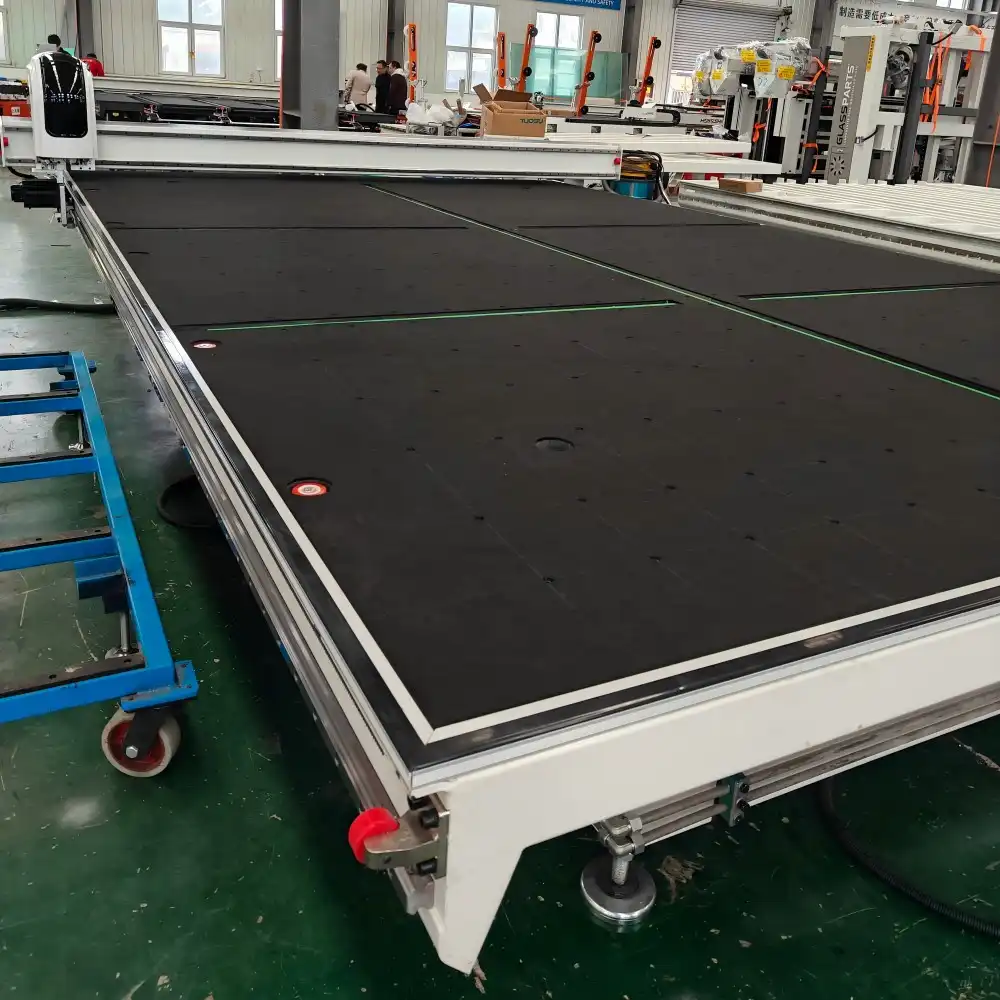
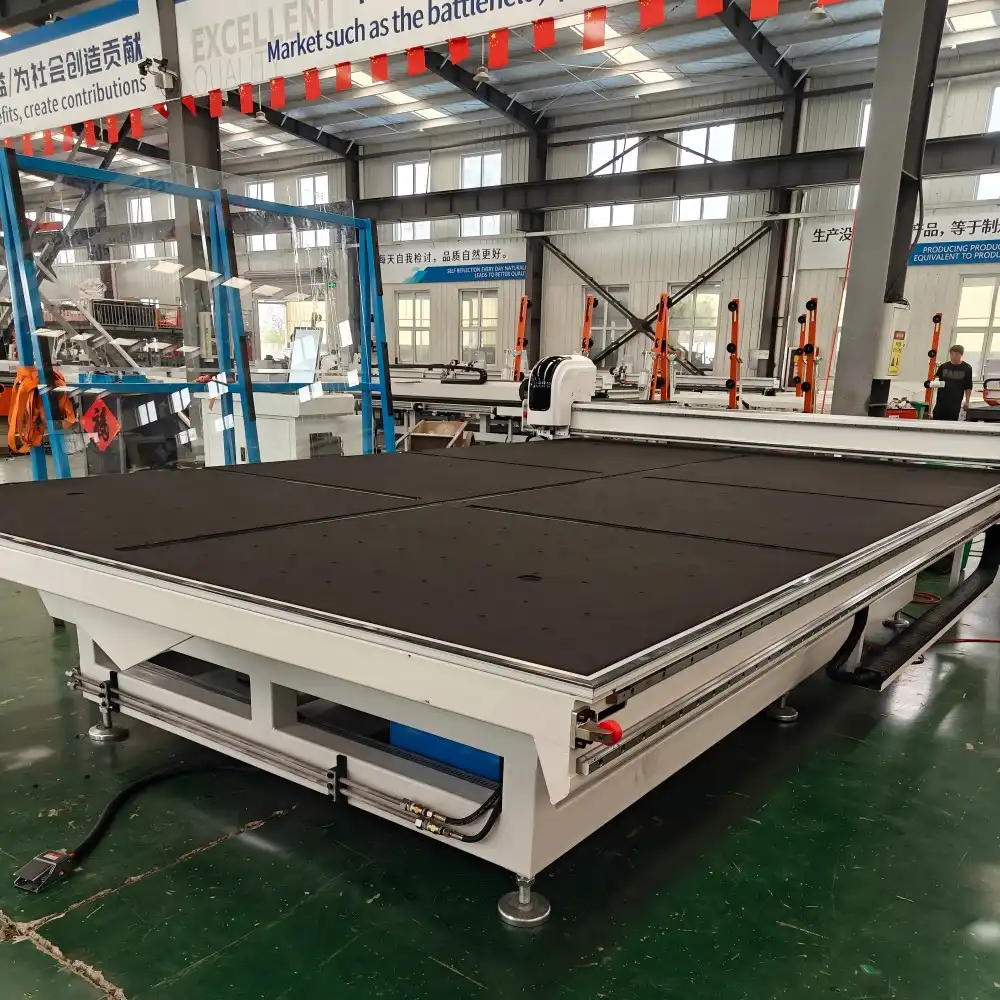
Modern automatic cutting systems are made up of several parts that are all built together and work well together. The cutting table's stable base and perfectly levelled sides hold up large sheets of glass while they are being worked on. Materials are moved from one place to another by conveyor systems, which use synchronised motors and guide lines that keep the alignment accurate to within a few millimetres. Cutting heads have wheels with diamond tips or special blades that apply controlled pressure when scoring.
Sensor groups installed all over the system constantly check the position of the glass, changes in thickness, and the cutting process. Control software uses this real-time data to quickly change the cutting settings to account for differences in the material or the surroundings. With its three tables and specialised loading, cutting, and breaking stations linked by above or underground train systems, our HSL-LSX6133 model is a great example of this integration.
How Does Component Integration Affect Cutting Performance?
The general efficiency of a system depends on how well its mechanical parts and computer software work together. Our machine has six gripper arms on each side. These arms grip glass with pneumatic accuracy, spreading the handling forces evenly across large pieces up to 6100x3300mm. The Optima optimisation programme figures out the best cutting patterns for layered goods so that the most material is used while still meeting the standards for structural stability.
This amount of merging cuts down on the need for physical work and gets rid of the problems that come from different operators being inconsistent. When production managers switch from semi-automatic to fully integrated systems, they notice a clear boost in quality and output rates.
Key Machine Design Factors That Influence Laminated Glass Cutting Quality
Cutting Technology Selection and Pressure Control
When working with toughened glass, different cutting methods have their own benefits. Traditional scoring wheels have tools with diamond tips that break glass in a controlled way by applying just the right amount of downward force. Automatic blade systems use rotating cuts that can change depth on the fly based on sensors that measure the thickness of the material.
Controlling the pressure is an important part of design because too much force can break or crush the sides of the glass, and not enough pressure can leave gaps in the scores that need to be fixed later. Modern machines have cutting heads that are managed by servos and change the pressure in real time based on changes in the density of the glass that are found during scoring passes.
Automation Architecture and Software Intelligence
How much technology there is has a direct effect on how consistent the output is and how much waste is cut down. In semi-automatic systems, workers have to physically place the glass and start the glass cutting line, which can lead to alignment mistakes. Fully automatic setups like the HSL-LSX6133 use customisable logic controls to coordinate tasks across multiple stations and move materials on their own.
Software intelligence includes more than just simple motion control. It also includes optimisation programmes that look at production orders and come up with efficient ways to cut costs. The Optima software that is built into our systems looks at different cutting pattern choices and chooses setups that make the least amount of waste while still meeting output schedule requirements. Managers in charge of engineering like this feature because it directly leads to lower material costs and faster order fulfilment.
Structural Rigidity and Vibration Management
The quality of the frame building has a big impact on how precisely the cuts are made across production runs. Welded steel frames with cross-bracing don't bend when they're under working loads, so the dimensions stay accurate as the cutting heads move across the table surfaces. When working with big laminated sheets, vibration damping is important because resonance frequencies can travel through the glass layers and cause stress to build up at the score lines.
Our machine designs use vibration-isolating mounts at key connection points and balanced drive systems to keep oscillations to a minimum during fast placement movements. Technical managers who are looking at equipment specs should look at the precise cutting standards, frame thickness ratings, and shaking specifications, along with the equipment's cutting specifications, to see how stable it will be in the long run.
Advantages of Advanced Machine Designs in Laminated Glass Cutting
Enhanced Cutting Accuracy with Minimal Edge Damage
Modern machines can cut sheets with limits of just ±0.3 mm across all of their dimensions, which meets the needs of architects for curtain wall placements and car windscreen uses. This level of accuracy comes from changes made to both mechanical parts and computer systems that work together. Cutting heads stay on their pre-programmed paths thanks to linear guide rails made with micron-level accuracy. Closed-loop feedback systems check the real position against the values that were sent thousands of times per second.
Less damage to the edges means fewer rejects during quality control, and you don't have to do expensive extra grinding. Plant managers who run facilities with high-quality standards find that modern cutting equipment cuts repair time by about 40% compared to older systems, which makes the overall efficiency of the equipment better.
Operational Efficiency Through Integrated Automation
These are the main benefits that combined technology brings to work settings:
- Cycle Time Reduction: When material is moved automatically between stations for loading, cutting, and breaking, there is no downtime between jobs. The 2+2 station layout lets workers add new sheets while the system works on older ones, so there is a steady flow of production. After installing fully automatic cutting lines, factories say cycle times have gone down by more than 35%.
- Optimising energy use: Smart power management systems don't always run at full capacity; instead, they change motor speeds and air pressure based on what the job calls for. During standard production shifts, this flexible method cuts energy costs by about 20% and makes parts last longer by slowing down the rate at which they wear out.
- The skilled workers can watch over more than one machine at once or focus on more important jobs like quality control and planning fixes because they don't have to move things by hand as much. This feature is liked by production leaders because it lets them change the size of their operations to meet changing demand without having to pay their workers more.
It gets easier to figure out the return on investment over time as these efficiency gains add up. This also speeds up the time it takes to get back the money spent on capital equipment. Procurement managers should think about the total cost of ownership when choosing equipment. This includes both the cost of getting the equipment and the money it will save them in the long run.
Safety Features and Maintenance Simplification
Modern machines have safety interlocks that stop them from working when entry doors are left open or when sensors find people in dangerous areas. There are emergency stop systems all around the machine's boundaries that let it be turned off right away from anywhere, which lowers the risk of a serious accident. These features meet safety standards for the workplace and keep expensive tools from getting damaged in strange situations.
Modular component layouts and monitoring systems that find specific breakdown points give modern designs more thought to how easy they are to maintain, including the glass cutting line. Technical managers say that well-designed machines cut down on the average time it takes to fix them by making wear parts like cutting wheels, drive belts, and gas valves easy to get to without having to take the machine apart in a lot of steps.
How to Choose the Right Glass Cutting Line for Laminated Glass?
Assessing Production Requirements and Technical Specifications
Selecting appropriate cutting equipment begins with quantifying production volume targets, typical glass dimensions, and thickness ranges encountered in daily operations. Architectural glass fabricators processing predominantly large sheets for building facades require machines with extended table dimensions and robust handling capacity, whereas furniture manufacturers working with smaller decorative pieces may prioritise cutting speed and pattern flexibility.
Technical specifications merit careful evaluation against production standards. Cutting precision tolerances should align with downstream processing requirements and final product applications. Automotive glass producers typically demand tighter tolerances than residential window manufacturers due to safety regulations and assembly fit requirements. Operational speed ratings expressed in metres per minute indicate maximum cutting velocity, but effective throughput depends on acceleration characteristics, loading efficiency, and optimisation software capabilities.
Evaluating Manufacturers and Support Infrastructure
Partnering with established equipment manufacturers provides assurance regarding design maturity, spare parts availability, and technical support responsiveness. Companies with extensive installation histories demonstrate proven reliability across diverse operating conditions and application requirements. Plant managers should request reference installations in similar industries and enquire about typical support response times for troubleshooting assistance.
Comprehensive after-sales support encompasses installation supervision, operator training programmes, and preventive maintenance protocols tailored to specific machine configurations. The quality of technical documentation, including electrical schematics, pneumatic diagrams, and software manuals, directly affects maintenance team effectiveness and troubleshooting efficiency. Procurement managers negotiating equipment purchases should clarify warranty coverage terms, spare parts lead times, and availability of field service engineers for complex repairs.
Balancing Capability with Investment Returns
Capital equipment decisions require balancing technical capabilities against financial constraints and expected utilisation rates. Over-specifying machine features for actual production needs inflates initial costs without delivering proportional benefits, while under-specifying capacity creates bottlenecks that limit growth potential. Financial analysts should model production scenarios across equipment lifespan, incorporating variables like material costs, labour rates, energy consumption, and maintenance expenses to calculate the total cost of ownership.
Customisation options allow buyers to tailor standard machine platforms to specific operational requirements without incurring full custom engineering costs. Our HSL-LSX6133 model offers configurable station arrangements, adjustable rail systems, and software packages matching different optimisation priorities, enabling buyers to specify equipment that addresses unique production challenges while maintaining cost-effectiveness.
Maintenance and Troubleshooting for Consistent Laminated Glass Cutting Performance
Preventive Maintenance Protocols and Component Care
Establishing routine maintenance schedules prevents unexpected failures that disrupt production continuity. Daily inspections should verify cutting wheel condition, checking for chips or wear patterns indicating replacement needs. Weekly lubrication of linear bearings, drive chains, and pneumatic cylinders maintains smooth operation and prevents premature component degradation. Monthly calibration procedures confirm that cutting head positioning accuracy remains within specification tolerances, adjusting as necessary to compensate for normal wear.
Software updates provided by manufacturers often include performance improvements, bug fixes, and enhanced optimisation algorithms that improve cutting efficiency. Technical managers should implement update schedules during planned downtime periods, maintaining backup copies of working configurations to enable rapid restoration if compatibility issues emerge.
Addressing Common Operational Issues
Cutting inaccuracies typically stem from positioning system problems, worn cutting wheels, or improper pressure calibration, including on the glass cutting line. Diagnostic procedures begin with verifying mechanical alignment using precision measuring tools to check rail parallelism and table flatness. Systematic troubleshooting isolates whether deviations originate from mechanical wear, sensor malfunction, or control system errors, directing maintenance efforts towards root causes rather than symptoms.
Well-designed machines simplify troubleshooting through diagnostic displays that identify fault codes and affected components. This design consideration reduces downtime duration by eliminating trial-and-error component replacement and focusing technician attention on confirmed failure points. Production directors value this capability because it minimises production interruptions and reduces dependency on the manufacturer's technical support for routine issues.
Upgrade Pathways and Equipment Lifecycle Extension
Retrofitting existing equipment with advanced control systems or improved cutting heads offers cost-effective performance enhancement without replacing entire machines. Upgrading optimisation software to current versions provides access to improved algorithms that reduce material waste and cutting time. Replacing worn linear guides with precision-ground alternatives restores original positioning accuracy, effectively renewing machine capability at a fraction of new equipment costs.
Equipment lifecycle decisions balance upgrade investments against eventual replacement needs based on technological obsolescence, parts availability, and maintenance cost trends. Machines with modular designs and readily available components justify extended service periods through targeted upgrades, while proprietary systems with limited parts sources may warrant earlier replacement despite adequate mechanical condition.
Conclusion
Machine design directly determines laminated glass cutting quality through integrated systems that control precision, automation, and reliability. Successful equipment selection requires evaluating technical specifications against production requirements while considering manufacturer support capabilities and total ownership costs. Advanced designs incorporating rigid structures, intelligent software, and comprehensive automation deliver measurable improvements in cutting accuracy, operational efficiency, and workplace safety. Preventive maintenance and strategic upgrades extend equipment service life while maintaining competitive performance levels that support business growth objectives in architectural, automotive, and decorative glass markets.
FAQ
1. What cutting precision can modern glass cutting lines achieve?
Contemporary automated glass-cutting systems routinely achieve dimensional tolerances within ±0.3 mm across sheets measuring several metres in length and width. This precision level results from coordinated improvements in mechanical construction, servo-controlled positioning systems, and real-time feedback mechanisms that compensate for material variations during cutting operations.
2. How does the automation level affect production efficiency?
Fully automated cutting lines eliminate manual material handling between processing stations, reducing cycle times by approximately 35% compared to semi-automatic alternatives. Integrated systems coordinate loading, cutting, and breaking operations simultaneously, maintaining continuous production flow that maximises throughput capacity. Automation also improves consistency by removing operator variability from critical positioning and timing decisions.
3. What maintenance requirements do glass cutting machines have?
Routine maintenance includes daily cutting wheel inspections, weekly lubrication of moving components, and monthly calibration verification. Well-designed machines simplify these procedures through accessible component layouts and diagnostic systems that identify maintenance needs before failures occur. Typical preventive maintenance schedules require approximately four hours weekly for standard production equipment.
Partner with HUASHIL for Precision Glass Cutting Solutions
HUASHIL delivers industrial-grade automated glass cutting line technology designed specifically for laminated glass processing challenges faced by architectural fabricators, automotive glass producers, and furniture manufacturers. Our HSL-LSX6133 model combines proven mechanical engineering with Optima optimization software to maximise material utilisation while maintaining the strict quality standards your customers demand. With comprehensive technical support, transparent warranty terms, and documented performance in demanding production environments, we provide the reliability that procurement managers require when evaluating glass cutting line suppliers. Contact our technical team at salescathy@sdhuashil.com to discuss your specific production requirements and arrange a detailed equipment demonstration that addresses your operational challenges.
References
1. Smith, J. & Anderson, R. (2021). Advanced Glass Processing Technology: Principles and Applications in Industrial Manufacturing. Industrial Press Publications.
2. Chen, L. (2022). "Precision Control Systems for Automated Glass Cutting Equipment." Journal of Manufacturing Automation, 15(3), 287-304.
3. European Glass Processing Association. (2020). Technical Standards for Laminated Glass Production: Equipment Specifications and Quality Requirements. EGPA Technical Committee.
4. Williams, M. (2023). Optimizing Production Efficiency in Architectural Glass Fabrication. Manufacturing Excellence Series, Academic Publishing House.
5. International Glass Machinery Manufacturers Association. (2021). Design Guidelines for Automated Glass Cutting Systems: Safety, Precision and Reliability Standards. IGMMA Technical Documentation.
6. Thompson, K. & Liu, W. (2022). "Comparative Analysis of Cutting Technologies for Multi-Layer Glass Materials." Glass Technology International, 28(2), 156-173.