




Selecting an all in one glass cutting machine requires precision, automation features, production capacity, and total cost of ownership. We've helped dozens of plant managers and purchasing teams choose by considering throughput, automation, warranty terms, and provider reliability. This handbook covers equipment selection factors such as cutting thickness, machine size, maintenance, and certification. Thus, you may purchase equipment that meets your factory's production objectives and boosts efficiency.
Understanding All-in-One Glass Cutting Machines: Features and Benefits
Core Components That Drive Performance
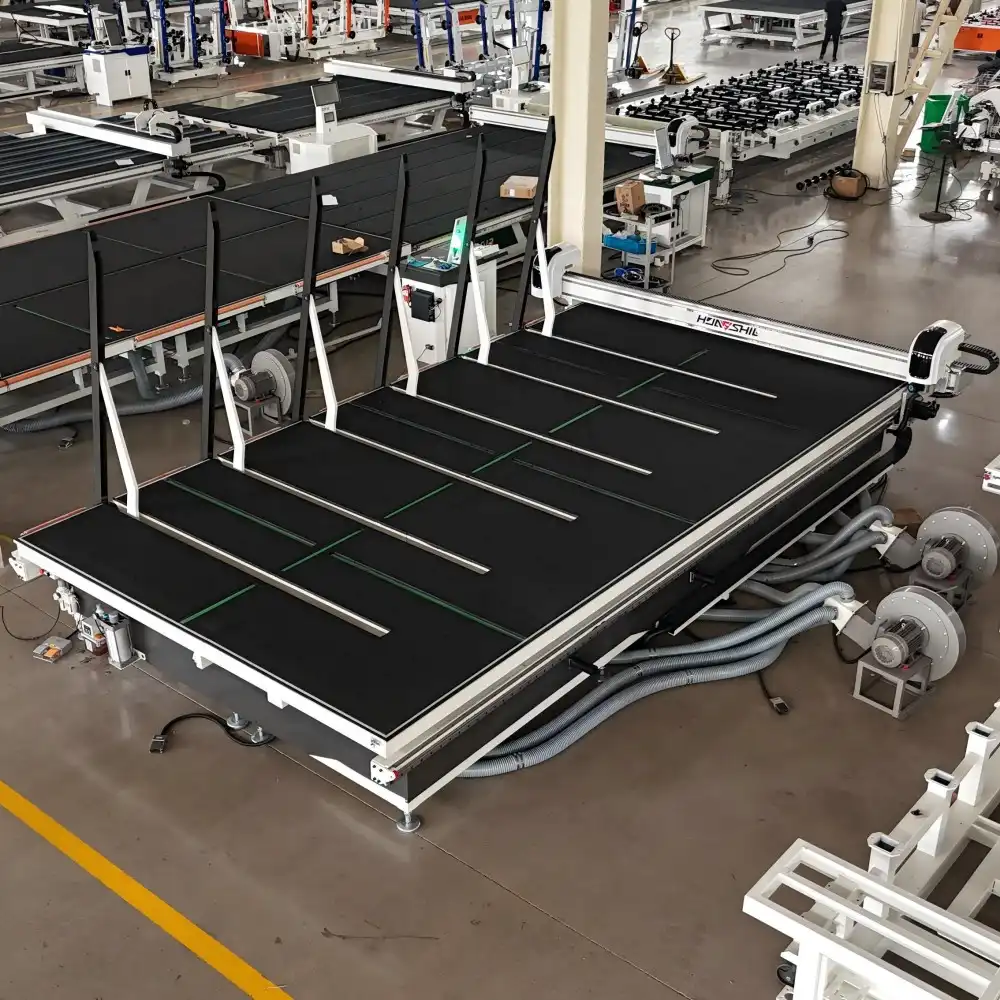
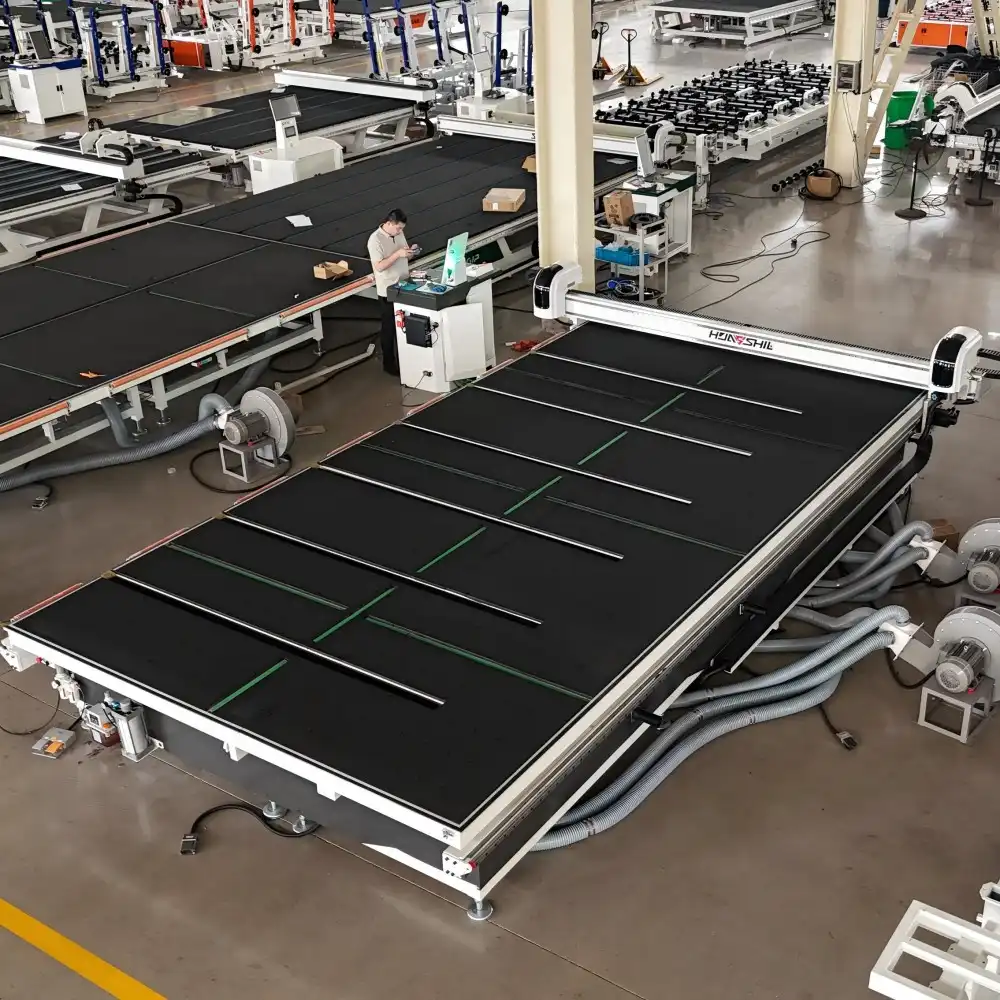
Several crucial pieces operate together in every glass-cutting device. The cutting head's tungsten carbide or diamond wheels determine edge strength and durability. CNC systems manage route accuracy and uniformity, while automated filling systems save manual labor. Modern versions contain air-floating glass sheets. This prevents scratches and makes moving sheets over large workspaces easier.
Modern machines, such as the HSL-YTJ3829, can handle glass up to 3660 x 2800 mm and 2 mm to 19 mm thick, suitable for both thin artistic panels and substantial building glazing. Automatic pressure control adjusts cutting power according to glass type to ensure clean scores and no chips. Automatic sheet-edge-finding sensors reduce setup errors and waste.
Innovations Shaping 2024 Equipment Standards
New innovations use smart technology and less energy. Optimization software like Optima finds the optimal cuts, reducing scrap by 15% compared to human designs. Synchronous belt conveyors transport smooth glass, and built-in breaking tables eliminate the need for breaking equipment.
Safety measures have also evolved. Working remotely using remote-controlled walking devices lets workers control machine movement without being near moving parts. The device satisfies European safety requirements with CE certification, and ISO 9001 certification ensures quality control throughout production. These credentials assure buying teams that the equipment fulfills worldwide workplace safety and product requirements.
Efficiency Gains Over Traditional Cutting Methods
Cutting, cracking, and shaping are done individually by hand or with a machine. Every action has the potential for breakage, surface damage, and dimensional errors. Single-area integrated systems manage glass loading to the final panel, addressing these issues.
When production managers use automated cutting lines, throughput increases by 30–50%. One person overseeing many processes reduces labor expenses compared to numerous people working elsewhere. Consistent automated scoring reduces grinding and increases return rates by making cleaner breaks. Accelerate enhancements, decrease unit costs, and accelerate order turnaround.
Key Criteria to Evaluate When Choosing the Right Machine
Production Volume and Accuracy Requirements
Your daily production objectives dictate the machine automation speed and amount. High-volume architectural glass factories that cut hundreds of panels daily require systems that can load panels continuously and cut glass at over 10 meters per minute. Flexible CNC programming and rapid changeover let mid-sized furniture glass manufacturers create unique shapes.
Varied purposes need varied precision. Curtain wall builders must keep panel sizes within 0.5 mm to accommodate frame systems. Some decorative glassmakers can manage greater restrictions, but they must cut intricate shapes. Check whether your needs involve cutting circles, ellipses, and complicated forms in addition to straight lines.
Budget Considerations and Total Cost of Ownership
Tools are just half of the cost when purchasing an all in one glass cutting machine. To calculate the total cost of ownership, add installation, operator training, software licensing, and regular maintenance. Although they cost more upfront, machines that use less energy, last longer, and break down less frequently offer lower operational expenses.
Warranty coverage protects against early production repair expenditures, which are crucial. Guarantees should include electrical systems, control software, and mechanical parts. Know whether warranty servicing involves a technician visiting you or shipping the item back to the manufacturer. Production plans are affected by downtime.
Maintenance Accessibility and Service Support
Automation equipment requires frequent maintenance to perform effectively. Check whether cutting wheels, belts, and sensors can be obtained locally or imported. Local inventory is crucial since slow-to-arrive spare parts might interrupt production for weeks.
Service networks matter too. Suppliers with U.S. service facilities can dispatch technicians faster and stock popular parts. Remote diagnostics may address simple issues in hours instead of days. Ask vendors about response times, assistance routes, and technician certifications before buying equipment.
Energy Efficiency and Safety Features
Energy expenses are high since glass-cutting gear runs 24/7 during shifts. Air flotation devices use variable-frequency motors to adjust blower output depending on glass weight. This utilizes less power than set-speed motors. Unused modern CNC controllers fall into low-power sleep. This saves more energy.
Safety devices prevent costly accidents. Emergency stop buttons around the machine's edge allow for immediate shutdown. Light screens and interlocking guards prevent access to moving parts during operation. Companies may avoid workers' compensation claims by using OSHA-compliant machines.
Comparing Popular All-in-One Glass Cutting Machines in 2024
Leading Manufacturers and Their Innovations
Many well-known glass tool firms specialize in distinct fields. European companies prioritize accurate engineering and robust construction that can support high-volume manufacturing. Many Asian manufacturers, including Shandong Huashil Automation Technology, provide affordable designs that can be customized for curtain wall installers and furniture producers.
Huashil has international expertise in autonomous R&D, production, and sales. CE and ISO 9001 certificates demonstrate its quality. Their HSL-YTJ3829 platform offers automated loading, pressure management, and 360-degree remote-controlled positioning. Medium-sized producers that wish to automate but don't have room or money for entire production lines may use this setup.
User Feedback from B2B Clients
Architectural glassmakers often praise edge-finding equipment. This functionality reduces task change setup time and material waste, they claim. Furniture producers want adaptable computer tools that can accommodate frequent design changes without engineering assistance.
Users commonly complain about optimization software learning curves and initial tweaking. Buyers who get thorough installation instructions report smoother transitions and a speedier return to work. When several issues arise, timely professional after-sales service reduces downtime.
Price-to-Feature Analysis
Early integrated cutting machines cost roughly $80,000 and lack modern optimization software and automated filling. The middle-range models, which cost $120,000 to $180,000, offer automated loading, CNC control, and rudimentary optimization for rectangular cuts. High-end systems above $200,000 include stronger safety measures, powerful construction software, and multi-tool heads for multitasking.
Instead of buying the most sophisticated equipment, consider your workload. Curve-cutting may not be necessary for curtain wall makers who typically cut rectangular panels. This makes mid-range models greater value. Despite the initial expense, enterprises that create ornamental glass with complex designs should purchase powerful CNC programs and multi-axis cutting heads.
How to Make the Final Decision: Matching Needs with Machine Features
Aligning Machine Capabilities with Factory Requirements
Your production scale will determine whether you require separate tools or a connected line. Job shops and custom fabricators with modest orders may employ single tools. Standard goods manufacturers benefit from whole manufacturing lines with automated storage, cutting, edging, washing, and packing.
Glass types also impact tool selection for an all in one glass cutting machine. Annealed glass should be handled differently from tempered or fused glass. Machines that handle treated glass require particular equipment to protect the coating. Companies that create thin artistic glass and thick construction panels require machines like the HSL-YTJ3829's 2–19 mm range.
Customization Options and Scalability
Be adaptable to expand your company. Modular machines may add automated loaders, break stations, or cutting heads as productivity increases. By upgrading the program, you may handle increasingly complex forms without buying additional tools. When vendors provide OEM and ODM, they may customize machine designs for manufacturing. Curtain wall installers on large construction projects benefit from this.
Scalability goes beyond hardware. Check the machine's control system's compatibility with factory management software. This lets you track production and quality. Industry-standard file formats make it simpler to transfer designs from CAD to the cutting machine, reducing manual data entry errors.
Building Strong Supplier Relationships
Equipment purchase is a long-term commitment. Suppliers can provide greater advice and support when they understand your company's issues. Request facility visits or virtual demonstrations of glass-working instruments that match your needs. Watch the output to assess cutting quality, cycle durations, and operator effort instead of utilizing specification sheets.
Authorized shops are better than direct imports since they carry replacement parts locally, handle warranty servicing quickly, and provide local expertise. However, direct partnerships with producers might provide better costs and greater flexibility. These considerations should be considered depending on your technical expertise and risk tolerance for using tools.
Practical Tips for Procurement and Maintenance of Your All-in-One Glass Cutting Machine
Procurement Strategies for B2B Buyers
Purchase and maintenance of an all-in-one glass-cutting machine. Sourcing tactics include trade exhibits, online B2B platforms, and direct manufacturer contact. Glasstec and Glasstech Asia let you use tools and chat with vendors. Online vendor comparisons provide a lot of information, but you must examine licenses, client references, and guarantee conditions.
Buyers avoid faulty instruments with certification. A CE label indicates that a product fulfills European health, safety, and environmental regulations. ISO 9001 accreditation ensures a corporation follows quality control procedures throughout design, manufacturing, and service. In certain U.S. locations with severe power safety standards, UL certification may be required for particular installations.
Negotiate significant discounts, extended warranty periods, and packaged training packages for major sales. Confirming your order normally requires a 30–50% deposit. Before shipping or installation, the balance is payable. Letter of credit agreements safeguard both parties while conducting business abroad by requiring payment only upon delivery.
Maintenance Protocols for Maximum Lifespan
Routine maintenance begins with daily cleaning of guide rails, belts, and sensors to remove glass dust and other debris. Weekly checks should include the cutting wheel, belt, and air flotation system pressure. Lubricating moving parts monthly prevents wear and keeps the equipment working smoothly.
Manufacturers recommend preventative maintenance programs that involve professional inspections every three months to verify electrical connections, troubleshoot control systems, and calibrate them. In a yearly overhaul, bearings, belts, and seals may be changed before they fail. Following these strategies prevents unexpected production stops and costs less than emergency repairs.
Fixing common issues speeds response times. Cutting quality that fluctuates indicates dull cutting wheels that require replacement. Encoder calibration drift or guide rail obstructions might cause positioning errors. Control system error codes assist technicians in identifying faulty parts. Keeping a journal of maintenance actions and issues helps identify recurring issues and maximizes spare parts utilization.
Safety Measures and Regulatory Compliance
Safe loading methods, emergency stop procedures, and the right personal safety equipment are all covered in operator training for air float tables. Safety glasses protect your eyes from glass chips when you're breaking things. Cut-resistant gloves keep you safe when you're handling things by hand. Machine guards must stay in place and work. Ignoring safety interlocks is against OSHA rules and puts workers at serious risk of getting hurt.
Lockout-tagout methods keep maintenance work from starting up by mistake. Before you can get to the floating parts of a compressed air system, you have to release the pressure and lock it out. Electrical disconnects must be easy to see and reach so that power can be turned off right away in case of an emergency. Safety checks are done on a regular basis to make sure that guards, sensors, and emergency stops work properly and that workers follow the rules.
Documentation helps with compliance and limits risk. Keep track of training for operators, upkeep tasks, safety checks, and reports of incidents. These records show that proper care was taken during government checks and can be used as proof in case of harm claims at work. Automated systems that keep track of machine performance and repair tasks make paperwork easier while also making operational control better.
Conclusion
Technical requirements, financial limits, and supplier skills must all be considered when choosing the best all-in-one glass cutting machine. Find out how much you need to make, how accurate it needs to be, and what kind of glass you need to start narrowing down your tool choices. Think about the total cost of ownership instead of just the purchase price. This means looking at things like how much energy they use, how often they need to be maintained, and what the guarantee covers. Give more weight to providers with strong service networks, spare parts that are easy to find, and expert help that responds quickly. When you buy the right machine, you can see real improvements in output, quality consistency, and operational efficiency that build over years of reliable service. This is true whether you're replacing old equipment or starting a new production line.
Frequently Asked Questions
1. What advantages do integrated glass cutting systems offer over traditional setups?
Integrated platforms get rid of the need to move materials between different stations for cutting, breaking, and shaping. This lowers the risk of breaking and the cost of labour. Software that automates loading and optimisation cuts down on setup time and waste. Consistent mechanical scoring makes cleaner breaks than human ways, which improves the quality of the edge and lowers the need for extra grinding. Facilities say that output has gone up by thirty to fifty percent and failure rates have gone down by a large amount.
2. How do I identify the appropriate machine size and features for my production profile?
Figure out how many panels you need to make each day and the largest glass sizes you usually work with. Architectural makers who work with a lot of sheets should use machines that can handle bigger sheets and faster cutting speeds. Custom shape makers need CNC machines with advanced features and programs that can be changed easily. The HSL-YTJ3829 can handle thicknesses from 2 mm to 19 mm, which is a wide range that can be used for a wide range of products. Think about how your business will grow in the future; scalable designs allow for more production without having to buy new core equipment.
3. What should I prioritize regarding warranty terms and after-sales support?
For at least twelve months, full guarantees that cover mechanical, electrical, and software parts protect against problems with the way the product was made. Make it clear whether fixes need to be done on-site or in the building, as shipping costs and downtime are very different. Find out how responsive a seller is by asking for customer examples and the average time it takes to fix problems. When compared to foreign help, having spare parts and service technicians in the United States cuts down on downtime. When production plans depend on how well equipment works, strong relationships after the sale are more valuable than small savings at the beginning.
Partner with HUASHIL for Reliable Glass Cutting Solutions
Shandong Huashil Automation Technology sells tested glass processing equipment that is backed by years of experience in making the equipment and selling it all over the world. In a CE and ISO 9001-approved platform made for the production of architectural, automotive, and decorative glass, our HSL-YTJ3829 all in one glass cutting machine combines automatic loading, intelligent pressure control, and air flotation technology. Our goal is to help you reach your output goals by giving you thorough training, quick technical support, and easy access to extra parts that keep your equipment running smoothly and extend its life.
We know how hard it is for U.S. glass fabricators to meet tight project dates and keep costs down because we are an experienced all-in-one glass cutting machine producer. Our team gives you in-depth technical advice to make sure that the settings of your tools meet your exact production needs. This way, you can be sure that the money you spend is well spent. You can talk to our sales team about your fabrication needs, get full specs, or set up a virtual display by emailing salescathy@sdhuashil.com. Find out how our cutting-edge glass technology can help your business grow in the long run and improve the quality and efficiency of your production.
References
1. Glass Manufacturing Industry Council. (2023). Automation Trends in Architectural Glass Fabrication: 2023 Industry Report. Glass Industry Publications.
2. Peterson, R. & Chen, M. (2024). Precision Cutting Technologies for Modern Glass Processing. Industrial Automation Press.
3. National Glass Association. (2023). Equipment Selection Guidelines for Commercial Glass Fabricators. NGA Technical Standards Committee.
4. Williams, J. (2024). "Total Cost of Ownership Analysis for Automated Glass Cutting Systems." Journal of Manufacturing Efficiency, 18(2), 145-162.
5. International Commission on Glass. (2023). Safety Standards for Automated Glass Processing Equipment. ICG Technical Documentation Series.
6. Thompson, L. & Rodriguez, A. (2024). Integrated Manufacturing Systems in the Glass Industry: Best Practices and Case Studies. Industrial Engineering Publications.