




A low cost automatic glass cutting line pays for itself by reducing manpower, glass waste, and handling danger while maintaining accuracy and support. The true cost is beyond the sum paid. It covers installation, training, power, maintenance, and replacement parts for many years. At HUASHIL, we find that buyers who consider these things before they purchase make better judgments. The book utilizes the HSL-LSX3829, a machine that can cut glass up to 3660 by 2800 mm, to explain what a realistic line looks like, how much it costs to operate, and what advantages a U.S. glass mill may anticipate.
What a Low Cost Automatic Glass Cutting Line Includes
What Is a Low Cost Automatic Glass Cutting Line?
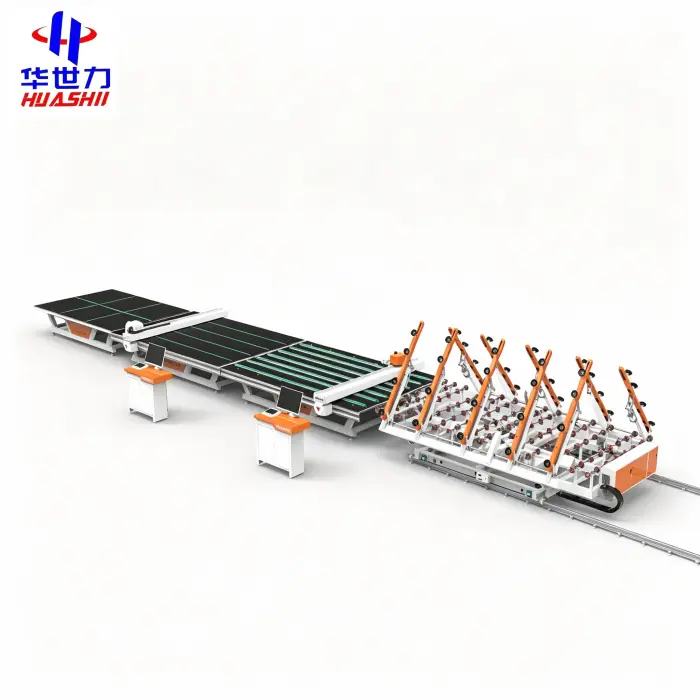
An automated glass cutting line is a linked system that loads, places, scores, and breaks flat glass with little human handling at a low cost. Unlike a stand-alone CNC table, the sheet travels through numerous stations instead of waiting for an operator to transport it. The HSL-LSX3829 handles sheets up to 3660 x 2800 mm, or roughly 144 x 110 inches. The size is appropriate for architectural glass, window and door glass, curtain wall panels, furniture glass, and shower door blanks. The sheets are coated and need to be handled carefully; therefore, this line also often uses Low-E glass. Before ordering, please advise your coating type and thickness.
Main Components of the HSL-LSX3829
The HSL-LSX3829 has 3 tables: a loading table, a cutting table, and a breaking table. The sheet is loaded on the loading table, scored on the cutting table, and broken into scored pieces on the breaking table. The Optima optimisation program prepares the cutting scheme, so each sheet is properly utilized. Depending on your floor layout, the rail might be above or below the floor. The station configuration is 2+2, and you are able to customize it to suit your workflow. Each side has three great arms. Because an underground rail requires floor construction, I propose that you share your plant design early.
How the Line Works Day to Day
The operator enters the orders into Optima and the procedure begins. The program nests parts on each sheet to minimize offcuts and transmits the blueprint to the line. The sheet is moved from the loading table to the cutting table, where the cutting head scores the preset routes. The broken glass is then cut into final pieces on the breaking table. The low cost automatic glass cutting line from HUASHIL that I found indicates precision of +/- 0.25 mm and speeds up to 150 m/min. When quoting, I'd suggest verifying the numbers for your precise design. Real production is based on changes in sheets, thickness, and cuts per sheet, not just on speed.
Costs, Capacity, and Running Expenses
Price Factors and Total Cost of Ownership
Pricing is based on sheet size, thickness range, amount of automation, software, number of stations, kind of rail, and customisation. The purchasing price is one line in the budget. Include ocean freight, export packing, import taxes in the U.S., installation, operator training, floor preparation, electrical hook-up, and spare parts. Then compare the five-year total cost of ownership instead of the lowest quotation. An estimate that doesn't include software, installation, or training typically ends up seeming inexpensive until the missing things appear as additional bills. I would recommend asking for a detailed quote with what is and isn’t included. Payment terms: Deposit plus final payment, or Letter of Credit for foreign purchases.
Capacity, Power Use, and Maintenance
Capacity is completed pieces per shift, not merely meters per minute. Things like sheet changes, thickness of glass, complexity of cuts, shattering, sorting, etc all impact that figure, so inquire about sheets per hour on glass sizes like yours. Power is mostly from vacuum pumps, motors, compressed air, and controllers. Please rate the request and average usage individually. Confirm voltage and frequency for your U.S. plant prior to delivery. Maintenance is straightforward. Clean the tables, lube the moving parts, check the sensors, examine the cutting wheels, and test the vacuum system. We provide our clients with technical advice and replacement parts, and we keep a modest supply of worn parts to save downtime.
Manual, Standalone CNC, or Automatic Line?
Manual cutting requires the least investment and is suitable for low-volume or one-off projects. However, it is dependent on operator competence and is prone to increased waste and size fluctuation. This makes a standalone CNC table more accurate. But still, humans load, break, and sort. A low cost automatic glass cutting line is more expensive and uses more floor area but reduces handling and increases throughput. This is the importance of handling. The weight. An average density of 2,500 kg/m³ means that a whole 3660 × 2800 mm sheet of 6 mm glass weighs around 154 kilograms (340 lb). The NIOSH lifting calculation begins with a 51 lb load constant under ideal circumstances; thus, sheets this big must be handled mechanically. Cheaper computers are used, but check age, quality of controller, software licenses, and spare parts beforehand.
Benefits and Buying Guidance
Benefits for Plants and Fabricators
Automation reduces the time between sheets and enables reproducible batch operations. CNC control makes cutting uniform, and Optima helps limit glass waste. Mechanical loading helps to eliminate manual lifting, which decreases breakage and injury risk. Steady production for window and door fabricators. Curtain wall integrators provide the project with standardized panel sizes. Furniture, bathroom door, and partition manufacturers can make faster revisions to orders. Because the station architecture may be modified, the line can be adapted to the plant’s workflow rather than the process having to be adapted to the machine. Actual benefits will be dependent on order mix, glass specs, and operator training.
How to Choose an Affordable Line
Start with your product mix, sizes of glass, thickness range, monthly production, and growth strategy. Then compare accuracy, speed, table size, software, footprint, and suitable materials. Match today’s volume to the amount of automation and provide space to improve. Examine safety features such as emergency stops, guarding, interlocks, and vacuum alarms. ISO 12100 is a standard approach for risk assessment for equipment. OSHA has recommendations on machine guarding. Beware the usual traps: quotations that exclude software or training, speed claims that are considered as daily production, and plants that have insufficient ceiling height or access. Acceptance test your own glass sizes. Complete with
Procurement Steps and Supplier Support
Individual machines frequently shut down within a few weeks, but whole lines might take 3-6 months due to technical evaluation, site visits, and financial clearance. First, prepare a requirements document and then get matching quotations from two or three manufacturers. Engineers need to review designs and electrical data. Purchasing needs to review pricing, delivery, and warranty. Finance needs to review payment conditions. We provide technical documentation, business offers, and OEM/ODM customisation for each position. Shandong Huashil Automation Technology Co., Ltd. is engaged in R&D, manufacture, and sales of automated equipment, and has many years of export experience. Make sure warranty conditions, replacement parts timeframes, and remote help are all in the contract before you sign.
Conclusion
A low cost automatic glass cutting line should be rated on total cost of ownership, not the lowest quotation. What a realistic setup consists of: HSL-LSX3829. Loading, cutting, and breaking tables, Optima software, a flexible rail, and a 2+2 station arrangement; maximum sheet size 3660 x 2800 mm. Costs are more than just the equipment – they also include freight, installation, training, electricity, and replacement parts. Real capacity is items completed each shift. Complete line with less handling of heavy sheets, uniform sizes with reduced waste compared to manual cutting, and standalone CNC tables. Choosing wisely involves making decisions on glass sizes and production, confirming safety against recognised criteria, and testing with actual sheets before approval.
FAQ
1. How much does a low-cost automatic glass cutting line cost?
Price depends on sheet size, automation, software, and customization. Freight, installation, and training add to it, so project-specific quotes are more useful than general online figures.
2. Can the HSL-LSX3829 cut Low-E or laminated glass?
The line handles flat glass up to 3660 x 2800 mm. Send us the glass type, coating, and thickness, and our engineers will confirm suitability. Laminated glass may need dedicated equipment.
3. What maintenance does the line need?
Regular cleaning, lubrication, sensor checks, cutting wheel inspection, and vacuum system checks keep performance steady.
4. How long does the buying process take?
A single machine often takes a few weeks to decide. A full line usually takes three to six months.
5. What payment terms are common?
Most orders use a deposit plus final payment, or a Letter of Credit for international buyers.
Get a Low-Cost Automatic Glass Cutting Line Quote from HUASHIL
Send HUASHIL your glass sizes, thickness range, daily output, and plant voltage, and we will recommend a configuration with a clear quotation. As a low cost automatic glass cutting line supplier with OEM and ODM support, we back every order with technical guidance and spare parts. Email salescathy@sdhuashil.com for details on the HSL-LSX3829.
References
1. ASTM International, ASTM C1036 Standard Specification for Flat Glass, 2021
2. International Organization for Standardization, ISO 12100 Safety of Machinery: General Principles for Design, 2010
3. Occupational Safety and Health Administration, Safeguarding Equipment and Protecting Employees from Amputations, 2007
4. National Institute for Occupational Safety and Health, Applications Manual for the Revised NIOSH Lifting Equation, 1994
5. International Organization for Standardization, ISO 13849-1 Safety of Machinery: Safety-Related Parts of Control Systems, 2023
6. ASTM International, ASTM E2190 Standard Specification for Insulating Glass Unit Performance and Evaluation, 2019
