




If you manage a glass fabrication plant or oversee equipment procurement, you've likely faced this question at some point: should we retrofit the existing industrial glass cutting table, or replace it entirely? The honest answer depends on a careful reading of your current operational costs, production targets, and the machine's remaining mechanical integrity. Retrofitting can extend equipment lifespan by several years, reduce capital expenditure significantly, and restore cutting precision without the lead time associated with purchasing new machinery. This guide walks through the key financial and technical factors that determine when retrofitting makes genuine economic sense.
Understanding the Need for Retrofitting Industrial Glass Cutting Tables
Most tools used to cut glass don't break down overnight. It slowly breaks down—cut deviation goes up by fractions of a millimeter, vacuum hold problems show up when loading, and cycle times get longer every week. It's already too late for production leaders to stop yield losses; the damage to the company's finances has already been done.
Rising repair costs, uneven break-out quality, old CNC processors that don't get software updates, and pneumatic or vacuum systems that need to be serviced often are all signs that a retrofit might be worth looking into. Maintenance standards in the glass industry say that unplanned downtime can cost anywhere from $5,000 to $15,000 per day in lost throughput, depending on how the line is set up and how many orders are coming in.
Retrofitting immediately fixes these places where things are breaking down. Instead of paying for a whole new machine, we can fix worn-out parts and get them working again for a lot less than the cost of a new one. This is done while keeping the original table frame and rail infrastructure's structural stability.
Key Components and Technologies Involved in Glass Cutting Table Retrofitting
For a retrofit to work, the parts that break down the fastest and have the most direct effect on output quality need to be replaced or upgraded. Usually, the cutting head assembly, control software, vacuum circuit, sensor arrays, and motion drive systems are all part of the scope.
The way cutting plans are estimated has changed thanks to new automation software, such as the Optima optimization platform used in Huashil's HSL-LSX6133 model. Optima makes the best use of materials by figuring out the best way to cut the whole sheet of glass. This cuts down on trash and increases output per square meter. One of the most profitable parts of any retrofit project is usually updating old control software to a new optimization engine.
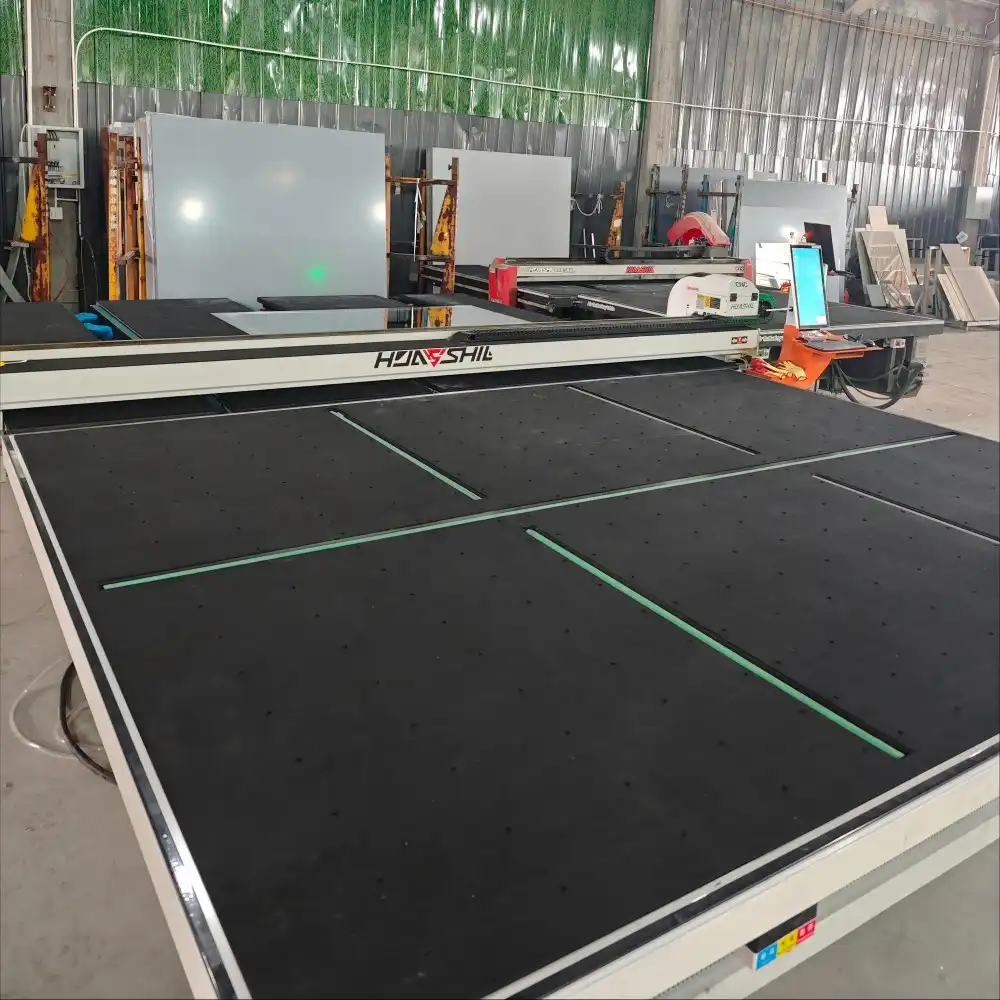
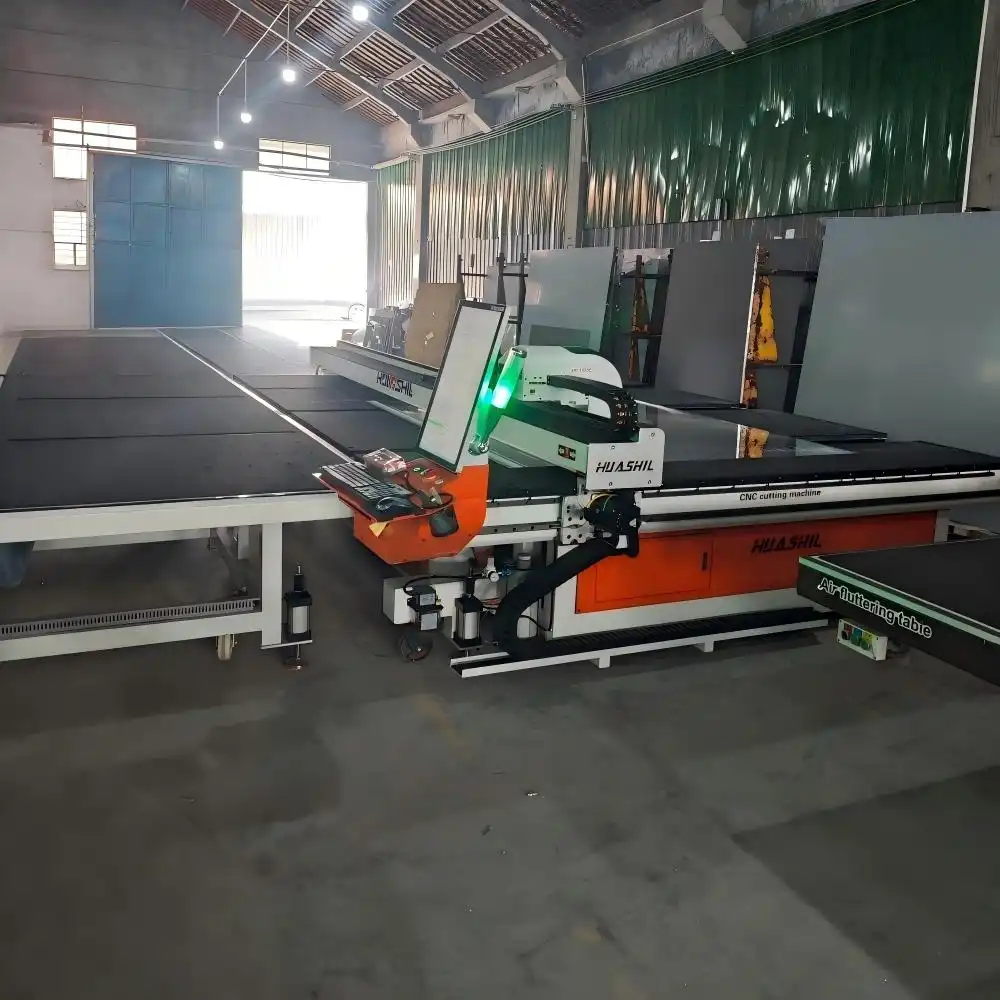
The weight of hardware improvements is the same. Replacing worn-out cutting heads fixes the accuracy of the position, and fixing up the vacuum circuit makes the sheet more stable during the cutting cycle. For example, on the HSL-LSX6133, the industrial glass cutting table system combines a loading table, a cutting table, and a breaking table into a single work area. It also lets you choose between above-ground or underground rail, and the 2+2 station layout can be changed. The unit can hold glass sheets up to 6,100 × 3,300 mm and has six great arms on each side. As an example, this design displays a modern line that works well together, and it helps repair engineers figure out if old equipment can really meet today's performance standards after being upgraded.
Financial Analysis: Calculating the ROI of Retrofitting Your Glass Cutting Table
The financial case for retrofitting depends on three things: how much the retrofit costs, how much money it saves in operations, and how long the upgraded machine can still be used.
Costs for retrofits usually include new parts, labor for installation, time for commissioning, and a short break in production, usually for one to five days for partial upgrades. These costs only happen once. When you save money, the rewards of compounding build up over time:
- Reduced scrap rates translate directly into lower raw material costs. A glass sheet measuring 6,000 × 3,000 mm carries significant material value; even a 2% improvement in cutting yield adds up across thousands of sheets per month.
- Lower maintenance frequency reduces both parts costs and technician labor hours. Equipment running on calibrated, refreshed components breaks down far less often than machinery operating on degraded originals.
- Energy efficiency improves when motors, drives, and pneumatic circuits are brought up to current specifications, reducing per-unit power consumption across the shift.
To figure out the payback time, split the total cost of the retrofit by the amount of money saved each month on running the business. For mid-sized architectural glass fabricators in the US, cutting table retrofit projects often pay for themselves in 12 to 24 months, which is a lot shorter than the 36 to 60 months it usually takes to replace all of the equipment. When the base structure of the machine is still in good shape, a total cost of ownership analysis over five years almost always shows that retrofitting is the better option.
Comparing Retrofitting with Alternative Solutions
There isn't always a clear-cut choice between buying new tools or making changes to old ones that cut glass. Retrofitting works best in situations where the machine's frame and rail system are still mechanically sound and where output levels haven't reached the latest models' full throughput cap yet. When the old machine has hit the end of its useful life, when production grows and needs a lot more space, or when a full line change is planned, it makes more sense to buy new equipment.
Another important factor is the level of automation. By adding a new CNC processor and optimization software to a semi-automatic table, you can make it work as well as fully automated lines for a lot less money. Businesses that work with standard rectangular architectural glass, like those that make windows, curtain wall panels, and shower screens, often find that a well-done repair meets their needs for accuracy and speed without having to replace the whole thing.
Adding a vacuum system should be looked at separately. Not every retrofit requires a complete vacuum overhaul, but for plants cutting large-format glass or thin decorative panels, a functioning, consistent vacuum circuit is non-negotiable for dimensional accuracy and operator safety on a china automatic glass cutting table.
Best Practices and Maintenance Tips Post-Retrofit for Maximized Value
Structured upkeep and proper user training are the only ways to make sure that a retrofit keeps its worth over time. Even though the upgraded parts are brand new, they still need regular maintenance to work at their improved level.
Here are the main upkeep tasks that will keep your retrofit purchases safe over time:
- Daily checks should cover cutting wheel condition, vacuum circuit pressure levels, and sensor calibration status. These take minutes but catch the small deviations that compound into costly problems.
- Weekly tasks include lubrication of rail systems and motion drives, inspection of pneumatic connections, and a review of software-generated cut logs to identify any emerging pattern anomalies.
- Monthly reviews should assess overall cutting accuracy against original calibration benchmarks, inspect structural rail alignment, and verify that control software remains on the current update version.
These actions directly boost the return on investment (ROI) that was made through the fix. Staff training on the new control interface, especially after optimization software like Optima has been installed, cuts down on operator error and helps the team get the full efficiency gains that the retrofit was meant to bring. When plants spend money on training after retrofitting, they always report faster response times and fewer quality slips in the first three months of operation.
Conclusion
To save money, it's a good idea to retrofit an industrial glass cutting table if the machine's main structure is still solid, problems are limited to specific old parts, and production doesn't need a full capacity jump just yet. Retrofitting is a smart business move for companies that work with architectural glass, curtain wall systems, furniture glass, and powdered stone because it lowers the cost of capital, speeds up return on investment, and causes little to no impact to production. When the right cost information and an honest look at the machine's state are used to make the choice, retrofitting always gives measured operating and financial returns.
FAQ
1. What should I assess before committing to a glass cutting table retrofit?
Check the table frame and rail system's structural soundness, see if suitable replacement parts are available, and figure out how much it costs to maintain and throw away old parts. If the base structure is sound and recognizable subsystems are driving efficiency loss, a retrofit is likely possible.
2. How long does a typical retrofit take?
Most partial retrofits, which include cutting heads, control software, or vacuum systems, are finished in one to five business days. Full-scope retrofits that include many subsystems could take up to two weeks. Planning the retrofit around maintenance windows reduces the impact on production as much as possible.
3. Does retrofitting bring equipment up to current safety standards?
Better safety compliance is made possible by improved control systems, sensor arrays, and vacuum circuits. With modern automation software, operators don't have to do as much work during the cutting cycle, and they are less likely to be exposed to moving parts. Always make sure that the new designs follow the latest OSHA and ANSI safety rules for glass processes.
4. When does full replacement make more financial sense than retrofitting?
When the frame or train system of the structure is worn out beyond repair, when production needs to grow beyond what the current platform can handle, or when the total cost of repairs is getting close to the cost of new equipment, it is better to just buy new equipment.
Ready to Evaluate Your Glass Cutting Equipment? Contact HUASHIL
People trust HUASHIL to make high-quality industrial glass cutting tables. They have a lot of experience with both full production lines and specific equipment upgrades. The HSL-LSX6133 and the rest of our product line are the result of years of technical work that was meant to work in real manufacturing settings. Our technical team is ready to give you honest advice based on data, whether you're looking at a retrofit or a new automated cutting line. For starters, you can email SalesCathy at salescathy@sdhuashil.com.
References
1. Glass International – "Maintenance and Lifecycle Management of Glass Processing Equipment," 2022.
2. Glassman Europe – "Automation Trends in Flat Glass Fabrication," 2023.
3. The Fabricator – "When to Retrofit vs. Replace: Capital Equipment Decision Frameworks," 2021.
4. USGlass Magazine – "Total Cost of Ownership in Glass Processing Operations," 2023.
5. Manufacturing Engineering (SME) – "ROI Analysis for Industrial Equipment Retrofitting," 2020.
6. Glass Processing Days (GPD) Conference Proceedings – "Software-Driven Optimization in Glass Cutting Lines," 2022.