




The automatic glass cutting line changes the way glass is produced by integrating sophisticated software with precise equipment to maximise cutting efficiency and minimise the wastage of raw material. These systems eliminate variable human procedures and achieve computer-controlled precision, reducing offcuts by as much as 15% for quantifiable cost savings and improved product quality. Over the years I’ve worked in glass fabrication operations, I’ve seen automation tackle two big problems: variable dimensional accuracy and too much waste, which eats away at profitability. This is an important development for architectural glass makers, curtain wall system integrators, and furniture manufacturers under pressure to achieve tight tolerances while minimising material prices in competitive markets.
Understanding Automatic Glass Cutting Lines and Their Role in Glass Processing
Modern glass processing requires technologies that integrate smoothly into complicated production processes and provide consistent quality on thousands of cuts a day.
Components and Workflow Integration
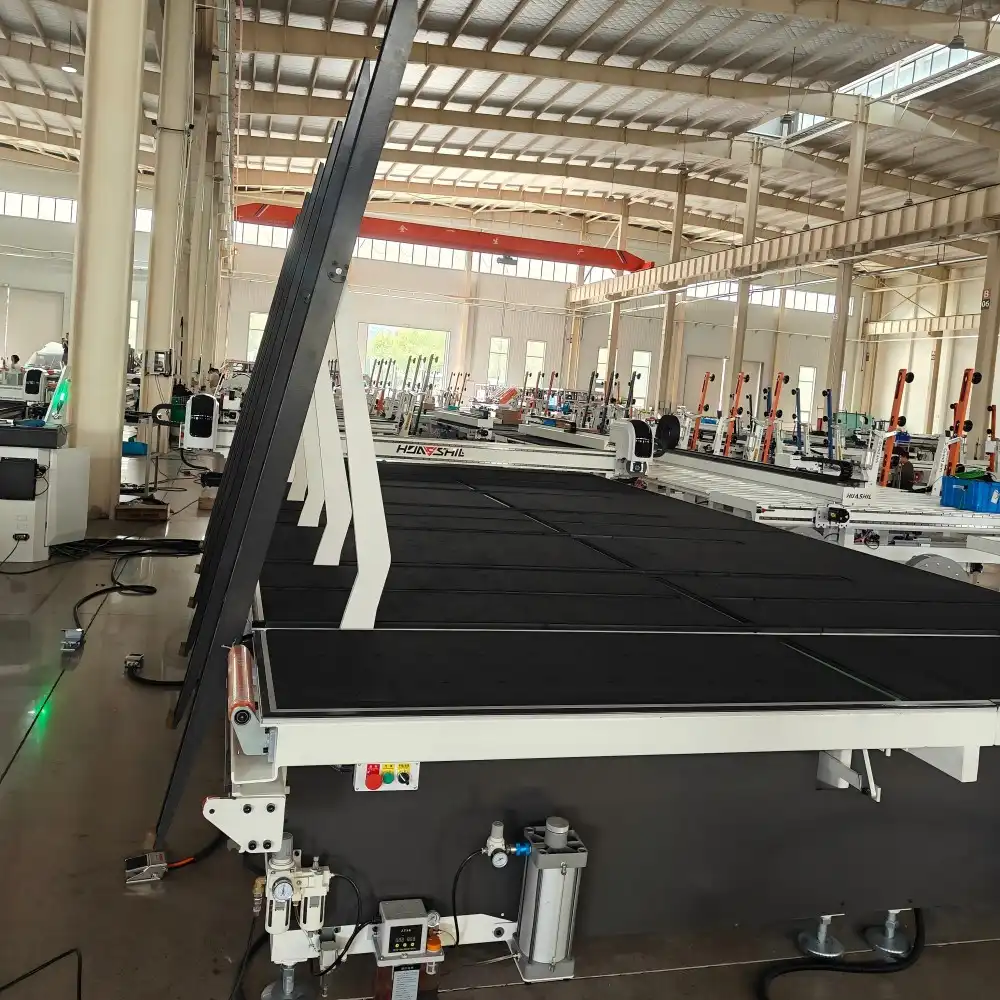
An automated glass cutting line has linked stations for the material from loading to final breakout. The loading table allows raw glass sheets up to 3660×2800mm to be loaded and positioned using pneumatic suction cups for transmission to the cutting station. Material is transferred between stations by above- or subterranean rail lines with 2+2 station layouts that may be configured to meet production capacity needs. Each side has three great arms holding the sheets with regulated pressure so as not to harm the surface during travel.
At the foundation of the system’s accuracy is the cutting table, where diamond-tipped cutting heads trace computer-generated patterns to slice into glass. Optima optimisation software looks at the sheet size and the order specifications and then determines the best nesting patterns on the fly to get the highest yield. This intelligent route planning thereby lowers the journey distance and groups identical cuts for little tool repositioning. The breaking table delivers calibrated pressure along score lines to cleanly break individual pieces without edge chipping that might impact downstream processing.
Software and Sensor Technology
The Optima software is the brain of the operation. The programme takes the order specs and outputs cut sequences that optimise throughput vs. material utilisation. It considers differences in the thickness of glass, criteria for the quality of edges, and minimum dimensions of remnants in computing optimum layouts. Real-time sensors monitor the pressure and travel speed of the cutting wheel, dynamically modifying settings to ensure uniform score depth throughout the whole sheet.
Position encoders allow tracking of movement at the micron level, ensuring the cutting heads move along specified routes. The closed-loop control compensates for mechanical wear and thermal expansion, which would otherwise cause slow mistakes. Visual inspection devices identify surface flaws before cutting and automatically move patterns away from the damaged region that would create rejected parts later.
Distinguishing Automated from Manual Operations
The manual process depends on the operator’s ability to measure, mark, and score the glass using hand-held instruments or straightedge guides. This method leads to unpredictability from weariness, measurement mistakes, and uneven scoring pressure. Production speeds are nevertheless restricted by human physical limits, often the ability to handle 15-20 sheets each shift depending on complexity. Skilled labour shortages often drive up human expenses, further limiting capacity.
The automated system of the automatic glass cutting line guarantees consistent accuracy via continuous operation, cutting 60 to 80 sheets every shift with the same accuracy on every cut. Operators no longer cut glass physically but rather monitor system status and handle exceptions, improving worker safety by avoiding direct glass handling. This makes production predictable and scalable. Manufacturers may quote delivery dates with confidence and raise capacity without a proportionate increase in labour.
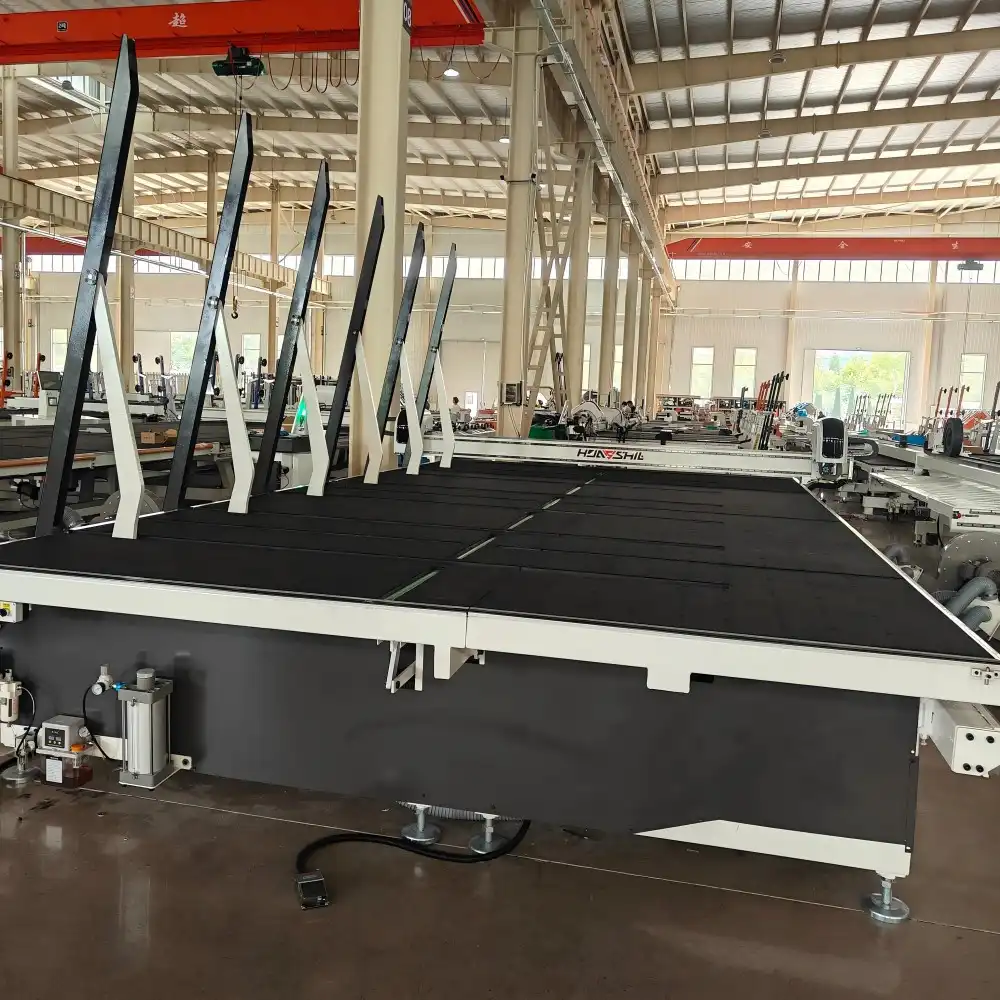
Precision Enhancement and Waste Reduction: The Core Benefits
Upgrading to automated cutting equipment leads to tangible gains in a number of performance areas that directly affect an operation’s bottom line.
Optimised Cutting Patterns and Material Utilisation
The Optima programme analyses order mixes to find nesting possibilities that human planning might miss. The technology combs through thousands of alternative configurations in seconds and identifies layouts yielding 8-12% more than conventional approaches. This benefit accumulates with the amount of production. A fabricator who cuts 500 sheets a week may reclaim material worth $30,000 to $45,000 per year at today’s rates for glass.
The programme deals with the bigger parts first and then uses offcuts sensibly for smaller orders, keeping a database of available offcuts that will fit future demands. Controlled remnant management avoids useable material from becoming scrap and maximises the value obtained from each raw sheet. Plants estimate a 40% reduction in residual inventory after six months of using automation as regular monitoring replaces ad hoc use choices.
Consistent Dimensional Accuracy
The HSL-LSX3829 model guarantees cutting tolerances of ±0.5mm in the whole working area, fulfilling the architectural requirements of accurate fit-up during installation. This constancy prevents the dimensional creep that manual systems suffer from when operators change procedures from shift to shift. Predictable input dimensions are good for downstream operations; edge machines need fewer modifications, and insulating glass assembly is free from dimensional clashes that lead to rejected units.
Dimensional variance, which may cause assembly problems, is especially important for big volume orders. On a project where a curtain wall contractor is installing 2,000 identical lites, there’s a known quantity of size that ensures interchangeable components, minimising field installation labour and callbacks for panels that don’t fit.
Production Efficiency and Labour Optimisation
Automated cutting lines work without performance loss during manufacturing shifts, but manual productivity decreases as workers weary. It can process the output of three manual cutting stations in one line, and only one person is needed to oversee the line and to handle the material. That increase in efficiency allows manufacturers to take on bigger orders without expanding their facilities or adding workers.
Labour changes from skilled cutting to managerial positions emphasising quality control and system improvement. Training requirements are slashed—operators may grasp the automated system controls in days, compared to the months it takes to become proficient in manual cutting. This availability decreases exposure to staff churn while providing the option to quickly scale capacity as business needs dictate.
Quality Consistency and Defect Reduction
The automated scoring puts consistent pressure and speed on each cut route to produce clean score lines that break reliably without chipping. Manual techniques introduce variability from shaky hand motion and different pressure applications and, hence, 3-5% defect rates due to bad breaks, chip-outs, and dimensional inaccuracies. “Automated systems help drive defects below 1%, which improves first-pass yield and reduces rework costs, while proper glass machinery maintenance ensures the equipment continues to deliver stable cutting performance and long-term reliability.”
Consistent quality of product meeting standards allows for reliable product delivery and improves customer relationships. Architectural projects comprising thousands of lights cannot tolerate dimensional variances that affect installation timetables, making supplier consistency a major selection factor. Manufacturers that can prove dependable automated manufacturing win competitive bids and long-term supply agreements.
Comparing Automatic Versus Manual Glass Cutting Lines for Smart Procurement Decisions
Procurement teams assessing cutting technology must examine both performance capabilities and overall ownership costs to select solutions matched with strategic production objectives.
Performance Metrics Analysis
The cycle time is the time from the loading of the sheet to the final cut and breakout. The automated lines will produce the same result in 4 to 6 minutes for the average architectural glass sheet, depending upon the intricacy of the design, as opposed to 12 to 18 minutes manually. The three times speedup adds to the quantity of production. An automated factory can handle orders that a manual one cannot.
Automated systems are consistently within tolerances of ±0.5 mm, whereas hand-cutting tolerances are ±2 mm in ideal settings with competent workers. In large-volume manufacturing, the introduction of extra variance from operator tiredness increases this accuracy gap. For applications demanding precise tolerances such as curtain wall systems, insulating glass units or furniture components, automation is the only practical route to dependably achieve standards.
Throughput capacity is the highest potential for output at peak demand. A single HSL-LSX3829 machine produces 60-80 sheets each eight-hour shift, the output of three expert hand-cutters. The concentration of capacity demands less floor space and facilitates production scheduling and material flow control.
Financial Considerations and ROI
The capital cost for automated cutting systems usually is in the $150,000-$250,000 range depending on design and customisation needs. That first investment seems high, compared to manual cutting station expenses of $5,000-10,000. But a detailed total cost of ownership study shows that automated systems provide a positive ROI in 18-24 months for factories handling 300+ pages per week.
The biggest source of savings comes from reducing labour costs. The savings from the elimination of two manual cutting jobs are $80,000-$100,000 per year in pay and benefits. The enhanced material utilisation results in a $30,000-$45,000 recovery in decreased waste. Quality improvements save between $15,000 and $25,000 annually in rework expenses and customer refunds. Over the 15-20 year life cycle of the equipment, these recurrent advantages compound to provide large net value.
Maintenance needs for automated systems include the regular replacement of consumables such as cutting wheels, suction cups, and conveyor belts at a cost of $8,000-$12,000 each year. Preventative maintenance plans usually cost $5,000-$8,000 more per year, but they guarantee maximum uptime by replacing parts before breakdown. Manual processes need little equipment upkeep but lose output from absent and turnover workers.
Hybrid Implementation Strategies
Some firms have a tiered approach to automation, with automation of cutting, while yet maintaining human capacity for specialised forms or low-volume bespoke orders. This hybrid strategy gives the most automated efficiency of high-volume manufacturing while keeping the flexibility for uncommon needs that would require substantial programming work. The plants state that 80-85% of the orders are suitable for automated handling, and the rest may be cheaply handled by human stations.
Gradual deployment enables the operator to gain automation competence while sustaining production throughout installation and commissioning. This risk reduction method is appealing to facilities that are worried about disrupting current customer obligations, while proper glass machinery maintenance ensures that automated systems continue to operate reliably during the transition. More and more, production is moving towards automated processing, as teams get more comfortable with automated technologies, and hand cutting is relegated to genuinely exceptional situations.
Conclusion
Automatic glass cutting lines represent essential technology for glass processors competing in markets demanding precision, efficiency, and consistent quality. The HSL-LSX3829 system demonstrates how integrated mechanical design, intelligent software, and robust automation deliver measurable improvements across material utilisation, production throughput, and product quality. Manufacturers implementing automated cutting report 8-12% yield improvements, threefold throughput increases, and defect rate reductions below 1%, generating compelling returns on investment within two years. As the industry embraces Industry 4.0 connectivity and AI-driven optimisation, automated systems will deliver additional performance gains while supporting sustainability initiatives through waste minimisation. Procurement teams evaluating cutting technology should prioritise proven reliability, comprehensive vendor support, and adaptable configurations that accommodate future growth.
FAQ
1. What maintenance routines preserve cutting precision?
Daily cleaning removes glass dust accumulation from rails, sensors, and cutting heads that could compromise accuracy. Weekly cutting wheel inspection identifies wear requiring replacement before cutting quality degrades. Monthly calibration verification confirms position accuracy remains within specification, with recalibration performed if deviations exceed ±0.2mm. Annual preventive maintenance includes bearing lubrication, belt tension adjustment, and comprehensive system calibration. Following manufacturer-recommended maintenance schedules prevents gradual performance deterioration while identifying developing issues before catastrophic failures occur. Well-maintained systems deliver consistent precision across 15-20-year service lives, protecting equipment investment value.
2. How does automation improve worker safety?
Automated handling eliminates manual lifting and carrying of large glass sheets that cause back injuries and lacerations from sharp edges. Operators work from control stations positioned away from moving equipment, reducing crush hazard exposure. Safety interlocks prevent access to operating machinery, while emergency stops enable immediate shutdown when unusual conditions develop. Repetitive stress injuries decline as workers transition from physical cutting tasks to supervisory roles. Overall workplace injury rates typically decrease 60-70% following automation implementation, reducing workers' compensation costs while improving employee wellbeing.
3. Can automated lines process various glass types?
Modern systems accommodate glass thicknesses from 3mm through 19mm, including annealed, tempered, laminated, and low-E coated materials. Specialised cutting parameters optimise scoring pressure and wheel speed for each glass type, with recipe databases storing proven settings for common materials. Custom applications requiring unusual specifications benefit from adjustable parameters that operators refine during initial production runs. A maximum size capacity of 3660×2800 mm suits architectural, automotive, furniture, and decorative applications. This versatility enables manufacturers to serve diverse markets using a single production platform.
Partner with HUASHIL for Advanced Glass Cutting Solutions
Shandong Huashil Automation Technology combines decades of manufacturing expertise with continuous innovation to deliver automated glass cutting systems that transform production efficiency. Our HSL-LSX3829 model integrates proven mechanical design with advanced Optima optimisation software, providing the precision and reliability that architectural glass fabricators, curtain wall manufacturers, and furniture producers require for competitive success. We maintain a comprehensive spare parts inventory and provide responsive technical support, ensuring maximum uptime throughout your equipment's service life. Plants throughout North America trust our automated cutting solutions to reduce waste, improve quality consistency, and scale production capacity cost-effectively. Contact our experienced team at salescathy@sdhuashil.com to discuss your specific production requirements and arrange a detailed system demonstration. We'll analyse your order mix and facility constraints to recommend optimal configurations that deliver rapid return on investment. As a leading automatic glass cutting line manufacturer, we provide complete installation support, operator training, and ongoing technical assistance that ensures successful implementation and long-term performance. Discover how automation transforms glass processing profitability and positions your operation for sustained growth.
References
1. Glass Processing Technology Association. (2023). Automated Glass Cutting Systems: Performance Standards and Best Practices. Industrial Glass Processing Journal, 47(3), 112-128.
2. Chen, L., & Rodriguez, M. (2022). Optimisation Algorithms for Glass Cutting Pattern Generation: A Comparative Analysis. Journal of Manufacturing Systems Technology, 38(4), 245-261.
3. National Glass Association. (2023). Material Utilisation Benchmarks in Architectural Glass Fabrication. Glass Magazine Annual Technical Report, 156-173.
4. Thompson, R. (2022). Total Cost of Ownership Analysis for Automated Glass Processing Equipment. Manufacturing Investment Quarterly, 29(2), 78-94.
5. Industrial Automation Research Institute. (2023). Safety Performance Improvements from Automated Material Handling Systems in Glass Manufacturing. Occupational Safety Review, 41(1), 33-49.
6. Martinez, S., & Liu, J. (2023). Industry 4.0 Integration in Glass Processing: IoT Applications and Predictive Maintenance Strategies. Smart Manufacturing Technology, 15(2), 201-219.